
Ibram Kendi, in his book Stamped from the Beginning, makes a bold assertion: people don’t start with racist ideas (beliefs) and then engage in behavior driven by those beliefs. Instead, people begin with racist acts and then find beliefs and ideas that justify or match those acts.
Philosopher James K.A. Smith develops an entire book–Desiring the Kingdom–around a similar notion. For Smith, humans do not begin with a “worldview”–a set of guiding principles that they use to structure their lives. Instead, people engage in acts that form them to be certain kinds of people.
Smith’s is a broad philosophical review of what makes us human. He concludes that we are not primarily “thinking” beings but beings who “love”–who desire. Our love and desire point to what we believe human thriving requires, but we do not start with the idea of what thriving is. Instead, we live into that understanding. Our actions form us to be certain kinds of people–they form us to love and desire. We do not “think” our way into our values; we “act” our way into them.
He discusses our identities as formed by rituals, many of which have lost meaning, but some of which are critical to understanding who we are. The latter, a subset of cultural rituals or practices he refers to as “liturgies.” A liturgy is a “formative practice”–a repeated act that forms us into certain kinds of people. While liturgy is a religious term, Smith describes secular liturgies that shape us in specific ways:
- The liturgy of the mall (or, if he were writing today “Amazon), forms us to love instant gratification of our every desire–a kind of healing for our yearning for meaning;
- The liturgy of the military-entertainment complex forms us to a deep allegiance to the nation as protector and savior; and
- The liturgy of the university forms us to be productive consumers who will lead society to be faithful consumers.
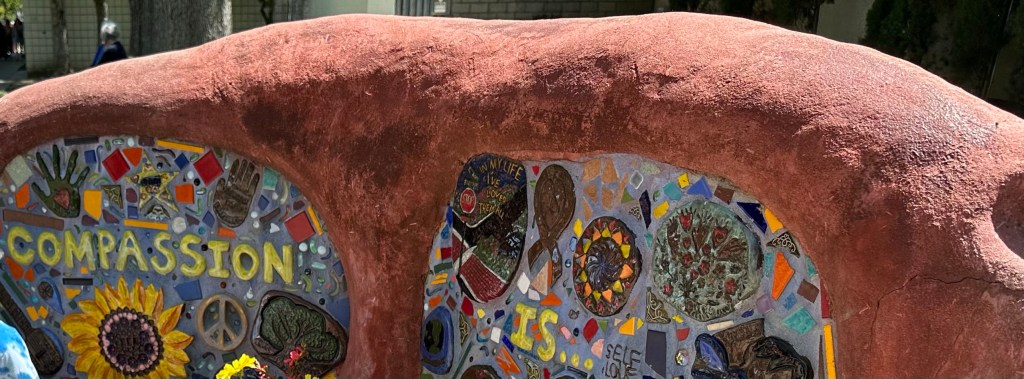
The Compassion Bench in Davis, CA is a place of liturgies—over time and in recent days, it is a place where we have engaged in practices that have formed us to be certain kinds of people.
At the bench we have engaged in a liturgy of compassion—a practice that has formed us to be people of compassion. At the bench (and elsewhere) we have engaged in a liturgy of lament—a practice that has formed us to be people who mourn the brokenness in the world, and express a yearning for healing.
Liturgy of Compassion
David Breaux led us in a liturgy. He did not ask us to think about compassion. Rather, he asked us to write about it, and in the writing to own our ideas in a different way. He fully expected that the act of writing would lead to acts of compassion—and, in fact, for David, compassion meant action.
But beyond the act of writing, in which many of us participated over the years, David sitting at the bench created a daily liturgy. Every time we passed by the bench, we were required to think about our commitments to compassion.
His very presence prompted us to engage in an ongoing formative practice: Have I loved as I should? Have I forgiven? Have I sought forgiveness? Have I been reconciled? Have I pursued reconciliation?
His question “how do you define compassion?” and his presence formed us to be people of compassion.
Liturgy of Lament
David’s death brought many of us back to the bench to engage in another formative practice—another liturgy—that we, as a community, have practiced far too many times in recent years.
This is the liturgy of lament.
As our community has faced devastating events—either directly or in solidarity with others—we have engaged in the formative practice of coming together to express our pain, support one another, and commit to action in the face of our sense of loss.
Whether the event was a murder, a mass killing, a hate crime, or the coming to power of people who dehumanize and destroy, we have come together to lament. We have gathered again, and again, and again to participate in a liturgy of mourning. But our mourning has always been accompanied by a commitment to stand against the hate that we lament.
We have come together to seek and offer solidarity: a hug, a smile of recognition, a communal song, a shared promise, a commitment. This formative practice has had a profound effect on all of us who join in the liturgy of lament. We have left our shared time prepared to not just “carry on,” but to live lives characterized by love and support of our neighbors.
The compassion bench is a place where our community has and will engage in liturgies—formative practices: practices that form us to be people who will face the challenges of our time with grace, compassion, and a will to seek change.
 Traveling at the Speed of Bike