
Nothing puzzles me more–more genuinely confuses me–than the way US citizens, over many generations and places, have denigrated immigrants. Nativist streams of thought ebb and flow throughout our history and the anti-immigrant fever is quite high in these days. I do not know why.
Though I could be accused of being a liberal cosmopolite–rootless and therefore not valuing rootedness and “place”–I am actually a committed localist who believes one can only love that with which one interacts on a daily basis. As such, I am not disdainful of the small town in which I was raised nor the small city in which I now live. And it is because I am a localist, I would argue, that I care so deeply about the immigrant.
I have not arrived at an understanding of the urge to “move” from studying the history of my own nation–though that is certainly instructive as we think about the role of the immigrant in shaping a place. Rather, I understand it because I lived in a region of the world in which borders really can’t matter and people move across them in all directions, here seeking a better life, there finding a second chance, here joining a friend, there doing the work that locals somehow refuse to do. In the economically-poor Sahel of West Africa movement is constant, little noted, and, from all appearances offering those on the move options they could not find at home.
I have traveled to the tiniest villages on the desert’s edge and found immigrants from many hundreds of miles away making their home there. From those same villages (it might be hard to imagine how small and isolated they are, but trust me, you have never seen anything like it), stream others wandering far and wide to find their lives.
We are restless upon this planet and it is typically those most willing to take risks and the most entrepreneurial who choose to leave family and friends to wander into the unknown. Beyond these are the talented many who are sent, proactively, from their villages to provide income streams or “premium” payments used for all manner of local “insurance” schemes that keep people alive in the most marginal spaces of the planet.
People move with intent.
And when they arrive they either fill or create and fill niches that were either empty or worthy of being created. My overwhelming experience of immigrants is that they enter a space and find opportunities in things that the locals either do not know how to do or will not stoop to do.
That is how I see those who toil in the fields, front lawns, hotels, and office buildings of Northern CA. They take nothing from the locals but do keep prices down by their willingness to work long hours for low wages, little to no health insurance, and no other benefits. They become parts of who we are–just like in every location in which I have found them around the world–they work their way into communities and become us.
As I listen to the rhetoric of those who see them as a threat in this time I wonder what is really driving the anger and disdain expressed towards them. The angry ones hide behind dubious studies purporting to show the negative impact of immigrants. They speak of crime as if immigrants are an organized band of land pirates sweeping across the landscape to rape and pillage the land and the people. They speak of the loss of cultural identity as if culture is an immutable good that is too fragile to rub up against difference.
When I hear their arguments I always wonder what exactly I am hearing. But I think I know. The words we hear in these days are a continuation of an ancient xenophobia. I focus on “phobia” here because I think there is a genuine fear of the “other” at play here. Perhaps it is a fear of not knowing how to act around the other. Perhaps it is a fear that their language hides threats that the native cannot decipher. Maybe it is the fear the other really is more robust, more resilient, more capable than they. It might be they fear the sheer stubbornness, the silent suffering under burdens of work, the spartan lifestyles, and the amazing grit they see in the faces of the immigrant. Maybe they fear they are not made of that stuff.
I don’t know for sure. I will forever speculate and wonder at these fears. To know an immigrant is to know someone who has taken a chance to move beyond the known to sow a seed in an unknown soil. They are welcome in my home because they have helped enrich the place I call home.


 nt on one hand that kind. And this was one.
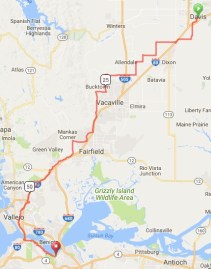 y floor, to the edges of the Vaca Hills, to a frontage road along I-80 that peaks out with great views of the Bay and Mt Tam, to urban riding and a major bridge crossing, to a thin car-free route along the edge of the Bay, this ride never gets tedious. There is some climbing here along I-80 but it is a quiet ride on a barely traveled road that ends with a screaming downhill into Vallejo on a mixed-use path with no cars.
 I have done this ride three times and each time I wonder why it took me so long to do it again. You need an early start to fit this in but it takes you through the city and long stretches with the Pacific at your right. With the new tunnel on Route 1 coming out of Pacifica, there is now only one tight stretch—the climb out of Pacifica itself—where there are no shoulders and traffic flow can be heavy. Beyond that the shoulders are wide and the climbs gentle.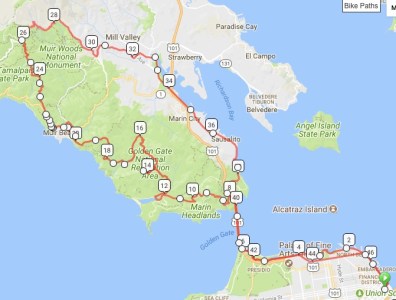
 This is a 60-mile loop that borrows from ride number 1 above but could be called the “two bay bridges ride,” because you cross both the Carquinez and Martinez bridges. My least favorite part of this ride is from Martinez back to Fairfield—the frontage road along 580 is not marvelous. But if you get the kind of winds that are common in that area, they will push you all the way.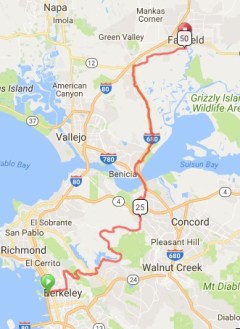
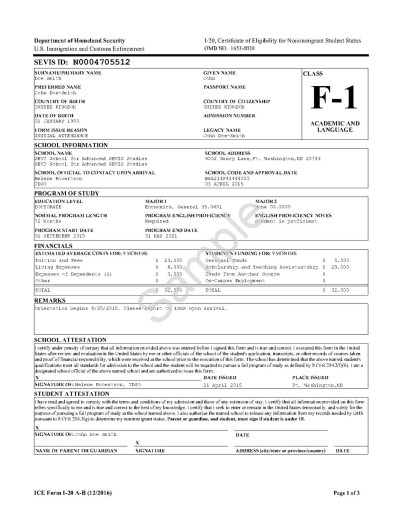 She snuck in right at 5:00 pm with that look that says, “I did not do what I was supposed to do and now I am frantic and need you to help me… PLEASE!” We close to students at 4:00 but some just walk in any way–despite the signs–and make their way to my office since it is the first in line. “I am leaving to go home tomorrow night, and I need a travel signature–mine expired,” she said. No surprise there. Happens more than it should.
 Traveling at the Speed of Bike