Our Unhoused Neighbors: Bringing them Home

French sociologist and jurist Jacques Ellul, who died in 1994, was a prolific writer best known for his writing on technique, propaganda, money, and ethics.

He was a Marxist Christian who embraced the contradictions between the two, believing that dialectic tensions should not lead to “synthesis” but should remain what they are: tensions. For Ellul “tensions” could and should form our approach to life because they acknowledge the complexity of the world and our approaches to dealing with it.*

For example, in his writing on technique, Ellul frequently dealt with the tension that technique was both a normal part of human advancement and a power that had enslaved humanity in a pernicious search for “the one best way” or the most efficient means to achieve something.  

For Ellul, the problem is that humanity’s quest for the one best way has left us enamored with means but bereft of a clear sense of where we are headed (the ends). He spoke of our deployment of prodigious means that enable us to hurtle full speed towards nowhere.

An Uncomfortable Dialectic

I have returned to Ellul over and over in these times and pondered his thoughts and what it means for the problem of houselessness in our community.  Dealing with the challenge exposes many tensions—many contradictions.

  • Tension: We promote “housing first” as the key—get folks into housing first and then deal with the myriad issues after that—but some will not use the “second” services offered, remaining trapped in substance use disorders and untreated mental illnesses that inhibit them from accepting treatment.
  • Tension: Unhoused people arguably do not represent a violent threat to the community at large, but violence within unhoused communities is a big problem.
  • Tension: Many unhoused individuals engage in illegal behavior to obtain drugs, but the nature of a substance use disorder limits their ability to make appropriate choices.

These real tensions send a message to disgruntled community members that no one has a clue about what is going on, that there is no real way forward, or that the problem is too big for a City our size to deal with.

At the limit, some view the challenges of and plans for dealing with houselessness as contradictory, inconsistent, and even dishonest. They sense that proponents of solutions are excusing bad behavior, minimizing impacts on the community, and allowing lawlessness to prevail.

But, like Ellul, I have moved towards the conviction that these tensions cannot be resolved.  There is no synthesis to be found.  We must live with the contradictions and seek a way through them to change our current reality.

I understand these contradictions/tensions to be a function of the many facets of the problem. The word “homeless” is a single term that cannot capture the diversity of situations, the wide variety of people trapped within it, and the many different situations that led people to this place.

We ignore the tensions by defining a syndrome by a simple and simplistic observable phenomenon: people living without permanent shelter, a fixed address, or a known place to lay their heads.

But tensions DO abound because this “thing” actually consists of many things simultaneously. One can say almost anything about houselessness, and it is probably true in at least one case. But drawing on Ellul, we must choose to remain within the tensions to better and more honestly understand the multiple causes, the difficult outcomes, and the uncertain impacts of our efforts to address the challenge.

To acknowledge the actual “thing” we are talking about, I will limit the remainder of this piece to examining what we are really seeking to address: chronic houselessness—people living rough for extended periods with limited options to move out of it.

The “Ends” of Our Efforts Related to Unhoused People

Recently, our City Council debated creating a new ordinance defining unauthorized camping on public or private land as “illegal” and imposing penalties, including charging it as a misdemeanor, engaging in a civil action against “campers,” and obtaining restraining orders against offenders.

This ordinance passed its initial reading and is on its way to becoming law. It criminalizes houselessness and responds to the calls of some in the community to make our community as inhospitable as possible for “the homeless.”

(The denials by certain Council members that this is NOT the criminalization of houselessness required rhetorical hair-splitting that was painful to watch.)

Indeed, when the ordinance was rolled out, the Chief of Police acknowledged that it was needed because neighboring communities were doing it, and we needed to protect ourselves from the inevitable influx of people being moved out of those communities.

In other words, other towns were sending criminals our way, forcing us to create laws to send them “elsewhere.”

Listening to the debate, I was struck by how profoundly it dehumanized the people in this situation. There was little nuance. While there was a suggestion that there were “good” unhoused people who accepted our largesse and “bad” unhoused people who did not, this simplistic dichotomy did nothing to elevate those directly concerned by the ordinance to the status of human beings with histories, agency, gifts, loves, and pathways to a better life.

The only name of an actual unhoused person uttered during the entire meeting was the public shaming of a young man with a long history of untreated mental illness by a local “respected” business leader.

The unhoused were absent, both physically and psychically.

While Council members, who spoke with gravity about the challenges, repeatedly evoked the “complexity” of the situation, the solution offered was a crude hammer that saw every complexity as a nail.

There was no discussion of causal factors (except by one Council member):

1) Untreated mental illness—not just in the present, but over the past two generations;

2) Untreated substance use disorder (drug use was viewed simply as a criminal activity done by immoral people);

3) Undiagnosed and untreated trauma; and

4) The firm commitment of this community and many others to build as little housing as possible (again, over the past generation, at least).

I am writing this piece today, in part, to express my grief over the discussion.  

The ordinance is a call to “social cleansing,” a call to “move them along,” “get rid of them,” or “make them leave.”

As I listened to the debate, I was forced to re-examine the “ends” and the efforts I support to address the problem.

And while it may be far too vague for programmatic purposes, I have settled on the following as the “ends” statement of what I am trying to accomplish.

I believe that the end of our efforts should be to “provide a homecoming” for those who are on the streets.  

Providing a homecoming implies a “welcome back,” a “reintegration,” a “return.” More than anything (and I want to be careful not to dehumanize the many people who find themselves in this condition), I see chronic houselessness as a form of alienation: alienation from society, from healthy relationships, and ultimately (I fear) from oneself.

I will not say, as many suggest, that this alienation is a choice, or perhaps more accurately, the inevitable outcome of a series of choices.  The evidence is clear that “choice” has very little to do with it and maybe never did.  But even if there was a choice in there at some point, today, in the moment, we see folks who are adrift, dis-integrated, on the margins.  

Though they are in our midst they are the “other” in a way that causes fear. Though we see them, we do not—indeed, cannot—look at them.  Though we know they are without a house, we do not want to imagine where they lay their heads.

And what I am saying is that our goal should be to bring them home. Now I realize that this can sound paternalistic or condescending. Please forgive me if it does, but what I am trying to convey is that we need to reel them in, to send out a message, to find a way to communicate that we want them not just among us, but with us; not just present, but included; not just housed, but home.

What this homecoming will look like varies by the case, but it will certainly mean a return to mental and physical health, a roof, a job if that is possible, meaningful and healthy relationships (even if not with kin), and a sense of peace about where one will go the next day to take care of life’s basic needs.

The Means by Which We Will Achieve These Ends

I realize this end is not fully articulated. Still, if we can grasp the concept of the need for homecoming, then we will have taken an essential step on the long path towards constructively dealing with homelessness.

But what of our means?  Well, the foregoing should point the way to the kinds of programs, approaches, and processes that will probably be necessary: mental health and addiction treatment, housing, job training, and supportive services.

But I want to focus on what I believe to be the means that will make all these other means work.

I believe that the means by which we must approach this challenge is best defined as “pursuit.”  

We must doggedly pursue the people whom we wish to welcome home. Again, I write the foregoing with a bit of trepidation.  What I mean by “pursuit” is that we must not give up in our attempt to welcome people home.  We must not grow weary because of the failures, the flameouts, the inevitable disappointments.  We must be determined to continue.

However, pursuit has another meaning: we must commit to the relational. We must never see houselessness as a “technical” problem to be solved, a condition that lends itself to “dose/response” input or is left to a cadre of professionals who deliver programs. No, we must pursue loving and longstanding relationships as simple folks with the simple commitment to “press on.”

I realize that not everyone is gifted to be a “pursuer.”  I know that others must stand alongside or stand aside as the pursuit continues.  That’s okay. But for those who are gifted (and I suspect you know who you are), for those who were made for or who have grown to do this work, we must be relentless in our pursuit of the relationships that result in the homecoming of these, our brothers and sisters without houses.

*See Garrison, Kevin “Jacques Ellul’s Dialectical Theology: Embracing Contradictions about the Kingdom in the New Testament.” in The Ellul Forum.  Issue 60, Fall 2017.

Lester Stoltzfus: A Story of an Obsession

This is a story from “The Domino Years.”

1969 was the year after I woke up to baseball. It was just one year after Bob’s 1.12 ERA, the mayhem of Paris, urban chaos everywhere, the tanks in Prague, and the police riots in Chicago.

It was just one year before the “four dead in Ohio.”

It was the year of the Amazing Mets.

And it was the year I became obsessed.

This is not a ghost story. At least I don’t remember it that way. But, there was a thin layer between worlds that year and it was a placque tournante (a “pivot point”) in my young life.

I was nine.

Baseball was everything that year. So was winning.

I don’t know how to describe it all—it comes in a rush each time I think about it. It was the year I made the team and caught my first fly ball in an actual game.

And, it was the year I got a taste of pitching. I never knew that that taste would lead to an addiction; but whoever things their first drink will lead to AA?

In Bowmansville, the demographic odds were apparently suspended, and our parents produced only boys for about three years in the late 50s and early 60s so that by ‘69, we had a full baseball team and then some. And we all worshipped the game.

Yes, baseball was our liturgy, our hope, and our devotion. Some of us even thought it could save us from the smallness of our hometown.

We scoured the land for level spaces to play the game. We explored backyards, fields, and all manner of grassy spaces to create our diamond. We had only one criterion: We needed a fence at one end (preferably left field) where we could launch home runs like the big leagues. We required that fence. We yearned for it, and we finally found it.

Our game was wiffle ball, a game with a plastic bat that we traded for wood only for league games. The plastic ball was wrapped in glossy electrical tape until is was as hard as a rock and sailed off the plastic bat like a rocket.

In those days the best way to get a runner out was to throw the ball at him. If you hit him between bases he was out. And we gloried in the pain of hurling a rock at soft legs and bellies.

How many games that year were halted due to a crying player? I can’t count. How many times did we go home with glowing welts on arms, legs, backs and stomachs—welts that would bruise purple and black? (If CPS had shown up at any of our homes, we would have been placed in foster care on suspicion of abuse.)

We sadistically hurled the rock as hard as we could to inflict not just pain and bruise, but to garner an out that would bring us to bat so we could “crank out homers” and dream of bigger things.

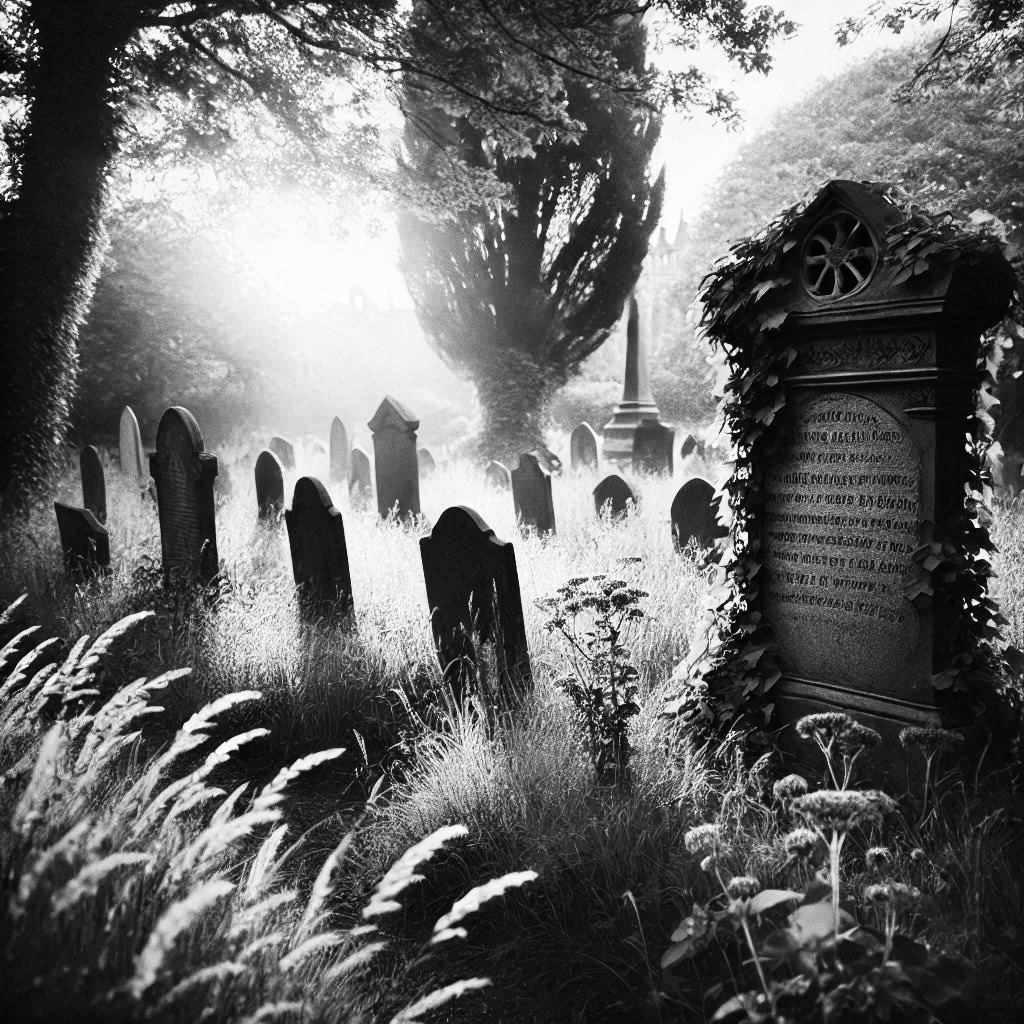
The “field” we found was down the street at the Pine Grove Mennonite church. And the fence was a rusted wrought iron relic around an ancient cemetary on the church property.

Now, we all had a code. It was code spanked into us by our dads: You don’t walk on graves. We knew that, and we respected it. We didn’t know why, but we knew it mattered.

So when we decided to make that one lone tombstone—outside the fence—first base, we talked it over and made sure that we would only step on the edge of it and never go behind it to the grave over which the grass had grown. We couldn’t avoid the thing, but if we did it right, it could funciton as first base without disturbing the grave’s occupant.

That particular, lone, tombstone belonged to Lester Stoltzfus.

We knew nothing about him (at the time), and few of us noted that the dates on the stone indicated he had died as a child—the same age as us.

The iron fence was perfectly placed on an open field that sloped only slightly uphill and we set up the field so it would stretch, in a straight line, from left to deep center field. Perfect.

If you pulled the ball hard, a homerun was an easy reward.

We started playing down there on an early summer day just after school let out and the homeruns came in droves. All was well. The skinny teenager who mowed the grass between the tombtones was a local kid who never said a word. He did not care that we used Lester’s tombstone as our base.

About two weeks into our daily, day-long games things changed—and quickly. I still don’t know who he was. He was an older man who simply walked down through the graves and came to a stop—in the middle of our game—on the pitchers “mound” (there was no mound, but you know what I mean).

He looked grave and simply shook his head. After a drawn out moment in which we all stood with heads hung, he said “No. You don’t do this here.”

And then he left.

He made his way back across the graveyard and meandered up the hill beyond where my dad’s boss later owned a home and he continued until he disappeared beyond.

We got the message.

We hung our heads, picked up our bases, and left. And we never used that diamond again. We knew. Our feet had touched the stone, and all of a sudden it was perfectly clear to each one of us that we should not have done that.

We were ashamed.

For about a week afterward we stayed home. There was a drizzle that covered our guilt and we stayed indoors and read, or watched tv, or teased our siblings until our moms threatened us with oblivion.

When the weather cleared, we found a new, less desirous space—without a fence—and continued our game.

It was during that interregnum that the dream came.

I shared a room with Dar, my older brother to whom I was never close (another story for another day.) We shared a bunkbed, and I was up top.

One night, I woke up to find a kid sitting on our desk chair next to our dresser. He looked upset—not exactly mad, but certainly not happy. I was scared, but not terrified. Dar sighed in his sleep below, but I saw the boy and, like you sometimes do when you are scared, I decided to fill the silence with talk.

“What’s wrong?” was all I could think to say. “Why are you mad?”

He looked up at me and my breath caught as he pierced me and held my gaze.

“They won’t let me play,” was all he said.

Then he got up, walked over to my bed and touched me on the left shoulder. Not the top of the shoulder, but on the scapula (I learned that word later)—the shoulder blade. I never feared him. I knew he would not hurt me, and his touch left no pain, just a tingle.

Then he moved to the door, and left.

I resumed my slumber, and while I remembered and pondered the dream the next day, I was not afraid. I was puzzled.

I suspected it was Lester…

That was the beginning of the obsession.

Pitching had been interesting to me before the “touch,” but afterward, it was a necessity. And so was winning—at everything.

But beyond pitching, I just needed to throw the ball—throw it hard, throw it often, throw it far. Just throw it.

A typical morning started with me hurling a hard rubber ball shaped like a baseball against the barndoor out back. I drew a rectangle on the smooth wooden door and that was the strikezone. I would spend an hour or two right after breakfast throwing ball after ball as hard as I possibly could at that door. I won every game I played out in my mind—always with a no-hitter—striking out the side in the bottom of the ninth.

Later in the morning, there would be two or three of us playing “batty out” a game that allowed you to bat if you caught a pop-up, two bouncers, or three ground balls. I never batted—ever. I stayed in the field and caught balls so that I would throw them back in.

After that I would routinely meander down to Jeffrey Sprechers and we would stand as far apart as we could and still get a throw on the fly to the other. The key was to throw it so that it 1) did not hit the ground, and 2) not require the person catching the ball to move. We would throw until Jeffrey begged mercy because his arm was aching.

Then it was on to wiffle ball, where I insisted on pitching (overhand).

Late afternoons would find me looking for Larry Klassen—four years my elder—to go to the diamond to throw balls at each other as hard as we could. I was proud because I could catch his hard stuff. I was prouder because I put a hole in his glove’s pocket. In contrast to the rules in the Jeffrey Sprecher toss-off, this one had us standing a mere 40-45 feet apart and throwing hard and straight.

The days ended with my mom calling me in in the twilight from more time spent at the barn.

Rainy days were agony.

And then I started pitching in real, hardball games. I experimented with all arm angles and windups—always returning to a Bob Gibson-style wind-up and delivering at three quarters side arm that gave my pitch a natural tail.

And I was good. And I won.

The world loves to see lefties and I was (am) one and so people would come to watch this skinny kid sling the ball.

Barry Hoschauer was my catcher. He was a lefty too, and in those days it was impossible to find a left-handed catcher’s mitt. So he used a regular glove. But I threw so hard that I bruised his hand and he almost had to quit until he swiped a bra pad from his mom and inserted it into the glove.

We would play a full game and then I would pitch some more in the twilight. He never tired catching me.

That was a summer of very big dreams. The first of maybe three during which I believed—really believed—that I could be a big league pitcher. And I never stopped throwing.

As fall came on, we kept playing and I kept throwing. I feared the coming of snow and weather that would put an end to the throwing.

Fortunatley, in 1969 we discovered football. It was a brand of tackle football (our parents objected, but we played for keeps and tackled hard without pads or protection) that had no running plays—only passes.

And, yes… I was the quarterback. I did not want to lead the team, I just wanted to throw. And win.

Football sated my obsession, but when the spring of 70 rolled around, it was back to baseball. That was the year I threw at the barndoor with abandon and not even a thunderstorm could stop me. I threw. I threw. I threw.

That was a year of no-hitters and one-hitters and endless days of throwing a ball to whomever I could convince to play catch with me. My dad bought a catcher’s mit and caught me after work while the bakery employees on smoke break huddled next door to watch me throw.

1970 was when we left Bowmansville and the Pine Grove Mennonite Church to move to Fivepointville about 3 miles away. There was no smooth barn door, and not enough kids to make a game, so I begged for a bike and rode the back roads to Bowmansville to feed my need.

And for several more years, all I cared about was throwing something. And winning.

My game moved from Bowmansville to Adamstown and then to Terre Hill as I moved into adolescence. I pitched everywhere and I threw hard.

The monotony of it is not worth telling. But a few things are.

I started playing other sports that involved throwing and shooting balls and I loved them all. I also started injuring myself in these games.

A broken elbow from a hard-core game of capture the flag. A broken thumb playing baseball in gym. A broken ankle playing basketball. A kneee injury playing football. And, later, a deep thigh bruise playing basketball and IT band problems from running.

The curious thing is that every one of these injuries occured on the right side of my body. The more curious thing is that I started to lose my ability to do things with that same right side.

I used to bat right-handed, but sometime in those years I simply couldn’t do it anymore. I wrote with my right hand, but my writing slowly deteriorated until I had to teach myself to write with my left hand. I couldn’t make a right-handed lay-up in basketball. My right side felt weak.

It still is.

But my left side—my left arm—stayed strong.

In 1972 I was invited up to the “midget” league where the mound went from 45 feet to 60 feet 6 inches—the big league size. I didn’t expect to pitch at that distance, but was called upon to do just that due to a lack of pitching on the team I played for (back in Bowmansville).

And I hurled the rock with abandon.

I tossed a two hitter against Glenmore in my first win and the future looked bright. I could do this.

And so I kept throwing—hard, often, with abandon. I tried to come up with an offspeed pitch but my brain wouldn’t let me do anything but throw hard.

I can’t explain it—I really can’t. Just like I can’t explain why I just can’t do things with my right hand. All I can say is that my brain won’t let me. Does that make sense?

Toward the end of that season I tossed a seven inning game against Morgantown (we won) and for the first time, ever, my arm hurt after the game. I don’t mean my arm—I mean my shoulder. I couldn’t sleep on my left side and my arm hung limp for two days after the game.

I was scheduled to play left-field in the next game and was all set, but during warm-ups I threw the ball home and the pain flared. I told the coach I could not play…

And that was it.

Oh, I played a few more years, but it wasn’t the same. I couldn’t control anything I threw. I couldn’t throw more than about 30 pitches before the pain made me chew on my glove. When I was 15, I walked off the mound in a game, walked off the field, got on my bike and rode home, and I never played again.

My right side wouldn’t work, and my left arm couldn’t throw.

As I write this, there is a dull ache in that same shoulder.

This is not a ghost story—at least I don’t see it that way. Years later I found a story in the Ephrata Review (the internet is an amazing thing) that dated from the winter of 1968/69. The Ephrata Review was one of those local weeklies that was a kind of lifeblood of rural PA communities in those days. Barry Hoschauer’s mom wrote a column about Eastern Lancaster County for the Review. It was a glorified gossip column that we read with great attention.

Sometime that winter she ran a very short story about a child who had been found dead in an abandoned farmhouse up on Silver Hill outside of Bowmansville. Very little was known about the boy, and there was no family to claim him. There were no records of him in the local schools. Hoschauer wrote that the Lancaster County coroner named the cause of death as “neglect.” The child’s name was Lester Stoltzfus—and his tombstone was paid for by an anonymous donor who felt no child should die unremembered.

Neglect.

No, this is not a ghost story.

Unless the ghosts are all my own.

In those baseball years, in those pitching years, in those obsession years, I cared not at all for the kids in our town who could not play ball: the kids we picked last, if at all. And as I grew in esteem and stature in my baseball circles, I was relentless in making sure my team won. I told kids to just go home, rather than pick them for my team. I scoffed at those who had no sports’ skills. I made fun of those who did not know how to hold a bat. If they could not help me win, I wanted nothing to do with them.

Sure, I wasn’t the only one. Those of use who had the skill ruled the game with a relentless commitment to win. The lost kids who didn’t have the requisite skill were not our problem.

Yeah, that was me.

We neglected them.

I neglected them.

I sometimes think that I was given exactly what I desired—an unquenched thirst to pitch, to throw, to win. I was given a yearning. I was offered an obsession. Maybe Lester offered it. I don’t know.

And I embraced it.

But even young bodies are not designed to handle the stress of such an obsession. And old bodies pay the price.


I Voted… Now What (13, fin)

To see the origin of this post, go here. Today, I continue to lay out a positive vision for what I would like my community and nation to become.

I envision a nation that embraces apocalypses.

In the first essay in this series, I described Donald Trump’s presidency as destructive. His intentional and reckless destruction of trust in people and critical institutions has made us sicker and less prepared to face future pandemics.

However, we must also acknowledge the valuable service Mr. Trump has rendered to our nation. More than any other recent historical figure, Mr. Trump has revealed us for who we are.

As commonly understood, an apocalypse is an end-of-the-world event that indicates destruction and hopelessness. Apocalyptic literature describes world-spanning scenes of destruction and mayhem.

And yet, that form of literature, and early use of the Greek term αποκάλυψη, comes from St John’s letter to a cluster of Southwest Asian churches and was meant as an encouragement to them.

It was a revelation—an uncovering. In John’s case, it was an uncovering of the vapidity and bankruptcy of the Roman Empire and an appeal to early Christians to consider who was really in charge of things.

Exposing, revealing, uncovering…

As a people, we need those things.

It is easy to believe that civilization progresses in an inevitable march toward an improved human condition. Technological advances, in particular, lead us to believe we have thrown off the small thinking and limitations of the past and found our way to a better world. We look at the people of the past as less knowledgeable, less aware, and less progressive in their understanding of the world and people—stunted somehow in ways that we are not.

But much remains hidden.

It turns out we are every bit as violent, racist, misogynistic, and uncouth as our less enlightened kin. Maybe not all of us, but as a nation, surely.

In the haloed years of the Obama administration, it was possible to believe that we had finally moved beyond our racist past. In the aftermath of 9/11, we claimed noble suffering on the world stage and basked in the (finally) new-found solidarity with other nations. We believed that mere court cases could secure eternal rights for gay people and women.

But, the hidden truth about all these things could not remain so.

In the years since Donald Trump began his first candidacy, it is as if there has been an inundation of and speeding up of the unveiling of many hidden truths. In the last days of this year’s campaign, the revelation has reached a fever pitch, and it is now fashionable in some circles—apparently large ones—to overtly call for assassinations of political rivals, mass caging of immigrants, and dismantling of critical national institutions. It is funny to call women the most vulgar names, to elevate and extol lawbreakers, to threaten violence at elections, and to glory in anti-semitic and racist suggestions (wink, wink, nod, nod). It is acceptable to lie—about apparently everything, all the time.

Oh, that’s not you. Yes, I know, that’s not you.

But it is “us.” And the apocalypse Donald Trump has brought concerns all of us. It requires a response from each of us. It demands a fundamental reconsideration of who we are and what we want—collectively, as a people.

This Apocalypse shows us the brutalized landscape that lies around us.

It lays some important choices before us.

It poses some important questions.

  • Where DO we go from here?
  • How do we confront the hate and exclusion?
  • What do we do with the ruin of our social engagement?
  • How can we rebuild things like truth-telling, integrity, concern for our neighbors?

And there are many, many others.

Maybe this time we won’t go back to the “just-so” stories of our national youth—when everything had a happy ending because we were all basically good people—indeed, perhaps a “chosen” people. We can’t pretend that the sins of our past will stay ensconced in another era.

Because we have lived through an apocalypse.

(Final note: I wrote this and all the other pieces in this series as a white man—who grew up in a country designed by and for white people. I realize that for many people, our national apocalypse has been permanent. I know that the lies and hatred experienced by many are fixtures—as they say, features, not bugs. What I have written, especially here, gets more to our chosen national narrative about ourselves—what the dominant white culture has comforted itself to believe. Donald Trump has put a definitive end to these fairy tales.)

Installment 12

I Voted… Now What? (12)

To see the origin of this post, go here. Today, I continue to lay out a positive vision for what I would like my community and nation to become.

I envision a nation in which all residents live in housing they can afford—housing costs less than 40% of their household income.

HUD’s standard for housing affordability is that it should take no more than 30% of total household income, but we are far behind, and in many places, that is simply not attainable.

I work in a basic needs center at one of the most prestigious state schools in the country. Over forty percent of our undergraduates face food insecurity—worrying about how they will afford meals, reducing meal sizes, or skipping meals altogether.

Thousands scour the campus weekly, looking for free food. Thousands more jump through various hoops to obtain about $300 per month in CalFresh benefits (SNAP or EBT—the federal cash-equivalent program for food run by the USDA).

I am talking about food, but the driver is housing.

Last week, I presented data on food security from our county and university to a class of master’s of public health students. During the class, I asked them to help me list out all their monthly expenses. Then we analyzed them to determine where their income is fungible—for which categories one dollar can be moved around and spent equally, and where it is not fungible.

They concluded that they have choices in a few categories: entertainment, hot drinks (yes, they have their own category), and food. Two categories were not flexible for them: transportation to school and housing, including rent and utilities.

(I should note that some of them remarked how housing and transportation were linked because they had to choose housing far from school to afford it, requiring them to drive and pay to park. They sought the option that reduced their costs. They did not note the time cost of their travel.)

Every day I meet with students who struggle to eat, because they struggle to pay for housing.

Even those with what appear to be generous financial aid packages struggle. Hold on for some arcane stuff right now…

Financial aid packages are created based on the calculation of the “average cost of attendance.” When students are looking at schools, these schools often publish somewhere the average cost—typically broken down by tuition and fees, health care, and room and board.

Packages differ depending on where you live: in a dorm, on-campus apartments, off-campus, or with family. However, the housing costs that go into the calculation are not the actual costs a given student pays for housing (which would require more information than is typically available when the packaging is done). Instead, costs, including housing, are based on the average cost of these things. This means that approximately half of students (it is not the median cost of housing, but the average is close to it) pay more than what they are packaged for.

If you have time to look, get to town early, and work hard, you can find a bed at or below the average. Notice I said “bed.” You are unlikely to get a room, let alone a place of your own. You will share a bedroom (or sleep in a closet as some do), and you will share everything else—bathroom, kitchen and living spaces.

If you are a transfer student who comes too late or someone whose housing fell through for whatever reason (roommates leave school or someone backs out of a joint deal), you are likely to have few choices and higher rents—many times MUCH higher than average.

As I alluded to above, you are likely to share a lease, which can and does lead to bad outcomes when one person on the lease leaves mid-year for whatever reason. It happens surprisingly often.

This is the student experience, but it is indicative of the challenge that everyone who works or comes to school in my town faces. And my town is not as bad as many in California.

This state of affairs is almost entirely due to policy choices cities and counties have made over the last generation. It is no longer just a California problem.

Put most crudely—and some readers will vehemently disagree—in California, those who own their homes have systematically and doggedly created systems that make building new housing (of any type) more expensive, subject to lawsuits (environmental impact), and increasingly difficult to do despite how lucrative successful development can be for landowners and developers (they have benefitted most from this regimen).

Often, in the name of environmental protection, cities, and citizens have made housing a luxury—a scarce commodity that only those with substantial means and time can afford. It has gotten so bad that it appears that the state is going to force the hands of cities and require them to build more. Lawsuits pepper the landscape.

In university towns like mine, citizens have demanded that the university itself provide more housing, and in many places, universities are now among the largest housing developers—especially for multi-family rental units. Universities may own land, but the money for building must come from the state—from citizens. I am happy to contribute in the form of taxes, but state budget priorities mean there is always competition for my tax dollars.

And so, out here, students suffer. Especially first-generation students. Especially students from low-income families.

I have focused on students here because they are in my office daily, talking to me about these things. I had a Zoom call with a student whose Wi-Fi was spotty because he spoke to me from a closet for which he pays $600 monthly. I had another whose roommate was dismissed from school, returned to his home in another part of the state, and left this student with an unexpected monthly rent increase of $800. Even a generous financial package cannot fill that hole.

This year, we will give out over $300,000 in grants to students to help plug a short-term hole in their rent due to some crisis. They live on a razor’s edge, but they have to pay rent.

I am here to tell you it does not have to be this way. After fighting the housing battles for four years on the City Council, I can confidently say that this is the biggest challenge our cities face today. And the solution is fully within our grasp.

Installment 11

Installment 13 (last)

I Voted… Now What? (11)

To see the origin of this post, go here. Today, I continue to lay out a positive vision for what I would like my community and nation to become.

I envision a community in which the gifts of all community members are identified, valued, and their sharing is encouraged.

One of the few images or analogies from my Christian upbringing that I still value is the idea of a “body of giftedness.” St. Paul wrote of this when reminding his readers that they are all part of one body and, like a body, each has a different function, a different gift—and NO function, no gift is any less important than another. And while certain gifts might be valued more than others if all members were that one thing, the body could not function. He even said to value the less esteemed gifts.

Paul’s message was clear: everyone contributes, and everyone’s contribution should be encouraged and valued.

In every job I have had, I have sought to identify my colleagues’ giftedness. In the few short years I served in city government, I made it my mission to watch for, call out, and support the gifts and talents of everyone I worked with: my city council colleagues, staff, and citizens.

I have learned a few things in applying Paul’s analogy to daily life.

First, far too many people go through life feeling more like an interchangeable cog than an essential part of a healthy body. They simply believe they do not matter and have nothing to contribute.

Second, for these people and even those who don’t feel that way, naming what you see in their contributions is a huge encouragement and can help them continue to give of themselves to support the community.

Third, we are enamored with certain gifts and are likely to name and value them more than others. Reading Paul, this seems to be part of the human condition. But Paul warned against this and told his readers to value all gifts because all are necessary.

Finally, naming gifts has generative power—like discovering a hidden treasure. Naming is a creative act that can change the course of relationships and people’s sense of who they are.

Identifying and naming gifts is an essential part of nurturing a thankful community. I remember a community Thanksgiving gathering at which I was invited to speak. I chose the theme of being thankful for the people in my life and named names and gifts. Then, I had community members present, write the gifts they had received from others on note cards, and present them as an offering to the community.

The outpouring of thanks for the giftedness of others in our community was breathtaking. That evening was one of the most encouraging of my life.

James Coleman wrote of social capital in his writings in the early 1990s. To Coleman

(S)ocial capital is some aspect of the social structure and its facilitates or in some cases permits actions that would be more difficult or impossible in its absence. (1)

This is how I view gifts. They are part of our social structure in that everyone in our community has them. To the extent that we can name and encourage them, we open the door to collective action for the good of the whole “body” that would otherwise be difficult or impossible.

We need each others’ giftedness to co-create the kind of community we want and need.

(1) Coleman, James S. (1990). Foundations of Social Theory. Cambridge, MA: The Bellknap Press of Harvard University Press.

Installment 10

Installment 12

I Voted… Now What? (10)

To see the origin of this post, go here. Today, I continue to lay out a positive vision for what I would like my community and nation to become.

I envision a nation where every resident has access to primary health care within no more than 20 miles of their homes. This care would not require co-payments or annual deductibles. It would include community health workers who would visit vulnerable populations in their homes with no community health worker serving a populaiton of more than 1,000 citizens.

You have heard the news: the US spends by far the most of any economically wealthy nation on its healthcare, and yet its citizens’ health outcomes rank at the very bottom.

Our neighbor to the south, Cuba, has a life expectancy at birth higher than in the US. And while many consider Cuba to be a pariah, its citizens live longer on average—despite being far poorer.

Obviously there are many reasons for this.

Among them is how we think about what health and healthcare mean and what access to healthcare looks like.

Unless you are extremely poor, access is mediated by large “insurance” and healthcare companies whose goal is to limit use, reduce treatment costs, return large profits to shareholders, and control all aspects of the drug, health specialist, and hospital markets.

They are for-profit healthcare exclusion organizations. This system leads to the high costs and poor health outcomes we seem to take for granted. Like everything, this system did not just emerge but evolved out of tax codes and policies that encouraged it. It is the product of highly successful lobbying by “insurers” and the dogged pursuit of “efficiency” in the name of economies of scale.

It is only marginally about health but provides its own figleaf by paying doctors, nurses, and technicians and running what looks like health-providing organizations (primarily hospitals).

That is a bit about our system, but what about how we view health and healthcare? While primary prevention has been promoted for over a generation: stop smoking, drink less, exercise, get a flu shot, etc., the big money is spent on secondary and tertiary prevention—essentially keeping things from worsening and preventing death.

(I relax by watching the World Series or a Saturday afternoon football game. It also illustrates our healthcare approach as advertisement after advertisement extols the virtues of expensive medications for serious chronic diseases. Immunizations, for example, get little airtime and are provided as public service announcements.)

In addition, our nation’s income and wealth inequalities, combined with virtually unrestricted and aggressive marketing of unhealthy products, mean that the cheapest and unhealthiest foods flow to the poorest members of our communities—many of whom are priced out of appropriate healthcare. There is scant time to focus on prevention, and everything in the ambient culture seems to promote poor health.

Healthcare providers live behind institutional arrangements where access is strictly limited and supportive health information is most readily available on the internet—if you are savvy enough to find it through waves of misinformation and have access to the medium.

In this regard, I am not suggesting active collusion between the industrial health and industrial food complexes. I am only saying that both are driven by an insatiable desire for profits and not the health of the people who consume their products.

A visiting lecturer in the MPH course I co-facilitate recently returned from Cuba and shared their experience visiting with people delivering primary health care there. I was struck by the humanity of it all: ready access to regular check-ups, doctors who live in and serve the communities where they live, and community health workers who extend care and provide needed information and support.

But, yeah, it’s Cuba…

I guess we prefer “freedom.”

While the Affordable Care Act has extended insurance to many millions in our nation, I am not convinced it has extended better health outcomes. I am not sure it has led to a boom in preventive resources—more frequent primary healthcare visits, better food options at fair prices, more focus on supporting healthy choices.

You may ask why it is the responsibility of a health insurance plan to ensure healthy food. I will answer that many of the chronic conditions we face have their origins in what and how much food we consume.

I harbor little hope that we can tear down these industrial complexes, but we must name what they are if we hope to try.

Installment 9

Installment 11

I Voted… Now What? (9)

To see the origin of this post, go here. Today, I continue to lay out a positive vision for what I would like my community and nation to become.

I envision a community that is thankful.

I live in a thriving, wealthy, safe, and attractive community. Like any community, we have challenges, but we also have the means and the human capital to deal with them.

I won’t go through a long list of everything we have, but a few are worth mentioning because they are important to our health and wellbeing.

  • For a California town, we have an amazingly robust water system drawing on both ground and river water. This is no small thing in the semi-arid valley in which we live.
  • We are part of a small alliance of local cities and county that purchases our own electricity, enabling us to aquire green energy.
  • We have an amazing system of bike paths and safe streets with ample bike lanes so that many children need not even ride on a street if they want to bike to school.
  • We host a global university that brings vitality and bright, inquisitive minds to our town.

I could stretch this list to many pages. When I first moved here over a quarter century ago, I found myself smiling incessently as I pedaled my bike around town. The air was clear, the vistas broad, and I just felt healthy.

We are a privileged community—though who likes to admit that? But, arguably, by any metric, we are.

I have observed what this means for many years and have concluded that it is the root of what I experience as a profound lack of thankfulness and contentment for what we have.

Privilege means, among other things, never having to accept “no.” Privilege comes with a belief that there IS a better way—and I or we know what it is. Privilege means never having to compromise.

But, of course, the world is full of “no’s,” ideal solutions never come to pass, and living in a community requires compromise. These realities can cause anger, frustration, and even bitterness and cynicism among the privileged.

Perhaps you feel I am being too harsh. Perhaps I am.

But I know my own privileged heart and can observe my privileged neighbors’ actions.

Let me provide one example of what I have seen. We rarely, if ever, celebrate in our town. Oh, sure, non-profits hold donor appreciation events, schools do their rite-of-passage celebrations, and we gather at holidays with families and friends to raise a glass.

But we cannot seem to ever celebrate the successes that I mentioned above. Indeed, I can site examples when outsiders have praised us for one or more of these features and we refused to accept the praise, demanding only that things change and get better.

I sat in a full Community Chambers one evening not too many years ago with community activists seeking to improve our bicycling infrastructure. I felt (and still feel) that we have much to be thankful for in this regard. Many of the others in attendance did not. They were angry about the still too-car-centric nature of our town.

At the event, we invited a prominent city official from another town who had transformed the streets of his city into a bike-friendly place. We invited him so he could tell us what we needed to do to transform ours—because, certainly, it needed transforming.

Like any good speaker commenting on a community, he arrived a day early and toured our town’s bike infrastructure by bike. He began his talk by sharing examples of some of his successes and some of his failures. They seemed pretty similar to ours.

And then he turned to what he had seen as he toured our town. He spent nearly thirty minutes praising us for the many innovations, features, and overall outstanding nature of our city’s bike facilities. As he spoke, I first noted a murmur and then a shaking of heads by many in the audience. And then he asked us to give ourselves a hand for all we had accomplished.

And we refused.

We sat on our hands. Many people left that night bitterly disappointed at the uselessness of his talk. He had brought us nothing.

Except thankfulness.

Thankfulness for the hard work that had led us to where we were. Thankfuflness for an imperfect but still, by comparison to other cities, amazing infrastructure. Thankfulness that he could learn from us.

I was part of that crowd. In the years I have lived here, I now realize that I have come to identify deeply with this particular feature of privilege. I spend far too much time in angst about what has not been done. I spend too little time in thanks.

This is my privilege problem and it is time for me to engage in the counter-cultural act of giving thanks.

Installment 8

Installment 10

I Voted… Now What? (8)

To see the origin of this post, go here. Today, I continue to lay out a positive vision for what I would like my community and nation to become.

I envision a nation that no longer uses a punitive criminal legal system but instead employs a system of restorative justice.

Our current legal system establishes laws, and those who transgress them are accused, tried, and, if convicted, punished by the state—by fines or incarceration.

The state is disembodied. It is represented in the process described above by law enforcement and prosecutors, supplying judges to determine whether the law is applied correctly and fairly.

There may be victims who passively (for the most part) participate in the proceedings; they are primarily used as props by the prosecution to convince a judge or jury about the heinousness of the act.

Arguably, their needs are not the focus of the proceedings because the focus is on the transgression against the state. We even talk about those who are punished—especially via imprisonment—as having “paid their debt to society.” The society, like the state, is an ambiguous mass.

Restorative justice, in contrast, focuses on harms caused by acts. It defines specifically who has been harmed. It asks the perpetrator of the act to face the harms their act has caused. It provides, when possible, for victims to express the impact of the harms on themselves and others. And, it seeks ways, with victims and perpetrators, to make the harms right—as right as possible. It becomes the responsibility of the person who committed the acts to take actions, agreed upon with victims or their representatives, to make the harms right.

In this way, restorative justice focuses on correcting real wrongs committed against real people (and defined communities) in ways that will restore community—as much as possible. Ideally, both the victim and the one who caused them harm find a way to live again in the community and find a way forward in life.

There is good evidence that restorative justice has evolved in Indigenous communities worldwide. I think I know why. To be punished by banishment—which is essentially what prison is—is a death sentence in subsistence communities. It also leads to cycles of revenge that will eventually destroy the entire community.

A restorative alternative, then, is a crucial way to reestablish balance, ensure that healing can begin to occur, and break a potential cycle of violence.

This vision is not “pie in the sky.”

It is already used in various forms in our society, but it sits awkwardly alongside the punitive criminal legal system—employed chiefly for property crimes or low-level interpersonal ones. However, it has been used successfully in even capital crimes. It seems especially effective for young perpetrators for whom the default in our punitive society still seems to be “give them a second chance.”

In my experience, some of the most vocal proponents of restorative justice are retired district attorneys—people who have lived within the punitive system their entire careers and dutifully represented the state in its proceedings against “bad people.”

They have seen its deficits. They have observed its impacts on victims. They have watched it destroy the lives of those convicted and punished.

The desire for an eye for an eye—for punishment to fit the crime—seems to lie deep within us. We want perpetrators to pay because someone has to pay.

And yet, if you have been the victim of a crime, you know punishing the convicted perpetrator does not alleviate your suffering. You likely have questions:

  • Why me?
  • Did I do something to cause this?
  • What were you thinking?
  • Do you know what this has done to me? To us?
  • Will you do it again?
  • Am I safe now?

In many cases, only the person who committed the act can answer these questions. Only by hearing them from a victim and responding can they fathom the depth of impact they have had on that person’s life. Only then can they take steps to begin to make things right.

We can begin to insert a more aggressively restorative processes into our current punitive system at many stages. We can do it before formal charges are made. We can do it after charges, but before adjudication. We can do it after conviction. We can even do it during incarceration.

At each step, we have the option to ask the victims what their needs are. After all, it is they, not the state, who is actually harmed by the acts. We can place them in a position of (safely) confronting the perpetrator with the impacts of their acts.

This is not being soft on crime. Rather it is redefining what crime is and what it means. It is recognizing that punishment does not solve problems, but actually exacerbates them. It views harms as happening to real people. And it seeks the restoration of relationships and community as the ultimate goal of naming and addressing the harms.

I believe that the vast majority of people who harm others or the community in which they live want a “second chance.” That is our way of saying, I made a mistake, and I want to make it right. I want to move on. I don’t want this act to define me. I believe this is in our hearts.

By extending this desire to those who harm us, we provide a remedy that we all deeply need.

Installment 7

Installment 9

I Voted… Now What? (7)

To see the origin of this post, go here. Today, I continue to lay out a positive vision for what I would like my community and nation to become.

I envision a country in which all citizens receive a set, basic income to cover their basic needs for food and housing.

Guaranteed Basic Income (GBI) or Universal Basic Income (UBI) programs are now being tested in over a dozen communities around the US. Their focus is mainly on populations receiving different forms of state support, such as CalWorks here in California.

In lieu of support from them, recipients receive a monthly check for a set amount. The amounts in these programs vary from $50 per month to over $1,000 per month. The cash is unrestricted, but participants’ expenditure categories are tracked via a cash card, and they typically agree to answer questions about the impact of the program on their lives.

These are pilot programs, and few, if any, have income streams that will permit them to continue, let alone expand.

The results are positive, with evidence of participants taking on new jobs, spending more on childcare, food, and other basic needs, and some saving money—perhaps for the first time.

State-funded cash transfer programs or cash-like programs such as SNAP (EBT or CalFresh in California), are under constant threat from legislators who state that “welfare leads to laziness.”

(I am simplifying, but that is basically it. Meanwhile, these same people will promote various forms of corporate welfare. And while that is “another story,” it is essential to this one, given budgeting priorities.)

In an ideal world, we would build enough housing of all types—including multifamily rental housing—to help keep rents low. In an ideal world, people would be paid a minimum wage that would cover their basic needs (even recent adjustments to minimum wages in some states and local jurisdictions still leave real incomes far below where they were a generation ago). In an ideal world, the universal scam we call health insurance would yield to MediCare-like free primary health care so that the threat of losing everything to medical costs would not loom over so many.

You get the picture: UBI is another band-aid that covers a multitude of policy injuries that we could change but apparently won’t.

Still, the value of knowing that there will be money tomorrow, no matter how meager, can change the trajectory of families’ lives.

By now, my PhD research is far behind in the rearview mirror of my life. But it changed me and my understanding of how people manage risk and uncertainty.

I examined how impoverished people survive in one of the harshest climates on earth—the Sahel region just south of the Sahara Desert in West Africa.

Using a variety of learning activities and interviews with community members, I learned that the simple act of creating a shield against the ever-present uncertainty in families’ lives consumed nearly all the living hours of people in that region. Not only did people work mainly in subsistence agriculture and herding, but they also spent hours working to create obligations towards themselves by various gift-giving mechanisms so that if disaster struck, they could hopefully call in a favor.

These techniques were very forward looking and their geographical breadth was amazing. But they placed people on an endless treadmill of anxiety and labor. They included the mass migration of men out of communities, first during certain seasons, and later all year round and quasi-permanently to urban centers both domestically and abroad. This further stressed families who lost contact with their migrant members but was a boon to those who continued to benefit from their family members’ remittances.

Living was a constant pursuit of just surviving, and it tore families apart, left women and children particularly vulnerable, and was not particularly effective (even when family members went far afield) given the broadly covarying risks of that region.

When there is no certainty about how the bills will be paid, all of life becomes a side hustle. The effects are well known: little to no savings, poor quality food purchases—and high food insecurity (food purchases being one of the few fungible expense categories most people face), poor health outcomes, children lacking parental presence, people forced to work long hours at multiple jobs, costly transportation costs as people drive many miles to work in places they could never afford to live in.

All of this brews a broad toxic stress in household members—but especially women. This in turn leads to the development of chronic health conditions such as high blood pressure, heart disease, and Type II diabetes.

We know this.

Yet we continue to allow millions to live on this razor-edge, like the former nomads I spoke to in Mauritania, who lived, literally, on the desert’s edge.

The big question, of course, is how would we ever pay to expand UBI nationally to all who need it?

I know what you are thinking—why not attack the root causes you outlined above, Robb? I would love to. But we are, at this stage, pretty far down a road of coaxing poverty to continue as a kind of ambient reality.

And so… maybe a bandaid.

Paying for it? I feel like I should not even dignify that with a response so I will simply say, for perhaps the millionth time: “Budgets are moral documents.”

We spend on what we value.

Nearly a trillion nationally on creating the most creatively destructive military the world has ever known. Billions more on caging people. Further billions so people with everything can have more.

We know that uncertainty and risk management born out of a lack of the means to live keeps millions from flourishing as human beings and relegates them to the constant and exhausting pursuit of “getting by.”

We can change that.

Installment 6

Installment 8

I Voted… Now What (6)

To see the origin of this post, go here. Today, I continue to lay out a positive vision for what I would like my community and nation to become.

I envision communities in which the first responders to mental health crises are trained mental health specialists and not the police.

We can point to several inflection points in the history of policing in the US that caused it to diverge from the path of other non-military police in other nations.

The end of slavery and the advent of Jim Crow led southern lawmakers to mobilize the police to arrest black men (mostly) on a variety of non-violent charges and send them to jail and prison as labor. These police also used violent means to control black populations, first in the South and then elsewhere.

Labor actions in the late nineteenth and early twentieth centuries saw industrialists mobilizing the police to crush strikes and keep factories open.

The war on drugs not only expanded the carceral state (as I wrote about here), but it also flooded local police departments with cash and materiel in quantity and lethality to wage an actual local war. SWAT teams arose in that era and the militarization of the police was nearly complete.

But a less considered historical point has bolstered that militarization all along: the many wars of choice that the US has fought since the end of the Korean War. With an annual budget now approaching a trillion dollars each year, it is safe to say that the US has made war making its chief end.

And the detritus of these wars (big and small) flows back into all of our communities in the forms of surplus military weaponry and war veterans who help populate local police departments (perhaps, especially their tactical units).

Because we have invested so heavily for so long in the police—especially to control certain bodies in certain communities—the police have become a “solution” to many community challenges.

And we have ALL been complicit. I can think of no other domain in which so-called liberals have more readily joined conservative forces to build an institution—this time in the name of “community safety.”

We give to that institution a monopoly on the use of force in local jurisdictions. We give it scant oversight. Our elected officials take its unions’ money. The police consume an ever-larger portion of local budgets. And once you have a hammer… well you know what every local problem looks like.

I have seen this in my nearby.

My vision is that we begin to chip away at the monopoly we have given our police over every aspect of civic safety—indeed over several critical public health challenges—by replacing them with trained mental health workers who will respond to mental health crises in our communities.

This is starting to happen around the country and has succeeded so far largely because the police themselves are ready and willing to cede this ground. They know that they are ill-eqipped to deal with these emergencies and bad things can happen when an armed person meets one in full crisis. We have seen it.

There are many domains that the police will not willingly give up. Power is not dispersed without a fight, and our generations-long empowerment of law enforcement has left them powerful indeed.

So, let’s take this one. Let’s stop the charade that the police are a militarized social service provider—uniquely equipped to deal with “dangerous” situations. And let’s use the knowledge and tools we have to open the door to change.

Yes, this will require shifting resources away from police departments to social services units. And, yes, the police will begin to raise the alarm about increased crime, threats to public safety, and the specter of anarchy that such shifts will entail. They have mobilized that kind of fear before and will do it again.

But our public health requires this shift. The shift from seeing force or the threat of force as the way to bring about public safety—the shift to redefining public safety first and foremost as a public health endeavor.

Installment 5

Installment 7