I Voted… Now What? (5)

To see the origin of this post, go here. Today, I continue to lay out a positive vision for what I would like my community and nation to become.

I envision a country where people value the labor that goes into bringing the food they eat to their table. In this country, people know the origin of their food and perhaps grow some of their own.

This vision might seem a bit dated at this point in our history. In the early 2000s, people like Michael Pollan wrote extensively about the industrial food complex, how it destroyed the environment, produced low-quality (nutritionally) food, and was demeaning for practically all the laborers who worked within it.

And then, for the first time in many citizens’ lives, high levels of inflation, fueled by a pandemic, raised the price of food rapidly and across a broad array of products.

Cheaper food, no matter its source, is now de rigueur.

And a new pandemic—highly pathogenic avian influenza—threatens critical food industries, making some wonder if certain foodstuffs will become less available.

And yet, the warnings of Pollan et al. remain relevant. And, like many things, they start with people. I cannot remember a time when both sides of the political aisle have so demonized immigrants. It has been a literal race to the bottom to see who can be tougher on those seeking the safety and hope of our land.

But from the mushroom farms of Delaware to the packing houses of the Midwest, the strawberry and produce fields of California and Florida, and the apple orchards of the Northwest, food is literally brought to you by people like these.

The canning tomato harvest in my home county ended just a few weeks ago. The canneries are still busy turning out the tomato sauce and paste that we all use every day. From the planting to the weeding (for organic tomatoes at least), the harvest and processing , real people—many of them migrants—toil. This is going on literally in my backyard. But I spare scant attention to the value these laborers provide to me.

Perhaps the traditional family blessings over a meal should return—less as an offering of thanks to God and more as an homage to those who provide for us.

One does not have to go to a local farmers market to consider the origins of our food. We can always ask that question and learn the answer. Knowing the origin is not essentially about promoting local eating (though that has merits that I will not go into here).

Thinking about our food more broadly, considering the labor that goes into producing it, and translating that knowledge into an attitude of thanks is the heart of this vision.

Our food system employees work the hardest in the most challenging work environments for meager pay, often without health insurance. They are voiceless, faceless, and frequently live in fear.

Our casual ignorance of their plight needs to change. If not, no matter the taste of food in our mouths, it will leave only bitterness in our hearts.

Installment 4

Installment 6

I Voted… Now What? (4)

To see the origin of this post, go here. Today, I continue to lay out a positive vision for what I would like my community and nation to become.

I envision a community and a nation in which leaders (at all levels and in all kinds of institutions) lead by articulating the ends they believe the institution must pursue and then leading with an unwavering focus on those ends.

It is challenging to articulate ends. In my experience, it is harder still to stay focused on and true to them day to day.

Jacques Ellul, writing in the immediate post-World War II period, noted that for humanity, all had become means—and these means—these “techniques” (as he called them)—were and are prodigious. But, sadly, we deploy these means and hurtle headlong toward… nowhere.

I think there are several reasons for this.

First, it is risky to really nail down your “raison d’être,” really laying out the main focus of why you are doing what you are doing—who benefits, who or what will be prioritized, what success will look like, etc.

Sure, many of us go through strategic planning exercises. They can help lay out ends. However, they often do not go far enough in naming the structures and the systems of inequality and inequity that will constrain and condition our work. And so we trace out lofty ends with a deep suspicion about our ability to get there.

For ends statements to truly guide us, they must carry a weight of challenge that we fear we cannot bear. So, we fudge.

Perhaps we fear failure. Perhaps we fear accountability.

It is easier to be vague.

It is easier to slap some new verbs or trendier nouns on some tried and true plan than to really step back and ask, as Ellul would, “Yeah, but where are we GOING?”

I will be circumspect here, but throughout my career and in some of the most public leadership roles I have played, I have found a genuine dislike among other leaders with whom I worked to define the ends of our work.

It has happened far too often. Each time, it has left me feeling bereft, unmoored, and dissatisfied with my attempts to rally colleagues to go deeper and take a stand on our commitments.

Ellul’s comments demonstrate a second reason why we eschew ends. The means at our disposal are so glamorous. Everyone, myself included, is interested in “best practices.” We want/need results. We do not want to “reinvent the wheel.” We need to demonstrate action.

And so we find the shiny thing that is sure to help us succeed.

This may seem too harsh. After all, best practices often flow from a strong commitment to making sure actions translate into desired ends. I know that.

However, it is a very short step from adopting them because they lead to change, and adopting them because we need “do something.”

Communications departments love the shiny things: the new program, the easily digestible soundbite about how X will lead to Y (always in a strictly linear way), and the visuals that certain shiny things produce.

In my experience too many leaders take their marching orders from Communications. Harsh? True.

Finally, a third reason why means trump ends is because of money. How many dedicated leaders have succumbed to the need to chase a new revenue stream, a new donor, a new grant to keep the lights on.

I know the pressure is great. In today’s world, CEOs and EDs are hired to bring in the money.

The pursuit of financial sustainability is the true end of far too many organizations I have known. We nod at our ends-oriented mission, even as we mobilize the entire organization to pursue cash.

Am I speaking too harshly?

Pursuing means keeps us busy, it keeps us in work, it tantalizes financial supporters. But it quickly causes us to lose track of why we even exist. In the process, the structures that destroy lives and our planet stay in place.

Perhaps this is because somewhere there ARE leaders who are doggedly pursuing ends known only to and serving only themselves.

Installment 3

Installment 5

I Voted… Now What? (3)

To see the origin of this post, go here. Today, I continue to lay out a positive vision for what I would like my community and nation to become.

I envision a nation in which the jails and prisons are emptied of those who 1) are awaiting trial, 2) have untreated mental illnesses, and 3) have untreated substance use disorders. In this nation, only those who represent a risk of direct harm to others would he detained.

The facts:

  • One of every five people incarcerated on this planet, are incarcerated in the United States. (About 4% of the world’s population lives in the USA).
  • Of those incarcerated, half have some form of mental illness.
  • Of those incarcerted, 60% suffer from a substance use disorder.
  • Fully 70% of those being held in local jails are awaiting trial. They have not been convicted of a crime.

As our local Public Defender recently told a class of Masters of Public Health students: “Our jails and prisons are the largest mental health treatment centers in the world.”

And, as any 4th grader who has taken a US civics class can recite: “In our system, you are innocent until proven guilty.”

Many others have written about how this has come to be. The now generation-long war on drugs, and “reforms” that led to mandatory sentencing for drug-related crimes are high on the list. The retreat from insitutionalized treatment of mental illness, followed by decades of severe underfunding for community-based treatment is also there. Lack of access to affordable treatment for mental illness and fundamental misunderstandings about and undertreatment of substance use disorders are also high on the list.

But there is more, and much of it is insidious and, evil.

There is money to be made in incarcerating large numbers of people. From building and running jails and prisons, to providing services to them, to benefitting from cheap prison labor (see below), to the issuance of bail, incarceration means fantastic profits for far too many people (we will return to this reality later when we discuss the military).

Rural prisons are also the lifeblood of myriad small communities across our nation.

But… there’s more.

The same amendment to the US Constitution that abolished slavery permitted involuntary servitude for those convicted of a crime. Slavery by another name continues to this day.

Indeed, in the election in which I just voted, California has a ballot measure—Prop 6–that, if passed

Amends the California Constitution to remove current provision that allows jails and prisons to impose involuntary servitude to punish crime (i.e., forcing incarcerated persons to work).

This is where we are.

Unwinding all of this will be quite a task, and moneyed interests will fight it.

But beyond the money, we, the people of this nation need to examine ourselves and ask why we allow this to happen.

I have often reflected that we seem to want to hide society’s ugliness. When I was mayor, I faced many enraged (yes, that is what I would call them) citizens of my seemingly liberal community who were angry at the way I proposed handling the challenges of our unhoused community members. I often heard some variation on the comment: “Your job is to make our city unwelcoming to them so they will leave.” In other words—we don’t want solutions. We just don’t want to see the problem.

We seem unwilling to deal with our brokenness—to look directly into the challenges of mental illness and substance use disorder. We can’t seem to acknowledge how devasting pre-trial detention is for families and individuals who lose jobs, housing, and a future.

Why can’t we investigate the causes of this and attack them at their root? Why can’t we look “upstream” from jail and prison and deal with the factors that end with a locked cell?

I think we are afraid that if we look, we will realize we are gazing into a mirror.

My vision comes with a price tag—they all do. But like so much else, we are already paying a high price. The price we pay for over-incarceration is millions upon millions of destroyed lives and families, lost hope, and intergenerational trauma.

Installment 2

Installment 4

I Voted… Now What (2)

To see the origin of this post, go here. Today, I begin to lay out a positive vision for what I would like my community and nation to become.

I envision a country where every child can safely ride a bike to play, go to school, or go out with friends and family.

This may seem like a strange place to start and too pedestrian (no pun intended) to constitute a “vision.” But a lot is packed into this dream that would change many things about our lives.

First, a bikeable community is one not built around and for automobiles. It is a community that does not engineer roads to maximize vehicular throughput, with intersections designed to stack cars and travel lanes made to enhance speed.

Instead, streets are designed to reduce speeds, separate different users of public spaces, and encourage even novice cyclists to ride. This moves people out of cars for short trips and reduces greenhouse gas emissions, crashes, and noise.

Second, when children can bike safely, they will bike, and their parents will likely go with them. Daily cycling can be a public health intervention that people enjoy. With childhood obesity on the rise in the US and the concomitant increases in cardiovascular disease and Type II diabetes, biking can provide needed intervention.

(Side note: My grandson moved from a bike-unfriendly community to Davis in September. He is a generally healthy teen, but when he came here bicycling became his means to get to school, about three miles from home. He has already remarked about getting more exercise and feeling better. He competes with himself to see how quickly he can make his trips to and from school.)

Third, a child who can cycle is a child who can learn, at a strikingly early age, to make decisions and take responsibility for their and other’s safety.

If you never cycled at a young age, you may not fully grasp the experience of sheer freedom that comes from powering yourself across terrain. To bike is to begin to learn to be independent—in a good way. Learning to control a bike is a heady endeavor. You learn how efficiently your body can move from one place to another.

Fourth is the exhilaration of the wind in your face, your slightly elevated heart rate, and your somewhat higher-than-walking perch on your bike seat. These combine to make bicycling an essential mental health break.

But only when the route is designed with you, the cyclist, in mind. If your route is designed for motor vehicle throughput, your ride will be neither fun nor relaxing. Few children will attempt it, and fewer parents will even let them try.

Am I claiming that designing for and using bicycles can help heal our bodies, minds, and planet? Yes, I am. Having lived in a bikeable community for a quarter century, I can confidently say that biking is an ingredient in creating planetary and personal health.

Installment 1

Installment 3

I Voted… Now What? (1)

I work hard to avoid hyperbole. I despise sensationalist headlines that hide the lack of genuine content in a news piece. So, I don’t say this lightly.

This is the most consequential election I have ever participated in.

In 2016, we knew of Donald Trump. He was a “media figure” whom it was difficult to take seriously. And whatever I felt about Hillary Clinton, I never really thought she would lose.

Until she did.

And then Trump’s presidency was a disaster. I say that as a public health practitioner who helped lead the response to COVID-19 in my local community.

It’s not simply that the president mismanaged the whole affair. At turns he minimized it or mobilized it to achieve his personal ends. Over time, he ended up leading an attack on public health institutions and leaders that risks our health every day, and leaves us nearly unprepared to face the next pandemic.

It was a disaster because so many died unnecessarily.

It was a disaster because it destroyed trust in public health structures, policies, and programs that, unfortunately, too many took and still take for granted. We are and will be sicker for it.

I am speaking about Donald Trump’s harmful impact on a single domain I know something about. He repeated that harm repeatedly, touching many institutions and people who work to make our communities nice places to live (see this for an example of what I mean).

Despite this, he might win again.

And I don’t know what I will do if he does. I am angry, sad, and confused—confused mostly, I guess. Confused that so many citizens of this nation seem to accept this man as a leader worthy of their respect.

But before I even start thinking about what will happen after November 5, 2024, if he wins, I need to figure out how to get through the days until that date.

So, I have decided to put away the news, the blogs, the social media feeds—all of it—and write instead.

But write about what?

When Mr. Trump won the first time, I was mayor of Davis, CA. In the days after his election, already knowing that his tenure would mean harms for many we loved, the people of Davis came together to prepare ourselves for this new world.

As mayor, I was asked to speak.

At the event, I tried to remind everyone who we are, what we value, and, most importantly, what our vision for our community is. It was a small speech—perhaps an inconsequential speech—but it helped me remember that without a vision, people wander. Without vision, we react. Without vision, we have no path forward.

But by articulating a vision, we can, in small and sometimes big ways, begin to move towards a future we value.

So in these days leading to November 5, 2024, I will lay out my vision for my community and my nation.

This might seem like hubris. After all, what gives me the right to lay out a vision? What does it even mean?

My response is that I do not expect my vision to prevail. But if I am to continue to contribute to a place I love. If I am to stand against the evils being let loose in our nation and world by people who care only for themselves, I must have something to offer in contrast to what I condemn: if not a plan, then at least a direction.

And I guess I would invite you to do the same.

What do you want for your community and nation? What ends do you want to pursue? What will drive you in a positive way in the days after November 5, 2024?

For, indeed, no matter who wins, it is incumbent upon all of us to know what we value and where we want to go to achieve the ends we desire for our community: to bring healing to the social, cultural, and physical world we inhabit.

See you tomorrow…

Installment 2

My Father’s Resurrection

This is not a theological reflection on what happens after death. Though I know if my dad’s somewhat confused understanding of bodily versus soul resurrection is true, he is in a good place right now.

But this is not that.

To be truthful, this is really about the resurrection of some of my father’s cherished beliefs.

Like the locusts that emerged in the Mauritanian desert after a period of dormancy, his beliefs never really went away. And like those locusts, once they return, they quickly spread—decimating everything in their path.

A great, moving and devouring, cloud of beliefs.

And these beliefs were not just his.

It turns out that dad’s views were held by many more people than I dared imagine. I shouldn’t be surprised. After all, dad was part of Nixon’s “silent majority.” A group of aggrieved “victims” who dredged up their victimhood from the scummy ponds of racism and the brackish creeks of xenophobia.

Mom was declining fast and we needed to find a place for her to go. All she had was Social Security and whatever passed as government support for end-of-life nursing care. It wasn’t much, but we needed it—Dad needed it.

We were in the car somewhere between Akron and Lititz, PA and I waxed oh-so-eloquent about how the tattered safety net that was giving mom a room in a subpar nursing facility was a god-send.

I was digging at dad because I knew he hated “entitlements.” Yes, I was acting like an ass.

Dad came back at me like a caged beast telling me how government aid was a horrible blemish on our history and how he wished he could go back and make sure Roosevelt had never lived. He hated it.

But he needed it.

Things got hot and I asked dad whether he was pulling down any social security benefits (I knew he was and I relished the opportunity to reveal his hypocrisy).

He said

“You bet I am, but at least I earned it.”

And there it was.

The deserving poor.

Dad knew he was. He also knew that “those people” who, in his view, most ardently sucked at the teat of the federal government most definitely were not. They were mostly urban. They were mostly black. And he knew without any nuance at all that the failure of our country was because of “them.”

Dad’s views were not spoken in polite circles in those quainter times. Now, they are espoused by a vice presidential candidate who has a Yale badge to go along with his apparent Appalachian bona fides.

Dad has gone mainstream, except today “black” is “Haitian” or, more generally “immigrant.” And while it’s not polite, it is, by now somewhat of a yawner in the mainstream media precincts.

And then there is the matter of Israel.

What I need to write, I am afraid to write. And what you are going to read in the following has likely been carefully edited—out of fear.

These days to criticize the Israeli state is to run the risk of being tagged with a moniker that no self-respecting person desires.

I will have to take that risk.

Dad was Anti-Semitic.

He was so in the most casual ways and in the most conspiratorial.

Dad would regret getting “Jewed”—cheated in some financial way in a transaction (usually involving an automobile).

And, dad, in his more ardent John Bircher moments, would also bitterly decry the ways Jews ran a worldwide shadow banking system that kept people like him down (always the victim).

These were both banal and dead serious.

But Israel—what even he referred to as the “Jewish State”—was untouchable. It was unassailable. It was not to be questioned or critiqued.

The reasons, to the non-initiated, are laughable.

But to the initiated—to those steeped in the arcane ramblings of Darby and his theological spawn—they are dead serious. They are existential.

To them, and I must oversimplify here, the establishment of the State of Israel was the final piece of God’s cosmic puzzle. It would, within a “generation” usher in the rapture of the saints (a kind of UFOesque snatching away of the chosen), seven years of earth-shattering “tribulation,” Armageddon, and then, the arriaval of Christ’s kingdom on earth.

Israel was a necessity—even if Jews were NOT among the “new” chosen (that particular view has changed in recent times).

But it was not just a necessity.

Because it was a precursor to everything that must come

AND

Because Jews were/are the historically blessed people of God…

Any nation that did not support Israel would incur the wrath of God. And that would not be good.

In the end, support for Israel, was a kind of insurance plan for the United States (or any nation). During the Cold War, the Soviet Union’s disdain for the state was the cause of its decline. Conversely, the US support for Israel is why we “won.”

Dad believed all this and our bitterest arguments—especially after Sabra and Shatilla in 1982—were about Israel. Dad feared for my mortal soul.

(Years later, after I returned from the “Middle East”—southwest Asia, perhaps—and I talked to dad about my Palestinian friends, our relationship almost ended. I begged him to consider his brothers and sisters in Christ who had been wronged by Israel, but he wanted nothing of it. And then later still, when I told him of standing in a Beirut mosque where the victims of the 1982 massacre were buried, he held firm.)

Dad’s beliefs were definitely not mainstream in those days.

But like the locusts, they have now swarmed the land. Who could have imagined that they would become the dominant doctrine of a Democratic administration.

Having grown up in that world, I could never have imagined that we would give Israel a pass on a massacre that is many orders of magnitude beyond Sabra and Shatilla.

But here we are.

Beliefs resurrected—or beliefs spreading like long dormant locusts, scouring the landscape of our time.

There was a time, no too many years ago, when I believed these beliefs were gone for good.

But just as I saw the reemergence of the long-dormant locusts, so too, have I seen the resurrection of his ideas. The resiliency of these beliefs is astounding and remind me that I must steel myself against that others that might come.

And, yes, there are others…

When You (Begin to) Realize it Was ALL a Lie

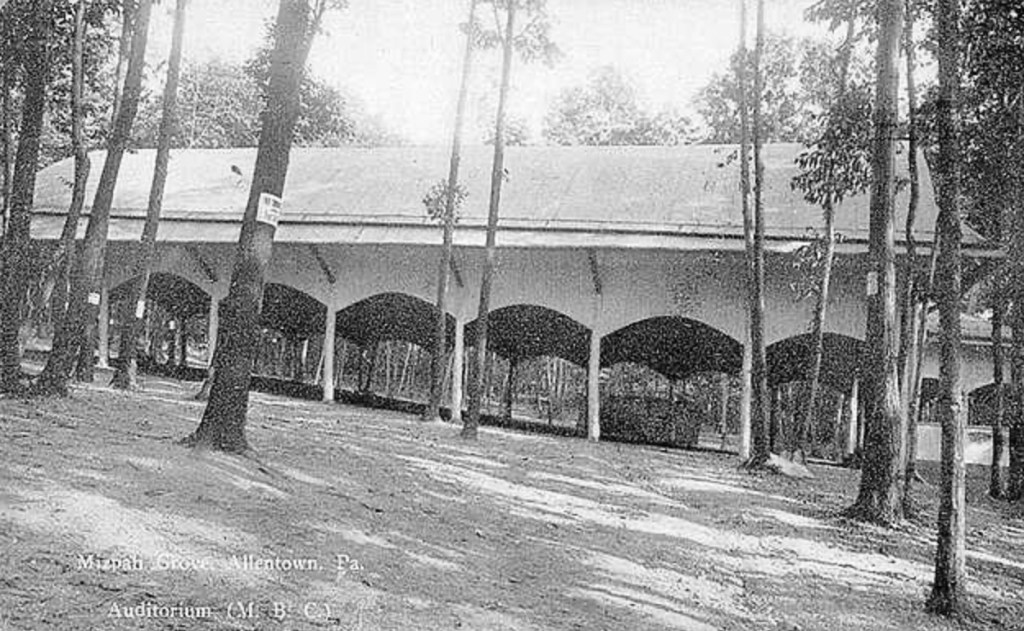
Mispah Grove Camp Meeting “Tabernacle” (there WAS a sawdust trail)

The start of my awakening to the lies and to the truth was at Pinebrook in the Poconos when I was about 21 years old. Pinebrook had inherited the mantle of an “old fashioned camp meeting” from Mispah Grove and, while there was no sawdust trail at Pinebrook, there was fiery preaching from the fundamentalist backbenchers who filled our churches in those years.

But that year, Pinebrook had a superstar: Henry Morris. Morris was an engineer who along with John Whitcomb had written the authoritative work on the young earth creation “theory.” Indeed, it was not a theory at all, but a mash-up of claims about how the world was only about 5,000 years old and evolution was a godless myth.

Not too many years before that Pinebrook awakening, I sat in the living room of our neighbors, the Kirkpatricks, and listened to my youth leader (curiously, a woman—she was at the limit of what SHE could do in that church), as she painstakingly chronicled the genealogies within the Hebrew Bible to come up with the c5,000 timeline that Morris and Whitcomb had proposed.

By the time I made my way to Pinebrook with my mom and dad and future spouse to spend a week basking in the mountain beauty and the stern reminders of why so many people were destined for hell, I was starting to doubt a whole bunch of stuff I had been raised to unquestioningly believe.

(Doubt was weaponized to question your “salvation” and place in heaven. Ergo: if you doubt “the faith”, you probably are not saved. You are damned.)

Sadly, I had no one with whom I could entrust my deepest doubts.

But a high school biology teacher, whose name I will never remember, was at Pinebrook that summer too.

And that was the beginning.

I latched onto him because he had an education outside the Bible colleges, which, we were taught were the only places committed to the truth. And one night that week when we all went bowling (an annual tradition), I sat next to him on the bus and, quite innocently, asked him what he thought of Morris’ teaching.

He lowered his voice and said something like: “I could get in trouble for this… but… it’s simply ridiculous.” He said little else except to note that none of Morris’ claims would hold up under any kind of scientific scrutiny.

But the damning thing he said, and what stuck with me forever after, was in response to a somewhat arcane argument Morris advanced about how light from starts that are millions of light years away could reach earth if the universe is only 5,000 years old. Morris claimed that God created the light to arrive at earth to make it seem like the universe was billions of years old (or something like that). My biology teacher’s response (stated in that same lowered voice) was that why would God do that? What kind of God would engage in that kind of bizarre trickery? To what end?

The teacher was profoundly offended by a God who would be so manipulative.

(Just another proof that these preachers had all created a god in their own image.)

And that was when I began to give myself permission to wake up. Permission to question. Permission to walk away. Permission to doubt the whole project. Permission to call BS on the entire package of lies meant to keep me in line.

But even though I gave myself permission, the actual escape, the actual liberation, the actual exit from that world took a long, long time. In some ways it is ongoing.

It’s hard for people who were not raised within a cult (take that term for what it typically means—a system that controls all aspects of one’s life and allows no questioning) to understand how hard it is to fully escape.

Believe it or not, Donald Trump has been a blessing in this regard. Imagine me saying that Donald Trump is a blessing—but he has been. As a truly apocalyptic figure (a figure who reveals), Trump has removed the veil from what the true project of Morris et al has always been.

Morris wanted control. He wanted control of a narrative. He wanted control of the explanation for how the world works. He wanted us to swallow the vision of a God who is unpredictable, punitive, and wholly lacking in grace. He wanted us to be afraid of that God because he wanted us to stay in line.

And though Morris is gone now, those who follow in his tradition want the same thing. That is why they attach themselves to a vile human being whom they believe will offer them the control they desire.

The biology teacher was, perhaps, the first truth teller I had ever engaged on questions of deep importance to me. And while he did not know it, he was granting me a key—a key to unlock the door to a world that transcended hate and control.

I wish I could thank him. I wish we could discuss the journey he set me on.

A Descent into Cynicism

I know where I do not want to end up. It gets harder to avoid it as the years go by.

I think of certain things I want to avoid as I age: meanness, stubbornness, aversion to change… I work hard to stymie them and, to date, I have kept them at bay.

Cynicism is another; perhaps less visible than the others, it is, nonetheless, more corrosive to the psyche. I don’t know what I will do if I end up there, but I struggle with it more every day.

I have been to the “killing fields.” There are lots of them and I have seen many—almost always after the fact; though Afghanistan was in real time.

I have seen what warlords do. The havoc that death squads—paid for with my tax money—wreak on a people. I know what happens when an occupying army lets local ethnic hatred turn to bloodbaths. I have stood above the crypts hollowed out in the floors of mosques where the school children are stacked like wood. I have seen what Made-in-the-US big guns look like perched on a hillside pointed at a neighboring village. I have walked the streets where the war on drugs breeds social cleansing.

Most Americans have not seen these things. Nor have they been to Southern Lebanon, Beirut, the refugee camps of Jordan and Syria, Peshawar, San Salvador, the country-side outside Managua, or Mazar-Esh Sharif (as the Taliban—whom the US created—drew near). I have walked among the blowbacks of US foreign policy and met people who were “cleansed” by its “democracy-loving” allies.

My descent, in other words, has causes born of seeing the devastation of what the power brokers in a powerful nation can and will do. Have done.

(Post 9-11 I listened to the fear of my Mauritanian friends who were sure they were next in the Global War on Terrorism (GWOT). I assured them they were not, then left the country on a flight deep into the Sahel with an American who clearly was there to scout out the potential targets.)

I think the long trip down may have started at Sabra and Shatila (which I visited many years later). It was hastened in the first Iraq war, and accelerated when, despite our marches, the US went back to war in Iraq after the WMD lies.

I want to be clear about something right here. I will do everything I legally can to ensure that Donald Trump never enters the White House again. He is a brutal thug with a taste only for himself. Narcissus must soon yield to what someday will be renamed trumpist/trumpism—a pathology about which Christoper Lasch, were he still with us, would certainly write.

However.

However. Just as I withheld my allegiance from Clinton over the “acceptable” deaths in the Balkans; just as I withheld my support when Obama failed to close Guantanamo and extrajudicially murdered Americans with drone strikes (carried out by good American boys sitting in a mountainside in Colorado); so, too, must I withhold my loyalty to the current candidate who supports (take your pick): a pogrom, ethnic cleansing, genocide—in Palestine.

(And I am NOT just talking about Gaza.)

And the contradictions contained in the prior two paragraphs only speeds my downward spiral into what I fear will entrap me—very soon, perhaps within the year.

Because I want, I desire, I yearn for a leader who will shepherd us beyond the hyper violence of the military industrial wasteland that our country has become. We are destruction and if I accept their terms, I will join the tacit confirmation that death dealing is my birthright. My obligation. My sacred duty.

And so I sink.

They Are Attacking Us

I have never worked as an election inspector (poll worker), but I have known several in the various places I have lived. They were/are my neighbors. I know the local Elections Clerk and Registrar of Voters. He lives in a nearby community.

I have sat on juries—one a horrific murder trial years ago in Baltimore and another in Yolo County, where I live now—that case was too bizarre to summarize in a sentence or two. Everyone on both juries lived not far from my home—they held a variety of jobs, and in a few cases, I got to know them personally in other ways after the trials were over. They, too, were/are my neighbors.

The “neighbor” part is important here. These people, be they election inspectors or jurors, are people pretty much like me. People who live, work, raise kids, and contribute in many ways to the well-being of the community of which I am part.

They are not members of a faceless bureaucracy or political operatives. They are citizens roughly committed to the same ideals I have. They want a safe place to raise their kids. They want to be fair. They want the best for their communities.

So, when I see Republicans (and let’s not dance around this one—they are, at least at this point in our history, all Republicans), when I see them attacking jurors because of where they live or the decisions they make when I see them attacking elections as rigged and suggesting that those whose job it is to ensure fair elections are corrupt or involved in some ill-defined conspiracy, I take offense.

And I am not alone.

Conservative (using perhaps an outdated meaning of the word) political theorist Patrick Deneen argues that the failure of liberalism (not political liberalism but the “western liberal project), is a function of a too great focus on individual autonomy at the expense of commitment to local community.

Wendell Berry, who I would also argue espouses essentially traditional conservative views (he writes exhaustively about “conserving”), emphasizes in nearly all his writing the importance of place-making, of sinking deep roots in a locality, and of fostering the deep interconnectedness that can only take place in a defined community.

An attack on election integrity—because all our elections are managed locally by people who live in the communities where elections occur—is an attack on our neighbors. It is an attack on the value of the local. It is an attack on the conservative values of place and the people who collectively inhabit it for the common good.

An attack on jurors (or their decisions) is an attack on my neighbors. Juries are tricky things, but having sat on two (cases that lasted over one month each), I can say that there is a sacredness to the process that transforms participants into deeply serious and committed community members (whatever they were before they were selected for that role). I have seen jurors cry out of fear that they would make the wrong decision. I have seen them agonize over the profound implications of the decisions we would collectively make.

(I remember an older white male juror in the murder case—the accused was a young black gang member—balk at making a finding of “guilty” because he did not want to be the one who altered a young person’s life forever.)

The point I want to make is simple: people who claim the moniker of “conservative” but attack elections and juries are not conservative. In their defense of a soulless man, they have abandoned the basic tenets of conservatism. In attacking the base of the local, they have revealed their commitment to attaining power by any means necessary. Whatever that commitment is, it is not a commitment to community, to the local, to the neighbor. And it is time that we articulate the truth that they are attacking the foundations of what creates resilience and meaning in our lives.

They are attacking us.

Power and History

History may be written by the victors, but in any age power confers the ability to manipulate history to achieve its ends. It does so in three related but distinct ways.  

  1. Mobilizing chosen traumas (collective myths)
  2. Appealing to recent (or “ongoing”) existential threats
  3. Promoting organized forgetting

Our world is one in which the “virtuous” powerful invoke a “rules-based order” designed to act as a check on aggression. But they transgress that order routinely in search of the talisman of the total defeat of their enemies. They accomplish this by manipulating history to remove the shackles of the “rules,” in order to engage in revenge, or to wage unlimited and endless war.

Chosen Trauma

In Transgenerational Transmissions and Chosen Traumas, Volkan provides an excellent recent example of the mobilization of chosen traumas in the case of the conflicts in Central Europe in the late 1990s.  In discussing the Serbian march to war, ethnic cleansing, and war crimes against Muslims, he describes how a historical event from the 1300s when the Ottoman Empire Turks (Muslims) in the Battle of Kosovo assassinated Prince Lazar. He notes how the mythologized tales of the battle were “translated from generation to generation” until “(w)ith the awakening of nationalism in Europe in the 19th century, Lazar’s image was transformed from that of martyr, victim and tragic figure to hero and then ultimately to avenger” (emphasis added). Lazar, as avenger, provided a foundation for the violence that was unleashed over 600 years after his death. 

Volkan notes: “Leaders intuitively seem to know how to reactivate a chosen trauma, especially when their large group is in conflict or has gone through a drastic change and needs to reconfirm or enhance its identity.”

He goes on to say: 

But when a chosen trauma is fully reactivated within a large group by stressful and anxiety-inducing circumstances, a time collapse typically occurs. This term refers to the fears, expectations, fantasies and defenses associated with a chosen trauma that reappear when both conscious and unconscious connections are made between the mental representation of the past trauma and a contemporary threat. This process magnifies the image of current enemies and current conflicts, and an event that occurred centuries ago will be felt as if it happened yesterday. An ancient enemy will be perceived in a new enemy, and the sense of entitlement to regain what was lost, or to seek revenge against the contemporary enemy, become exaggerated.

According to Volkan, history is manipulated, and those in power do it deliberately—intuitively.

Existential Threat

In addition to chosen traumas, the powerful use more recent traumas (not yet entirely historical) to maintain a sense of existential threat.  My son turned 33 this year, and I am reminded that throughout his entire life, leaders in the US have used perceived threats to maintain not only a global military footprint but also a global war.  

Perhaps that sounds like hyperbole, but long before the global war on terror (GWOT), the US was involved in various global policing exercises in the years after the fall of the Berlin Wall. The year my son was born found us in Iraq—well before the better-known Iraq war. I point to those years because those were the years when global communism crumbled, and the US was left as the sole superpower. It did not use that role for peace but to create and maintain global crises. 

The GWOT, however, was the epitome of appealing to an existential threat to compel acquiescence to continued military action. In the post 9.11 world, a visit to Washington was a visit to a city under siege—but the symbolism of the concrete barriers surrounding government buildings was not limited to that town.  In my small Northern CA city, we had the same visual reminder of the threat outside a local USDA field office.

It was the audacity of the GW Bush administration to maintain the existential threat and extend it to Iraq that was the hallmark of that historical manipulation.  Even as the color-coded warnings began to wane, we were reminded that 

America must not ignore the threat gathering against us. Facing clear evidence of peril, we cannot wait for the final proof — the smoking gun — that could come in the form of a mushroom cloud. (George Bush in a speech calling for military action against Saddam Hussein in October 2002).

It was all bullshit, of course, as we now know.  But revenge was needed against a former ally turned enemy, so…

Organized Forgetting

Of course, the entire GWOT (which continues in Southwest Asia and various parts of Africa to this day) also drew on the third form of historical manipulation: “organized forgetting.”

I first came across the concept of organized forgetting in listening to Philosopher Nathan Cartagena discuss it concerning critical race theory.  Cartagena attributed the idea to legal scholar Kendall Thomas, but Thomas traces it back to Roger Bromley in “Lost Narratives.” Thomas writes: 

Bromley describes the contested terrain of history as a dialectical unity of anamnesis and amnesia in which “[f]orgetting is as important as remembering. Part of the struggle against cultural power is the challenge to forgetting posed by memory. What is “forgotten” may represent more threatening aspects of popular ‘memory’ and have been carefully and consciously, not casually and unconsciously, omitted from the narrative economy of remembering.”

Most US citizens viewed the attacks of 9.11 as both unprecedented and unprovoked, and the leaders in DC did nothing to disabuse them of the idea that they were both.  By ignoring the role that the US played in creating the Taliban and Osama bin Ladin during the Cold War, they promoted organized forgetting.  They were successful in creating the narrative that far from the attacks being “payback” for US aggression around the world, they  were carried out by extremists who did it because (to quote the then-president) “they hated our freedom.”  

Later, there was a successful effort to promote organized forgetting about the support the US had provided to Saddam Hussein to wage war on the archenemy of the US—Iran during the 80s. In the aftermath of Iraq’s invasion of Kuwait, and a decade later in the lead-up to the Iraq war, the US’s role in supporting this brutal dictator when it suited their purposes was rarely discussed.

The carefully curated, organized forgetting of the history of the US CIA in creating the Taliban to fight a proxy war against the Soviet Union in Afghanistan, or the substantial support to Saddam Hussein to assist him in prosecuting his war against Iran, led the popular press—print and visual—to largely ignore these histories as merely posthoc arguments against a just war proposed by the (usual) anti-war (anti-American) suspects. 

 Organized forgetting meant that, in a real sense, history started on 9.11 when a nation committed to justice at home and peace abroad was attacked without reason by nihilists whose religion was described as a death cult. There could be no historical reason why the hijackers might take these horrific actions, and any suggestion that there was bordered on a justification for their actions and was, therefore, treasonous. 

But there was a history, and it was not a pretty one. It rolled out in far-off places ignored by most Americans. But it did occur, and the intrepid employed words like blowback to describe how the death-dealing of the US “over there” brought the chickens home to roost here.  

Still, there was no place for this history in the rapid reaction to 9.11 in Afghanistan or the much longer march to war in Iraq. Historical analysis would have required a clear-eyed look at what we had wrought. But for those in power, such a clear-eyed look would have stalled the actions necessary to exact swift and destructive revenge on those responsible. 

Revenge (the Goal of Historical Manipulation)

It is hard to argue that despite all our “progress” as a species, we have left revenge behind and that we only wage war to achieve just outcomes.

And so, a word about revenge.

World War II—a few observations (see references for sources about the following):

  1. The United States imprisoned approximately 120,000 Japanese Americans during World War II following the signing of Executive Order 9066 by President Franklin D. Roosevelt in 1942. 
  2. The United States did not imprison German Americans during this war.
  3. The United States opposed the “area bombing” of Germany in the early days of the war. It limited its bombing campaigns to strategic bombing of sites of military significance.
  4. Great Britain, on the other hand, practiced area bombing and experimented with firebombing in Hamburg in 1943 (calling the effort “Operation Gomorrah”). The US participated in the Hamburg bombings but focused on strategic targets. British bombing killed 40,000 citizens of Hamburg. 
  5. Germany bombed British cities—first by accident and later with purpose.
  6. Churchill used the German bombings of British cities to justify the area bombing of Germany.
  7. Japan attacked Pearl Harbor, which, while not a state, was a territory held by the US. 
  8. The US firebombed Tokyo in 1945—killing over 100,000 civilians.
  9. The US used atomic weapons in Nagasaki and Hiroshima, killing over 210,000 innocent people.

These are simply facts, and they do not prove that revenge on a population is the goal.  Indeed, if you read the official justifications for the area, and specifically, the firebombing of these cities, it was to damage citizen morale (thereby weakening support for the wars being waged by their governments) and to remove vital workers from the war effort. But it is hard not to see collective punishment as the actual goal—revenge for actions taken against the US and Great Britain by Japan and Germany respectively.

Further, the intentionality of these realities demonstrates the will to avenge the attacks against the US and Britain. In an exchange with Keith Lowe, author of Inferno: The Devastation of Hamburg, 1943, he stated that the bombing of Hamburg over ten days was a “trial and error” approach to learning how to use incendiary bombs to maximum effect to destroy a city. This trial and error approach gave way to a much more deliberate approach to ensuring that hundreds of thousands would die in city firebombing.

In his book Dead Cities, and Other Tales, Mike Davis describes a visit to a restricted military site in Utah where the US built a replica German city and firebombed it, rebuilding it over and over to perfect the bombings’ effects.  The British built a similar “city” in the UK. The rigor with which the engineers and architects built housing structures and added typical German furnishings to maximize fire destruction is stunning. No expense was spared to ensure the creation of massive firestorms (see Fire Weather: A True Story from a Hotter World, by John Vaillant for a full description of what a firestorm truly is—it is devastating.)

Here is Lowe, citing civil and medical workers who entered Hamburg after the firebombing:

On a little open square near Boonsweg – I shall never forget the sight – there lay hundreds of men and women, soldiers in uniform, children, old people. Many had torn the clothes from their bodies shortly before their death. They were naked, their bodies seemed unmarked, the faces showed peaceful expressions, like in deep sleep. Other bodies could hardly be recognized; they were charred, torn to pieces, and had shattered skulls . .. There an old woman lay. Her face was peaceful, soft, and tired 

… And there, a mother with a child on each hand. They were all three lying on their faces in an almost gracefully relaxed position . . . And there a soldier, with charred stumps for legs. There a woman with a torn body, on whose bulging-out intestines the flies were feeding. And there a child, clutching a birdcage in his hand. And there, detached from the body, a boy’s foot with a black boot; a small, brown girl’s hand with a blue ring . .. The heart almost stops beating at such sights.

In Lowe’s telling, Britain maintained a pretense of bombing strategically but sought justification for area bombing—which it found.  Few in Great Britain rallied against this destruction of human life—most cheered it on, and the cheerleaders used the ongoing existential threat posed by Germany long after Germany had effectively lost the war to continue the practice.

In the US, the voices opposed to the area bombing of Japanese cities existed within the US military, but they were systematically sidelined (see Searle, 2002).

I have taken this excursion into World War II for two reasons. 

First, to make a case that the ends to which the powerful use chosen trauma, existential threat, and organized forgetting are bent on punishing their enemies—not merely to obtain a military victory. A close reading of Inferno reveals a chilling resolve to destroy and punish.

Second, the devastation of Japanese and German cities during the Second World War was so great and so visible that it led to the development of international accords about the treatment of civilian populations in times of war.  

This so-called “rules-based order” stands as a self-congratulatory but largely empty standard that the powerful use to condemn others but conveniently ignore when it comes to their own wars.

When Hamas launched its attacks on Israel in October 2023, all three forms of historical manipulation were on display, and even as the global south pointed to the vacuousness of talk of a rules-based international order, the US and most European leaders provided cover drawing on these historical manipulations.

To be clear, what Hamas has done to Palestinians over the years and what it did on October 7, 2023, deserves unreserved condemnation.  It was a crime against humanity.  

But Israel’s response has proven every bit as destructive in terms of infrastructure and housing decimated as any of the area bombing campaigns during World War II.  The global south is well within reason to point out the hypocrisy of the “West.”

And the manipulation of history?  Let’s examine them.

Chosen trauma – Probably the most fascinating historical manipulation in this war is the trauma that Israel (and the US media) chose.  Immediately after the attacks, the media was filled with statements such as “This is Israel’s 9.11.”  

This choice would seem to be deliberate in that 9.11 was carried out by a “death cult” bent on the destruction of the US due to their hatred of our culture and freedoms.  A chosen trauma that draws on the tropes of radical Islam is purposeful and powerful.

Existential threat – Israel’s Prime Minister has been a master at holding the Israeli population in thrall to a multitude of existential threats—with Iran as the source of most regional actors bent on the destruction of the state of Israel.  Hamas’ attack, though relatively limited and “low tech” compared to the destruction Israel itself has been shown to unleash on Gaza, has been portrayed—even now after the overwhelming destruction—as an ongoing existential threat, calling for unlimited war to destroy the enemy.

Organized forgetting – In reality, the organized forgetting surrounding this event has a long history that stretches throughout the entire history of the Israel/Palestine conflict.  I can think of no other conflict in my lifetime in which the forgetting has been so organized, ongoing, and supported by media as this conflict.

Each time there is a Palestinian attack, the clear message is that it was unprovoked, unforeseeable, and unprecedented.  Even as settlers use violence to displace West Bank Palestinians and the effective land “controlled” by Palestinians shrinks year by year, there is still no reckoning with a history of violence against these people. It is organized forgetting on a massive scale.

Conclusion

If there is one, it is this: as our weapons of war have become ever more “efficient,” precise, and destructive, those in power have attempted to convince us that we can have war with limited loss of innocent life. They seek to curate an image of war that is cleaner and only used in the most dire of exigencies. 

But they know that we know it is a lie because the images that live stream onto our devices show us it is merely the same old civilian massacres carried out in the newest ways. 

And because they know we know, they must manipulate history to assure us it is proper, necessary, and unavoidable.

It is time we reject this manipulation by refusing to be bound by the myths of the past, by telling the truth about history, and by refusing to be made afraid by the latest existential threat scare tactics.  

References:

Bromley, Roger. Lost Narratives: Popular Fictions, Politics and Recent History. Popular Fiction Series. London New York: Routledge, 1988.

Cartagena, Nathan. “Whiteness,” June 30, 2021. https://www.nathancartagena.com/blog/whiteness.

Davis, Mike. Dead Cities, and Other Tales. New York: New Press : Distributed by W.W. Norton, 2002.

Giroux, Henry A. The Violence of Organized Forgetting: Thinking beyond America’s Disimagination Machine. City Lights Open Media. San Francisco: City Lights Books, 2014.

Lowe, Keith. Inferno: The Devastation of Hamburg, 1943. London: Viking, 2007.

Searle, Thomas R. “‘It Made a Lot of Sense to Kill Skilled Workers’: The Firebombing of Tokyo in March 1945.” The Journal of Military History 66, no. 1 (January 2002): 103. https://doi.org/10.2307/2677346.

Thomas, Kendall. “Rouge Et Noir Reread: A Popular Constitutional History Of The Angelo Herndon Case.” Southern California Law Review 65, no. 2599 (September 1992). https://scholarship.law.columbia.edu/faculty_scholarship/2177.

Vaillant, John. Fire Weather: A True Story from a Hotter World. First edition. New York: Alfred A. Knopf, 2023

Yilmaz, Ruveday Celenk. “Srebrenica: The Result of a Chosen Trauma,” July 11, 2018. https://ruveydacelenk.medium.com/srebrenica-the-result-of-a-chosen-trauma-a2c3ea24326a.

Volkan, Vamik D. “Transgenerational Transmissions and Chosen Traumas: An Aspect of Large-Group Identity.” Group Analysis 34, no. 1 (March 2001): 79–97. https://doi.org/10.1177/05333160122077730.