
Caution: The following contains major spoilers for three movies—The Shawshank Redemption, Unforgiven, and The Road to Perdition. None of these is new, so you may have seen them. I hope you have.
I keep an eye out for redemption stories. You could say that I am a sucker for them: the bad guy who is given a second chance, a relationship gone bad that finds healing before the end, or the person spared destruction thanks to the kindness of another.
Lives redeemed. Relationships redeemed.
To me, these are the most powerful stories because we ALL want redemption. We all want that second chance. We all want to find healing for our psychic wounds.
There are three movies I love more than any other, and each contains a clear redemptive message. But what is also interesting is that each contains a story of revenge. In each case, I would argue, the revenge taken does not pave the way to redemption. Indeed, revenge might even endanger it, in a sense. No, in each case, the redemption comes from acts of self-discovery or rescue by another.
Unforgiven
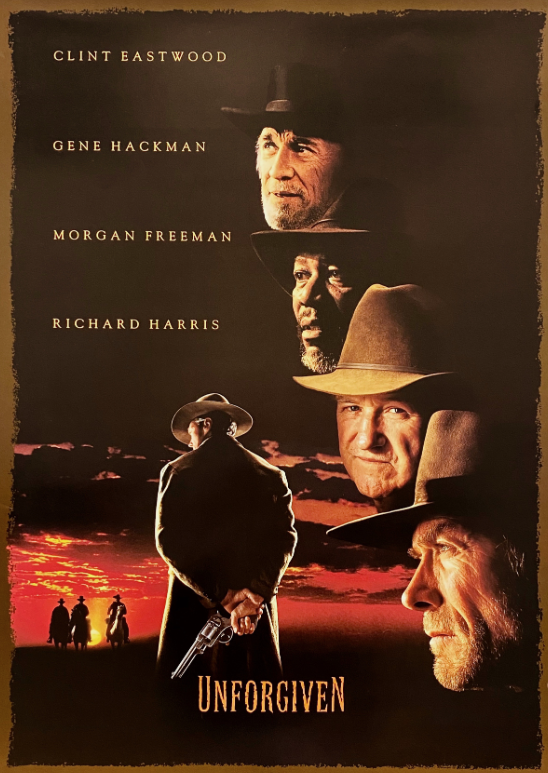
Clint Eastwood’s William Munny was a hired killer in one of the more honest westerns Eastwood has ever made. He lives with his children on a farm, his wife has died, and the situation looks dire. Out of nowhere a young gunslinger self-named The Schofield Kid shows up to recruit Munny to avenge the mutilation of prostitutes in a town some distance away.
The Schofield Kid needs Munny’s help (though he claims to be a cold killer himself), and he persuades Munny to go, promising to split the reward offered by the prostitutes’ pimp. Munny insists on bringing Morgan Freeman’s Ned Logan along. Ned and Munny had ridden and killed together in the past, but they are clearly past their prime.
We soon learn that The Schofield Kid is all talk and has never killed anyone in his life. There are other story lines here, but the main one concerns the sadistic sheriff of Big Whiskey named Little Bill Daggett played by Gene Hackman. Hackman knows killers are coming and swears to stop them before they can bring mayhem to his town.
The three men track down the perpetrators outside of town, and The Schofield Kid shoots and kills an unarmed man guarding the perps, regretting it immediately, though he drinks it off with bravado. When it comes to killing the actual perpetrators, Ned freezes up and can’t do it. Munny does the deed, but it is sloppy and leaves a man writhing in pain begging for water. It is a pitiable scene.
Ned leaves in shame, making a big mistake passing back through town. Eastwood is laid up with an illness, but learns in his convalescence that Daggett has tortured and killed Ned.
Predictably, what follows is revenge. This revenge is classic western with Eastwood gunning down an entire drinking establishment after taking to drink himself. He had given it up for years. He admits to The Schofield Kid that he had only ever killed when drunk. Revenge is violent and dark—happening on a dark night, where people die very quickly
Afterward, Munny and The Schofield Kid head home. Munny offers half the reward to The Kid, who refuses. Herein lies the redemption. Though he had killed a man, The Kid knows that this life cannot be for him. Refusing the money provides him with a break from a life he could have known.
The suffering The Kid faces in the aftermath of the entire affair is sufficient to help him escape what would have certainly been a short, violent life. His “dream” of being a gunslinger is challenged by the brutal reality of murder-for-hire and the realization that there is nothing noble down that path.
The Road to Perdition
Tom Hanks plays Michael Sullivan, mob boss John Rooney’s enforcer. Rooney, played by Paul Newman, is a small city gangster who controls commerce in his town under the patronage of Al Capone (who never appears in the movie).
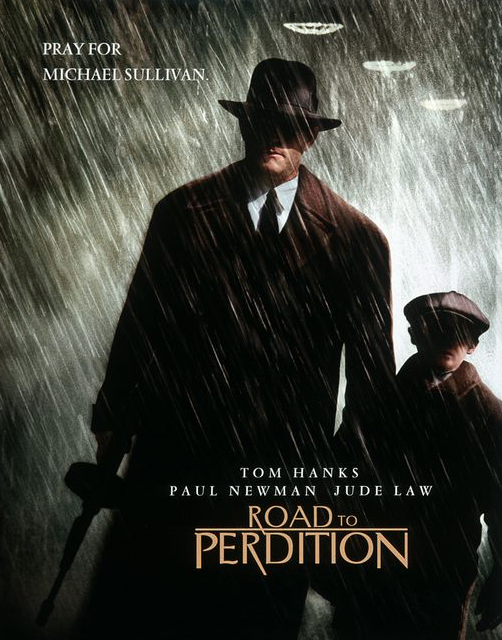
Sullivan also has a son named Michael, a boy of 12 or so who does not really know what his father does, but is proud of his standing in the community, nonetheless.
Rooney also has a son, a violent, untamed man named Connor, played by Daniel Craig.
Sullivan loves Rooney, and he loves, but does not seem to really know, his son. Michael, the son, witnesses Connor assassinate a Rooney associate in cold blood, and taking matters into his own hands, Connor then hunts down and kills Michael’s little brother and mother—thinking he had killed Michael.
And then, Rooney decides to protect Connor against Michael’s revenge. And the story evolves from there into a story of the growing love between a father and a son, as Sullivan and Michael make their way to Chicago to seek permission from the mob to kill Connor.
You could say that revenge is the dominant theme from there on out, as bodies fall and Michael finally kills both Rooney and Connor. However, the real revenge comes against organized crime itself, as Sullivan and Michael make their way across rural Illinois, robbing banks and taking only the money set aside as protection payments to Capone. Like in Unforgiven, the main character falls ill after a gunshot wound and is taken in by an older, childless couple who nurse him back to health.
Sullivan makes such an impact on his revenge tour, with his son as getaway driver, that Capone has to take his quest seriously. But the contract he puts out on Sullivan leads to a final showdown at a lakeside home that was to offer father and son sanctuary from the world.
In a final act, Sullivan shoots his assassin before Michael can pull the trigger of his own gun, thus sparing Michael the possibility of a life that he himself had lived. The redemption is Michael’s, as he is prevented from taking revenge himself against the man who shot his father.
In the end, Michael makes his way back to the farm of the old couple who had taken them in, their lot greatly improved by the money they received from the bank heists.
The Shawshank Redemption
Andy Dufresne, played by Tim Robbins, is accused and convicted of killing his wife and her lover. Sent to jail for life for a crime he did not commit, Andy is unlike any convict at Shawshank. Though Andy is reserved, it doesn’t take long for him to become a friend of “Red” Redding (Morgan Freeman). Throughout the film their friendship grows beyond mutual respect to genuine love.
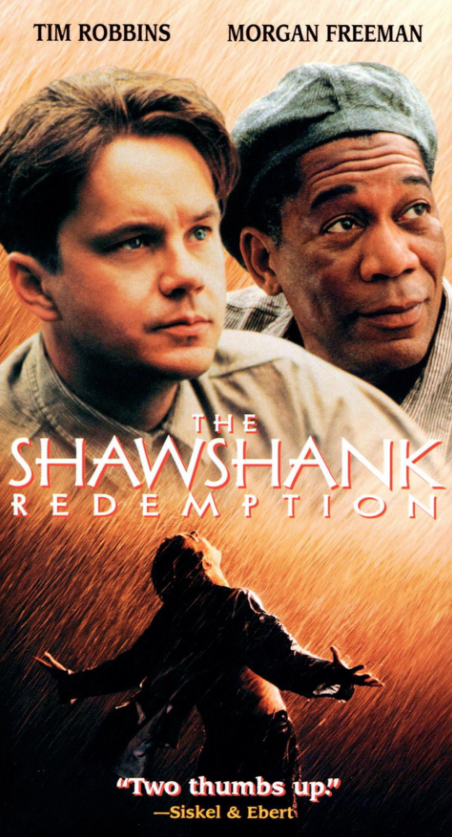
Red is also a convicted killer, but as we learn, he is guilty of the crime. Sprinkled throughout the film are snippets of Red going before the parole board and being denied each time. Red is a lifer along with the others. Andy dreams of escape while convicts like Red and Brooks fear what their eventual release might mean. They had, as Red suggested, been convicts so long that they had come to depend on the walls.
As the film moves forward, Andy gains friends, fends off a gang of prisoners bent on raping him, and becomes the unlikely bookkeeper for the warden, whose many illegal schemes include receiving bribes and kickbacks for offering “free” prison labor to local projects.
It turns out Andy was a banker before his conviction, and so he provides “sound financial advice” to the guards and warden in exchange for certain privileges, like opening a prison library. The film spans the post-World War II period through the early 60s and by the end, the warden has had men killed and made a lot of money.
When Andy presents him with a witness who can confirm that Andy’s wife and lover were killed by another man, the warden has the witness killed and warns Andy never to raise the issue again.
And this is when Andy takes his revenge. And it is exquisite. You see, Andy has been planning his escape for a very long time, and not only has he found a way to break out, but he has also found a way to bring down the warden in the process. Andy kept two ledgers for all the warden’s accounts, and he took one with him. Andy also created a fake person in whose name he opened bank accounts across New England. By the time escaped, he had taken not only the goods on the warden but also a large amount of his cash.
When Andy mails the details of the scam to the press, the warden’s days are numbered, but he escapes becoming an inmate himself by taking his own life.
While it might seem that Andy also found redemption, the person who experiences it in its purest form is Red. At Red’s ultimate parole hearing, he finally acknowledges that he does not know whether he is reformed (after having claimed as much at each prior hearing). But he finally comes to terms with his younger self, telling the board that he wishes he could go back and talk to him about his choices.
In confronting his past and acknowledging the harm he had caused, Red not only was granted release from prison, but was able to start a new life with his friend Andy. Red’s final words are: “I hope…” a fitting description of what happens when redemption comes.
Revenge and Redemption
The revenge in these films feels so right. One finds oneself cheering it on and savoring the rightness of it all. The myth of redemptive violence (for there is violence in each act of revenge in these films) explains why. As Walter Wink argued, the myth of redemptive violence permeates our popular culture.
The myth basically argues that redemption comes through acts of purging violence. Andy’s actions were not direct violence, but led to the warden’s death just the same. The films are case studies in the myth, but they don’t wrestle with who was really redeemed in each and what that really means and how it ultimately comes about.
In Shawshank, Red finds his own redemption in coming to terms with his past. His redemption is only distantly related to Andy’s revenge, and his experience of hope is born out of his love for another—another human being who loved him unconditionally and made a place for him in his post-incarceration life. Unlike Brooks, who kills himself after his release from prison, Red’s hope is grounded in repentance and the love of a friend.
In Perdition, Michael’s redemption is completed because of the love and care of an elderly couple who take him in twice in his hour of need. Michael could never have found redemption in his father’s ways—the trip to the house on the coast was an impossible dream that could never have brought release. But as Michael makes his way to his new home, we see the power of hospitality in making a place for a lost child seeking a new life. The couple are minor characters in this film, but their attention to doing good is the key to Michael’s final redemption.
In Unforgiven, The Kid gains redemption not through the reward that Munny obtained, but through the truth of Munny’s life. It is only when Munny “de-glorifies” gunfighting and tells the truth about the drunken slaughter that characterized his life or the sheer messiness of killing, that The Kid can let go of the idea that killing is glamorous.
True to form, these films uphold the myth of redemptive violence. But while the violence tastes sweet and seems to satiate the appetite, it is the redemption that provides the meal that fills us with hope (like Red’s). Redemption, born of repentance, kindness, hope, and truth-telling, is what remains with us long after the film’s end.


You are mining the deep stuff. More nourishing than political posts that don’t address these foundational concepts. Thanks. JaneSent from my iPhoneOn Jun 19, 2026,