
Jacques Ellul was a French sociologist and jurist Jacques Ellul. Ellul, who died in the 1994. He was a prolific writer best known for his writing on technique, propaganda, money, and ethics.
A theme that runs across much of Ellul’s work is the problem of “technique.” While translators typically render this “technology” when going from French to English, a close reading of Ellul’s use of the word reveals that they are not synonymous. Technology derives from technique, but technique is more like a “force” or a “power” in the world.
According to Ellul
Technique is the totality of methods rationally arrived at and having absolute efficiency in every field of human activity… The multiplicity of means is reduced to one: the most efficient… The individual participates only to the degree that he is subordinate to the search for efficiency… Our civilization sets the highest value on relations. But the structures of our world and its real norms represent diametrically the opposite. (quotes from Jacques Ellul’s, The Technological Society)
Over a decade and a half ago, I wrote a piece for the Ellul Forum in which I used Ellul’s writing on technique to critique our modern food system (see “Our Food System Equation” at https://ellul.org/wp-content/uploads/2025/08/forum_46_2012_fall_1.pdf).
In that piece, I tried to show how the focus on the most efficient means of food production, divorced from the ends of what food is for, left us with a prodigious industrial food system and massive food insecurity around the world. A focus on the means has also left us with highly efficient production in the short term, but a very brittle food system that does not withstand external shocks well.
But now, I am thinking about taking Ellul out of the fields, slaughterhouses, and food processing plants and to a baseball game.
Baseball—pick-up games, practices, cards, major and minor leagues, and statistics—is among my earliest memories of childhood. As my dad used to say: “That boy eats, drinks, and sleeps baseball.” It was true.
Over the years, I have watched baseball evolve. The pitchers’ mound was lowered, the designated hitter introduced, infield shifts became popular—and then they were outlawed, relief pitching moved from a role for washed-up starters to a sought-after specialization, and a seeming host of new statistics were introduced to go along with BA, HR, H, ERA, SO, W/L, and RBI. Most of these I don’t even know, but they are all ways to judge the value of an individual player to his team, and to compare him in a more refined way to all other players across all of time.
I have taken all these changes in stride. I still love the game, though I rarely watch it. The stars are still stars, and there are great games all throughout the long season. But beyond the changes outlined above, baseball has evolved in ways that make it, shall I say, more formulaic: less a meander through an afternoon, and more walk down a well-worn path. I am not saying there isn’t drama anymore, but it is a carefully orchestrated drama that uses pitch counts, one-on-one match-ups, and big number analysis to achieve the desired end.
Using Ellul’s concept, all of these things are means to an end. And not just any means thrown out on the diamond. No, these are the most efficient means. Now, Ellul suggested that means have become so important that humanity has lost sight of the ends it is trying to achieve. In one of his writings, he talks about “prodigious means” that allow us to hurtle ahead, going… nowhere.
I still think winning the game is the sought-after “end” to a baseball game. But because of: the focus on the most efficient means, the flow and direction of a baseball game is actually broken down into a vast array of smaller ends. These ends—the next out, the next pitch, the next sign—are analyzed incessantly, and they yield to the most efficient outcome possible, within the bounds of human talent.
What does this mean for the game? Well, a few things. One is that you no longer get to marvel at a pitcher like Juan Marichal. I was not a Giants fan. But if I knew Marichal was pitching, I would drop everything and watch if I could. I would say the same for Luis Tiant. These were pitchers whose unique wind-ups or deliveries were designed to keep batters off balance and give them an advantage.
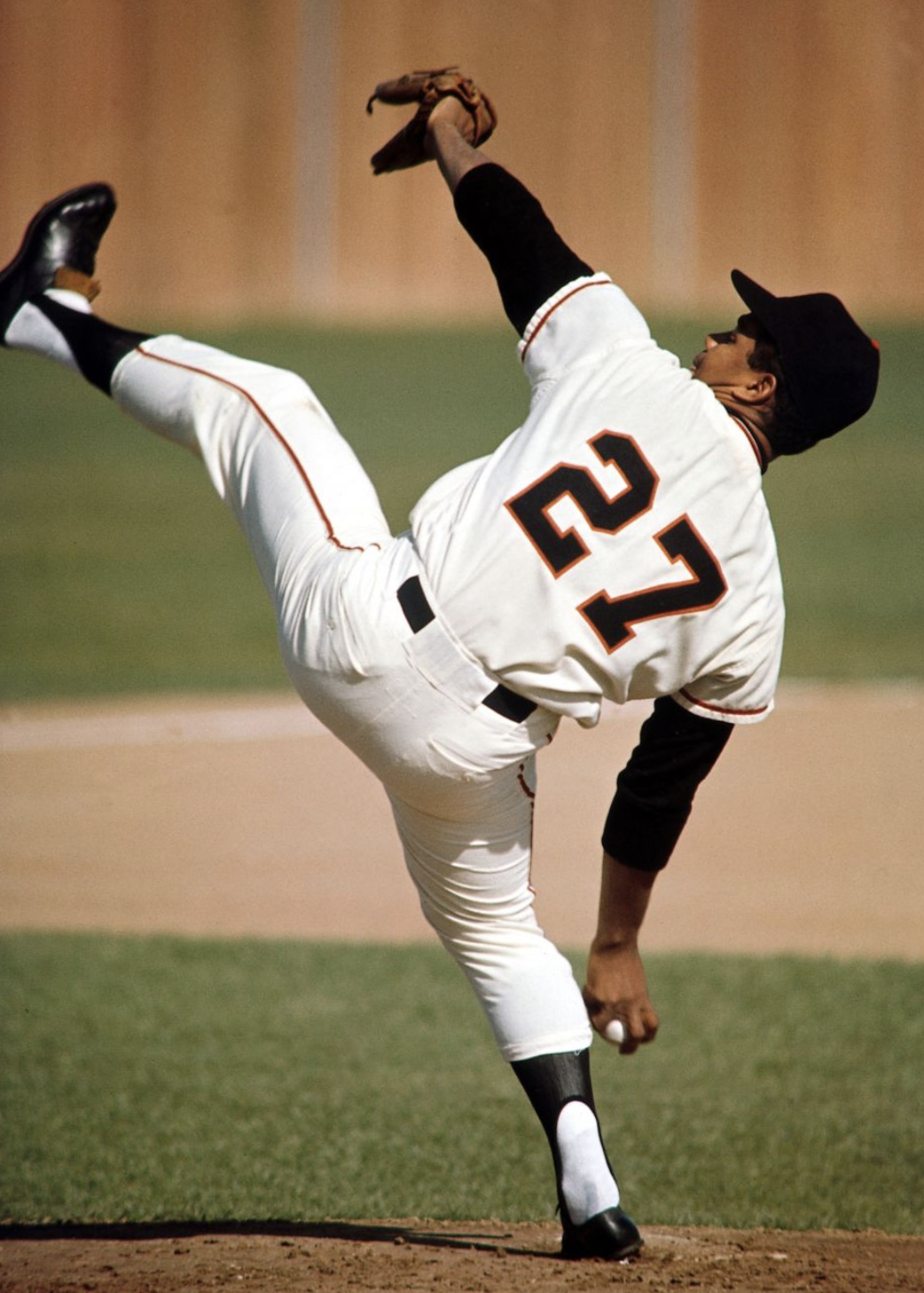
But they were not efficient. They were terrible for holding runners on base, and that could cost a base and a run.
Now, when I watch baseball, I see a limited variation on a pitching theme, which is to move through the pitching motion as efficiently and quickly as possible to get the ball to the plate. That is the only way to try to thwart the speed of the modern base runner, who is, in his own right coached to observe every unique aspect of the move of the pitcher to the plate so that he, too, might gain an advantage.
The game is less diverse (even as the ethnic diversity of players has grown). In addition, efficiency dictates developing things like spin rate, which places unique strains on a pitcher’s arm, leading to more injuries, and the need to limit pitchers to certain counts. And that, has increased the demand for an ever more specialized relief pitcher roster.
On the hitting side, looking for a game-changing hit replaces approaches that carefully manufacture runs. Batting is now a high-stakes, hit or miss (no pun intended) endeavor that raises the stakes for an at-bat. Batters, like pitchers, are coached on stances and launch angles that remove the uniqueness of a hitter’s approach and create greater uniformity.
Are these bad things?
Taking Ellul to a baseball game might reveal his recognition that technique is not bad, per se. But he would probably also want to talk about what we lose in the bargain. What does it mean, for example, that Little League coaches drill kids using standardized coaching approaches that are designed to raise the quality of play, but might also rob a child of the ability to just get out there and play the game?
What does it mean that players are increasingly treated as puzzle pieces that owners and general managers spend hours scouting to find the perfect fit—Ellul’s one best way? Does it change the focus of the game from hometown pride to a race to see who can buy and assemble the most prodigious means (players)?
Ellul might ask: Is baseball more human for its participants at all levels?
I can’t answer that question for sure. There is no doubt that the joy on the faces of players after the last out of a key game suggests that baseball is still a very human endeavor, and that technique has not robbed us of the sheer joy of seeing the game played on green grass under the blue sky of a perfect summer day.
But I also listen to parents who sign their kids up to play, as well as the kids themselves. They are hoping for a payoff that goes way beyond having fun together—cheering the hit or the strikeout. They view baseball as a means to a different end than winning: to make the traveling team, to get a scholarship, to make it big.
Maybe those kinds of dreams were always there (I had my own for many years), but technique does shift our gaze from baseball as a pastime, to baseball as a deadly serious undertaking (at all levels) in which the stakes are high and the search for the “one best way” is the currency.

