Supporting Volunteers in Community-Based Programming


Local jurisdictions and non-profit organizations working in social and community services routinely use and benefit from volunteers’ work. From short-term (or even one-off) service projects sponsored by cities to ongoing service delivery, volunteers extend the organization’s efforts and allow for deeper outreach while keeping costs down.

Traditionally, volunteers may have provided “manual” labor—packaging, delivering, distributing, etc. In recent years, volunteers have been taking on more sophisticated roles—some using technical specialties they bring from careers.  

With an aging but healthy population, the potential pool of volunteers in the U.S. has grown. Also, more universities and colleges explicitly require some form of community service as part of degree completion or value it through transcript notations or other types of credentialing.

While these factors offer great resources to agencies that benefit from volunteers, many may not provide the support needed to maximize volunteers’ contributions, reduce unnecessary turnover, and establish themselves as a “go-to” organization that can recruit and keep the highest quality volunteers.

I offer here three principles and seven practices that can help get the most out of volunteers and create a culture that assures they benefit the organization’s goals. A quick Google search suggests that others have written about these issues, but hopefully, what I offer here is concise and actionable. 

Please feel free to add to or correct the items below.

Three Principles

1. Volunteers are employees – It is easy to separate volunteers from regular staff because they are not part of the “career” pool of workers, are not paid, and, typically, work only part-time. While their roles are different from paid staff, it is critical to view them as staff for human resource management purposes.

This principle means that volunteers need everything staff does—from clear position descriptions, to onboarding, evaluations, recognition, and professional development/training. The complexity of the volunteer work will alter the amount of time an organization needs to commit to any one of these things, but organizations should consider them.

Of most importance is absolute clarity of the role they play in the organization, to whom they report, and to whom they can go if they have questions or needs. Even fairly routine tasks can introduce issues for which volunteers will need support.

2. Volunteers are not employees – Despite the preceding, it also essential to hold the opposite reality that volunteers are not employees in many ways: in things like remuneration, for example, which signal the critical nature of staff to an organization. Employees have required work hours, are expected to communicate absences in a timely way, are sanctioned for inappropriate behavior in defined ways, and typically have recourse to legal and other systems if they feel the organization is treating them improperly.  

I do not want to suggest that organizations should not lay out clear expectations and provide similar protections to volunteers. Even though most employees these days are employed “at-will” like volunteers, the latter are typically not held to the same standards, and sanctions (beyond just asking them not to come back) are lacking.  

This reality has significant consequences: quality control of volunteer work may be more challenging; communication expectations may be more challenging to reinforce, and separation more sudden and unplanned.

3. Volunteers are the face of your organization – Whatever their status, volunteers are the face of your organization, just like paid staff. This is both an opportunity and a risk. It is an opportunity because committed volunteers are community ambassadors who can invite their friends and neighbors to participate in your organization’s efforts. That can lead to increased financial support, provide expanded paid staff and volunteer recruitment pools, and help spread goodwill about the work throughout the community.

The risk is that volunteers will not represent the organization well to clients or inappropriately speak on behalf of the organization to outside groups. For community-facing volunteers, the risks are most significant. Community members who receive services from the organization do not distinguish between the “official” staff of the organization and volunteers—the person in front of them is the organization. Organizational leaders need to pay attention to the representational risks associated with volunteerism.

With these basic principles in mind, I would suggest that there are seven practices necessary to enhance your volunteers’ work.

Practices

1. Clear articulation of why the organization needs volunteers and their roles

Every volunteer should understand how an organization can use their help and what the organization expects of all volunteers. Organizations should announce not just volunteer opportunities on their websites and printed materials; they should also define the distinctive role volunteers play and why they are essential. This information should communicate the organization’s high expectations for volunteers, creating a sense of seriousness about the role.

2. Clear job descriptions—including “representational” role

In addition to a general description of volunteer roles within the organization, every volunteer position type requires at least a brief position description laying out needed competencies, critical tasks, and job requirements (including physical ones). Job descriptions are a great place to lay out the “representational” role of the position and what this means for volunteer behavior.

3. Adequate onboarding of new volunteers

Onboarding includes an introduction to the work environment, I.T. issues (as relevant), work hours and expectations, organizational structure and volunteers’ place within it, and principles and practices of conflict resolution (among volunteers or between volunteers and staff).

4. Quality initial training with monitoring to catch ongoing or refresher training needs

The amount of initial training and frequency of refresher or re-training is a function of the complexity of the work, but laying out clear job steps, how-tos, things to avoid, and minimal requirements should be the norm. Given that volunteers rarely come to an organization in a block, this training may have both a virtual (asynchronous) component that goes through the basics; and an in-person part that acts to clarify issues and answer questions arising from the virtual training.

5. Stated communication protocols and pro-active and responsive communication from leadership

Communication protocols include what volunteers should do and commitments the organization makes to volunteers. Of most importance is laying out expectations of what volunteers are to do if they cannot, for whatever reason, fulfill their volunteer commitments. 

Also, staff should commit to regular (weekly or more frequently?) communication to all volunteers and ensure that all volunteer questions receive timely responses. There is no better way to keep volunteers connected to the organization’s ongoing successes and challenges than via regular updates.  

6. Volunteer assessments and planned recognitions

Volunteers should know that they will receive and can request feedback on their work. Assessment and feedback should be routine tasks of the staff who work with volunteers, and there should be regular times to celebrate and provide recognition to volunteers. These can be spontaneous or planned. Given that volunteers do not receive salaries, feedback, and recognition become THE KEY ways to remunerate them for their work. It is critical.

7. Ongoing recruitment plans

Because volunteers are not employees (see above), they can and do leave their posts in unpredictable ways. Many start with high expectations for themselves only to find that life intervenes, and the volunteer role (because it is not a job), has to end. Be ready for this—it can happen quickly and can be extremely frustrating, especially if some time-sensitive work goes undone because of their departure or failure to show up.

Use volunteers to recruit volunteers. Often people will volunteer in response to some great need that they have learned about. Initial responders may be the activists who “want to do something.” They are genuine in their desire to help, but if another “big need” comes along, they may be one of the first to leave to pursue it. However, because they are active and their enthusiasm is often contagious, “first responders” may be a great source of recruitment of others who may stick around longer. 

Volunteerism is a visible sign of the coherence of a community. There are vast untapped pools of highly talented and committed people who would benefit from volunteering, and organizations can extend their impact by finding and employing them.  

One final note, it is not unusual for volunteer “offer” to outstrip the need for volunteers. It is crucial to capture the interest and communicate to those waiting for an opportunity regularly. Those offering to volunteer need to understand where they are in the “queue” of potential volunteers. Maintaining contact with them can enable organizations to build goodwill and make sure that the pool remains strong if needs arise in a short time.

The Language of Anxiety

I did not know until years later, but at one point, my father’s anxiety was so overwhelming that he broke out in hives, left his job, and nearly was committed to a hospital.

That piece of information hit me when I was about 20 after I had started plumbing the depths of my own dark holes (that’s how I always saw them), that landed me in the emergency room with stomach pains so severe I thought I had to have some cancer or worse (and of course that made the hole even more profound).

And then, without getting too specific about it, I finally, well into my 40s, began to develop some coping mechanisms to deal with the whole nasty knot when I started to walk with my daughter through a period that ended up far worse than mine or my dad’s.

(Thankfully, she has moved on to a better place too, as we learned together how to tame the raging confusion—learning to go to our “rational place.”)

Like a lot of things—the constant ringing in my ears, or being able to do certain things with my left hand but incapable of doing them with my right and vice versatility—I assumed everyone had the same experience of the world as me.

I mean, I assumed that until I got to know my wife and realized that she simply did not experience the world like me. She let each day come, and each day go and wasted no time using those crazy tics that I used (secretly) to try to bring some semblance of control to those out-of-control places where I seemed to spend far too much time each day. No, she simply did not know about dark holes. Of course, like most people, she had moments when she was anxious—but those were the usual things that come with some big unknown: childbirth, marriage, or moving across the world.

Knowing others did not necessarily experience the (near and far) future as an inevitable place of reckoning did not make me feel lonely or inadequate or anything like that. But it did make me feel like I was going to have to live with this thing and that I was going to have to try to figure out how to think my way through it.

I say “think my way through it” because from an early age, and perhaps intuitively, I developed ways to just “step outside” sometimes and see my worries (as I thought of them) for what they were: vaporous substances that stood up to no rational scrutiny at all.

The problem with anxiety, though, is that, sometimes, by the time you realize what has seized you and driven you to chew off those fingernails to a dangerous and bloody level, clearing the vapor could take some time and lots of effort–days in some cases. And that was confusing.

The breakthrough I have made in recent years is to learn to identify the “hole” before I start slipping too far into it. That means a shorter “path” to walk back over to get to the origins of the most recent descent.

I know, I am mixing metaphors—anxiety as a path, anxiety as vapor, anxiety as a hole… But I have had to come up with a bunch of different linguistic handles to explain it to myself. So I think of each round of anxiety as having its own “foundation myth”—that event or experience that triggers a simple fear. Each series has its “force multipliers” the extra bad news that gets loaded onto a simple fear to make it seem doubly bad and dangerous. Each round has a “descent”—steep or less so—into some sort of dark space. And each has that thing, that “cataclysm,” waiting at the end that is always ill-defined but sure to be disastrous for me or someone I love.

(Quite frankly, I rarely experience that cataclysm as something that will happen to me; it is something that will happen to someone I love, and I know the pain of the loss will crush me.)

So, yeah, I have had to find my language to talk to myself about the whole process, and getting out has its word too—it is a “path.” It is a path I have walk back on—backtrack—to move past the “force multipliers” and discover that simple fear—that “foundation myth”—that always sits at the beginning, waiting for my return. And when I get there, I always feel the same: “So that’s what this is all about… are you kidding me?”

The “paths” have grown shorter in these past few years. Sometimes I don’t even get to the “descent” anymore, and I see fewer looming “cataclysms.” For that, I am thankful. I can “step outside“ more efficiently, and sometimes I see the “foundation myth” almost immediately, and that helps me get to my “rational place” so I can move out of my “hole” and face the challenges of another day.

COVID-19: What has brought us here, where do we go next? (July 2020)

Mid-July 2020 and we, in the United States, find ourselves in a difficult place vis-a-vis the virus. It is a challenging moment and past time to think about what brought us here and what we need to do right now to get out of the worst of it and move forward.


I offer the following as a way to get us to the place where we can use the tools of disease surveillance to manage the virus until longer-term solutions—therapeutics and vaccines—can be put into practice. Implementation of traditional surveillance tools will enable schools and universities to move to in-person instruction, allow many businesses to offer services, and give people confidence in being in these spaces.


All of these things—schools and universities in-person and businesses offering services—will NOT be done according to the standards of pre-COVID life.


They will not.


However, with appropriate disease surveillance, we can start to achieve lifestyles that are, psychologically and socially, healthier than the current situation.


But, to arrive at a place where the traditional tools of disease surveillance for infectious diseases—testing, tracing, isolating, and quarantining—can work is going to require several things and, most importantly 1) clarity about how we have gotten here and what we need to avoid going forward, and 2) the key behaviors we all need to adopt now AND going forward until therapeutics and/or vaccines are broadly available.


The second point is VERY important: our behaviors need to transcend any understanding that there are ones that are appropriate for when we are “open” and others that are appropriate when we are “closed”. Indeed, it is clear to me that the concepts of “open” or “closed” (or shutdown) have become a hindrance to having a rational conversation about the behaviors necessary to get us through the crisis until treatments or a vaccine are widely available.


We need a clear set of behaviors that hold no matter the level of openness; that hold whether schools are in-person or not; and that hold whether businesses are providing goods and services or not. Why? Because these are the behaviors we need to “live with COVID-19” as the infectious entity it is.


So, what has brought us here? I would suggest six things, some of which we do not control and most of which we do.


  1. SARS CoV-2 (the virus that causes COVID-19) is a novel coronavirus. We know a lot about other respiratory viruses, and coronaviruses have been around for a long time. But THIS virus is new. It is more infectious and more deadly than other coronaviruses and we know little about its long-term impacts on those who are infected but survive. We are still learning about how it is transmitted (though our knowledge has grown quickly). Many of the other points below flow from this virus’ “novelness” and our lack of experience in dealing with such an efficiently spread disease like it.


  1. There is a great deal of misunderstanding about how science works. This is something we could control if we wanted to. Science does not advance with statements of absolute certainty—especially when it comes to novel infectious agents. Science advances with evidence built, hypotheses proffered, and corrections made over time. Many of us are watching the “art of science” practiced in public for the first time and while science speaks in “evidence for” and “probable outcomes”, newspapers (and politicians—see below) speak in headlines and an appearance of certainty and confidence that scientists find horrifying.


  1. We lack humility. I say this in two ways: we lack humility about the need to learn more before we speak in any certain terms about this virus; and we lack humility about how we use information to score points in arguments. We need to step back and acknowledge that there is much we do not know and share our learnings in careful terms, ready always to self-correct, acknowledge errors, and move on to make better decisions based on the weight of evidence.


  1. We have politicized EVERY element of this virus and our response. From its origin, to treatments, to testing, to preventive measures such as the wearing of masks, it is hard to talk about any part of this that has not been mobilized to denigrate rivals or advance narrow political ends. This demonstrates both a lack of humility AND a willful misunderstanding of science (or it is pure cynicism). From the president, who suggests scientists are lying to us, to local officials who call for “reopening” so we don’t “fall behind” the next county over, our leaders have too often used the virus to their ends, not ours. This has given the impression to normal folks that EVERY recommended behavior is contested and that there is no evidence, no truth, no clear path.


  1. We have created unnecessary binary thinking. This is the main tool of the politicization noted above. We have created false dichotomies: health versus economy, or death of a few versus mild illness for everyone else, and the list goes on. These binaries have hijacked our discourse, created confusion, and have kept us from advancing a more nuanced understandings of how we might move forward.


  1. We have been extremely impatient. Did I mention that this is a NOVEL coronavirus? Did we forget that it is has been infectious to humans for under 8 months? Despite this, we want answers, we want resumption of a normal life, we want normalcy to return. NOW! Well, none of that is going to happen quickly. None of it. And so, we must prepare for a long struggle and rediscover the value of patience and waiting (traits that many people in the world consider virtues).


This is how we got here and the negative synergies in the foregoing list describe why we feel helpless and angry, and unable to find a way through. But there is a way. It is not an easy one, but it is one that takes all of the foregoing and turns it around in three clear steps.  

It is what I think of as the “Steps to Living with COVID-19”


First, we need to follow some very basic guidelines that have already been established AND expect them to be updated. Remember how science advances: it learns, it updates, it corrects. If every changed or updated recommendation is met with derision and hostility, if every correction is viewed as evidence of malintent, we cannot move forward. We need to see changes to recommendations as evidence that we are learning to overcome this disease and embrace them.


Second, and this is one of those recommendations, we need to wear masks indoors at all times when others are present, except at home. Period.


We also need to wear masks outside when in crowds or in any other context in which six feet cannot be maintained between us and others.


Third, we need to avoid what the Japanese have termed the three C’s. We need to avoid CLOSED spaces with poor ventilation. And since we typically do not know about the ventilation in closed spaces, we should be careful in all closed (tight, low ceiling, narrow, confined, etc.) spaces if possible.


We need to avoid CROWDED places with many people nearby. This means indoors and outdoors but especially indoors and especially for periods longer than an hour. Outdoor crowded spaces? See masks above. Indoor crowded spaces? Avoid them with or without a mask.


We need to avoid CLOSE CONTACT—that is, close-range encounters with people. We must use masks but even with them, we should avoid prolonged conversations close to people (<6 feet).


We should specifically avoid situations where all three of the “Cs” are present because those are the situations of superspread events.


Many other details could be hashed out in any of these but if you take them as a hierarchy—masks first and then the three C’s—they will guide much of your behavior.


If we do these things, we will drive transmission down to a point that we will be able to catch the few cases that occur DESPITE these behaviors. That’s right, none of these individually or taken together reduce risk to zero. We are facing a highly efficient virus that can spread despite our best efforts. 


But, if we do these things, we can manage the cases that slip through, with lowered mortality, with schools and universities having in-person instruction, and with local businesses offering goods and services to clients. All of these will be modified but our lives will begin to feel somewhat normal and we can begin to regain the full social, cultural, and economic health we desire.


Diversity as Telos / Diversity as a Means to Telos

Telos is a Greek word that means “ends”, specifically “ultimate” ends—what in French is “raison d’être” or the reason for a thing, why it exists.

The first enormous truth flowing from our civilization is that, today, everything has become “means.” There are no longer “ends.” We no longer know towards what we are headed.  We have lost our collective goals.  We dispose of enormous means, and we put into action prodigious machines to reach nowhere… Humanity is moving ahead at astronomical speeds towards nothing. (Ellul, J. (1948). Présence au monde moderne. Geneva, Editions Roulet. Pages 62 and 66—my translation)

Too rarely, in our public discussions, do we focus on the true ends of our actions.  We put forth policies often without clear reference to the kinds of ends we are trying to achieve.  For example, our industrial food system, as Michael Pollan has argued in The Omnivore’s Dilemma, can produce prodigious amounts of food commodity, but often without reference to the true end of food production: human health and well being.

Because this “human” end is not articulated, in reality, food production (food commodity production) has come to be about very different ends: tonnage produced, commodity value, commodity as a contribution to GDP, commodity as a factor in trade balances, etc.

His analysis seems to confirm what Ellul argued: we have lost sight of the ends we want to achieve as a society concerning food production.

This failure to articulate clear ends is common in much of our public discourse. 

I argue here that diversity—whether in biological systems or political representation—is an end we should articulate and then set out to achieve.

But, in addition to being an end in itself, diversity, especially in human decision making and policy formation, can also be a means to help us focus or refocus our attention on important ends related to human thriving.

Diversity as Telos

Mono-cultures are, perhaps, efficient, but they are brittle.  Technocracy—a kind of decision making monoculture that relies on narrow technical knowledge—may also yield more efficient decision making structures but fail to preserve key human values such as justice or inclusion.  

We see this, again, in modern food systems that overproduce certain commodities, but invariably require more toxic chemicals to maintain productivity.  

The overproduction itself can lead to disastrous health outcomes when, for example, the by-products of corn production are converted to products like high fructose corn syrup.  Highly efficient systems can lead to nefarious ends and can be hard to sustain simply because they are divorced from the complexity which is our world.

In the same way, human decision-making systems can and often are monocultures.  I have experienced this myself.  When I led a non-profit response to Hurricane Katrina, the “system” in which I operated suggested certain voices (leadership) should be at the table to help formulate our organizational response.  However, those voices, as expert as they were, were wholly disconnected from the people most affected by the disaster in New Orleans—African Americans. 

While it was less efficient to back away from the pre-determined system of decision making and invite a more diverse set of voices and experiences around the table, doing so enabled us to produce a more thoughtful and adapted response that was built upon the lived experience of people who had experienced exclusionary policies related to housing, jobs, and medical care (all relevant issues post-disaster).  

This is the first reason I believe we need to list diversity in decision-making systems, like our local school board, as a desired end in itself: it will help us to create a more robust and resilient (school) system that eschews mere technical solutions to consider a broader set of factors in decision making.

The second reason I believe we need to list diversity as a desired end is because of the unique history of exclusion of voices and experiences within the US context.  Though some writers claiming the “conservative” mantle (Patrick Buchanan comes to mind) seem to argue that history is for the victors and folks just need to move on and accept the status quo that history has established, there are many others who understand history as having a long arc of impact that constrains freedom for many people across many generations; but also that “history” is not buried in the past in some final way.

The former is argued most eloquently by Louis Gates Jr in his book Stoney is the Road and by Ibram X. Kendi in Stamped from the Beginning. What is striking in both books is the argument with carefully researched evidence, that exclusion of black people in this nation was deliberate, planned, was reinforced within legal structures, and, especially in Kendi, was done to maintain the benefits those in power (and white) had.

It is impossible to read either book without acknowledging that “history did not just happen” to black people but that exclusionary practices were carefully “curated” to assure that blacks would not be able to participate as full members of American society.

In other words, for deliberate reasons, practiced over many generations in this country, we have systematically excluded the perspectives, understandings, and lived realities of many of our black brothers and sisters. 

The other argument—that history is not buried—is on display all around us and reminds us that it is not just black people who have “a history” in this nation but that other people of color or simply “othered” people face exclusion every day.  If you are Mexican American—as are my grandchildren—you are suspected of not being fully American and, perhaps even “illegal”.  If you are Chinese American, you are lumped with the “bringers of plague” and told that you are part of a wave bent on destroying our country.

The point is, we have many historical and contemporary means to exclude the voices of people and it is only in recognizing this exclusion and declaring our intent to include and diversify the voices to which we listen that we can grow the more responsive and resilient society we say we want. This is why, I believe, we must declare diversity to be an end—a telos. 

A final note on diversity as telos: when I say it should be an “end” I mean that we should explicitly talk about the need for diverse perspectives when we make decisions about whom to elect as leaders and whom to put forward to serve as appointees to various advisory structures.  We should encourage electors to consider diversity as a factor in their decision making, and we should encourage people with diverse perspectives given ethnicity, race, or heritage to run for office and support them to succeed. 

Diversity as a Means to Telos

In addition to diversity being an end in itself, I believe that diversity has the potential to help us focus on other important ends we seek because it opens the door to different questions and different perspectives on what matters.  Here, I should be clear, I am speaking specifically about decision making or policy-making that affects community members—schools, policing, recreational programs, and others.

In my field of intercultural learning, a key pedagogical outcome is the ability to appreciate and analyze how I “make meaning” and consider how others “make meaning”.  The point is not to encourage an abandonment or denigration of “my way” or to argue that how others make meaning is desirable (I say this because I hear some voices who seem to suggest that modern liberal education is about forcing people to abandon their values—that is not the point).

A key concept in intercultural learning is “cultural humility” (developed by Jann Murray Garcia and Melanie Tervalon in the health care field) which positions each person as a learner concerning the “meaning-making” in the other.  We understand, because we live in a globally interconnected world, that people DO make meaning differently, but cultural humility places us on a quest to examine ourselves and be curious about others.  

Cultural humility requires suspending judgment about the actions and practices of others while engaging in perspective-taking that tries to examine the world through that elusive lens of the other. 

In addition to perspective-taking, cultural humility pushes us to ask how systems of which we are a part, exclude voices so that those voices might be considered and valued.

I share the foregoing as a reminder—the way I make meaning, the things that I value, the way that I set priorities—is not the only, or, in a given situation, even the most useful way of dealing with contemporary challenges.  An interesting example in this time of COVID-19 concerns whether a highly individualistic way of viewing my place in society is well adapted to the kinds of collective responses (wearing masks, testing/tracing/isolation/quarantining) that are necessary to stem the virus’ spread. 

And so, having diverse perspectives when policies are established opens the door not merely to a richer discussion of options, but can also help surface different questions, different values about what matters, and about whose needs are, or are not being met.  In this sense, diversity makes it possible to consider other ends that would not even be brought forward in its absence.  Diversity is a means to other ultimate ends. 

I support diversity, not as an abstract “feel good” concept but as an end towards which we should strive.  I do this because I believe it creates more resilient decision making.  I do it because we have, for too long in this country, excluded too many voices—and we are poorer for it.  But I also support diversity because it opens the door to consider in new and different ways the collective ends to which we should be working. Diversity is a means to new ends. 

Taught to Fear

The Soviet Union’s goal is to plant its flag in Independence Square in Philadelphia on July 4, 1976

(Radio evangelist Jack Van Impe c 1970)

I woke last night in fear.  York, PA.  Sometime in the late 1960s…

Taught to fear.

But wait, long before that… we were always afraid and our deepest fears concerned that vaguely understood world straddling threat from the east: communism. I heard it on the radio every Sunday on the drive to church.  Godless communism would destroy us.  At night I cried in my bed begging Jesus to save me from the coming fire that would engulf the world.

I never feared my dad.  I never feared my mom.  Ours was a peaceful, loving home.

But communism lurked at the door and would be our doom.  This is why my brother and cousins shipped off to Viet Nam. And the evidence of its advance was in the news, not just in “Indo-China”, but in Africa, at the wall in Germany, and, in 1968 in the invasion of Czechoslovakia.  We studied scripture.  We were taught the signs: signs of an impending war in the Middle East that would sweep everything away.  But before that the utter destruction of our homes.  This was the narrative that slept with me in many years of endless night.

But communism was not just out there, it was here, in America and we knew its face.  It was Martin Luther King, the Black Panthers, Angela Davis, and other subversives like Tommy Smith and John Carlos.  Their hatred of America was ill-defined and their links to communism vague.  It was all very confusing but, at least in my home, I was taught to fear them as the vanguard of forces that would sweep us away.  And if Europe had its Prague, the US had its Watts, its Detroit, and all its other burning cities.  It was all of a piece and we were taught to fear it.

York, PA is not a suppressed memory, it is one that just somehow faded for a while.  But last night it visited with a reminder that what we are taught–especially what we are taught via defining and emotive narratives–stays with us for a lifetime.

I breathed in the recollection that was anchored where the affective lessons learned are stored…

I am in a car with my pastor (can’t remember why) returning from some trip and we are in “downtown York”:  a place that had the same signification as “the 7th Ward” in Lancaster near where I live. A place where brown and black people subsist.  A place of violence.

We pull up to a red-light, windows down on a summer day.  A car pulls up next to us.  I see him.  A boy my age.  He’s black.  I smile, he smiles.  I wave.

“Don’t you dare do that!” says my pastor as he quickly rolls up the window and casts a stern eye my way.

“They will be out of that car so fast and in this one, you won’t know what happened.”

That is all.  I drop my eyes.  I wonder why they would do that.  But I am afraid.

And in the dark last night, I realize that I was taught to fear–taught to fear black people.  I was taught to see them as an existential threat to my life.

James Baldwin told his nephew that white people had to believe “for innumerable reasons” that black men were inferior to white men.  And though many of them knew better, to act on that knowledge represented a danger.  The danger was the fear that they would lose their identity.

I talk to my sister–15 years my elder–from time to time. We ponder our very strange upbringing and we return again and again to the fears of so many things that still lurk in our minds and hearts.  We have accepted that we will go to our graves with these fears.

We also realize that we have spent the better part of our adult lives unlearning and unlearning and unlearning the things we were taught to fear.

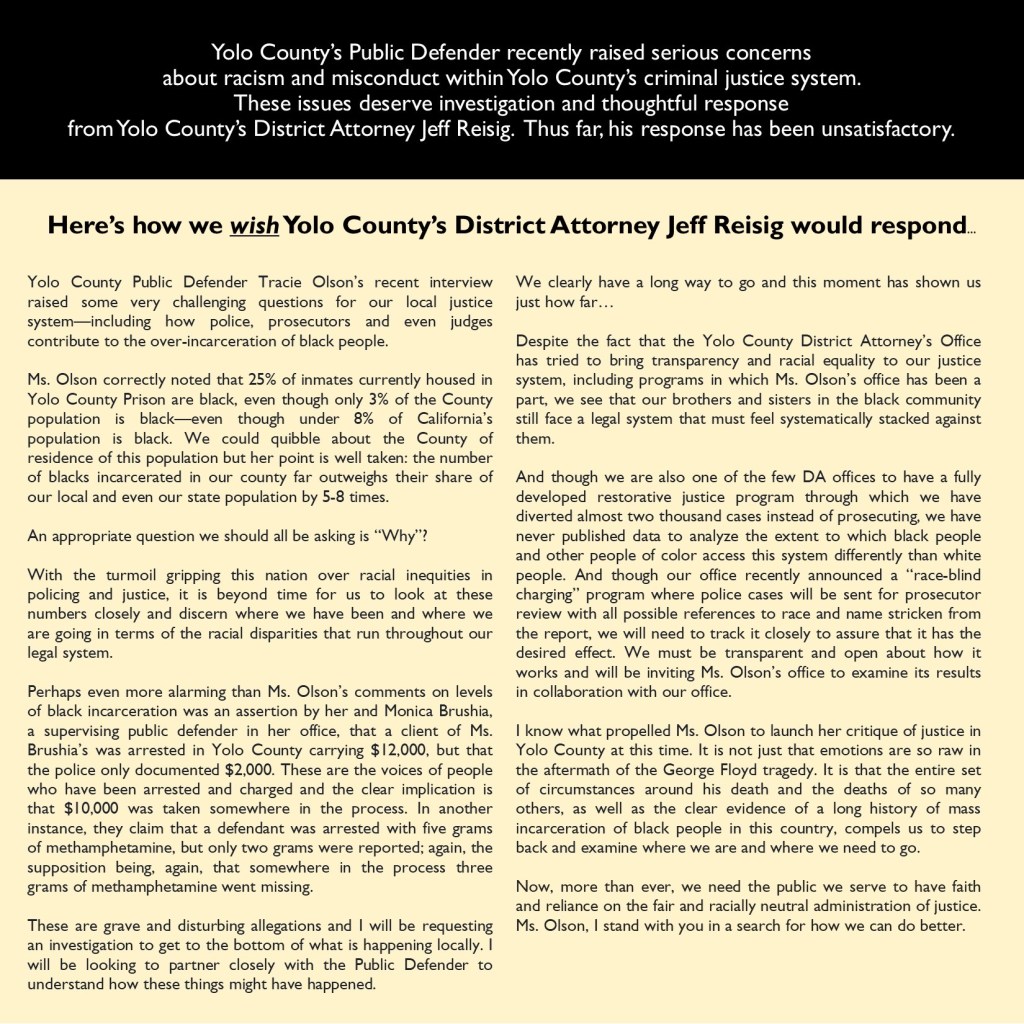
What we wish District Attorney Jeff Reisig had written in response to Public Defender Tracie Olson’s interview on racial disparities in imprisonment in Yolo County

It’s Juneteenth.  And clearly, there is a lot more freedom to be fought for in our community.

Below is a “response” that I wrote.  It is the response I believe Yolo County District Attorney Jeff Reisig should have given to discussions about racial inequality in our county’s legal system.  Many have stepped up spontaneously to support it.  You will find their names here as well.

Unfortunately, here is the response DA Reisig actually gave.

He was responding to these comments by Yolo County Public Defender Tracie Olson.

The Davis Enterprise will be publishing this alternate response in this Sunday’s issue. I look forward to collaborating with Ms. Olson, others currently working within our local legal system, community members, and my former colleagues in local government to undertake the analysis, investigations, reporting and oversight outlined in the letter.  I hope you will join us.


Al Rojas Greg Brucker Margaret Ong
Alina Lusebrink Hazel Watson Marilyn L. Perry
Alina Stenlund Hoang-Van Nguyen Mark Aulman
Ann Block Jake Whitaker Mark Simon
Anoosh Jorjorian Jeannette Hogan Marne McGuinness
Antonio De Loera-Brust Jen Higley-Chapman Marsha Carlton
Bapu Vaitla Jennifer Rindahl Martha Teeter
Ben Wormeli Jewel Payne Monica Nolte
Betsy Elzufon Joanna Friesner Morgan Poindexter
Caitlin French Joanne Haller Nan Rowan
Cathy Forkas Jonathon Howard Natalia Deeb-Sossa
Christi-Anne Sokolewicz. Juan Tamayo Natalie Wormeli
Claire Goldstein Karen Dodds Gossard NJ Mvondo
Conner Gorman Karen Friis Nora Oldwin
Dave Griffin Karen Hamilton Peggy Bernardy
David Campos Kate Mellon-Anibaba Rachel Beck
David Greenwald Larry Guenther Rev. Dr. Brandon Austin
David Lichtenhan Lee Bartholomew Robb Davis
Dean Johannsson Linda & Stu Brensick Robin Rainwater
Denise Hoffner Linda Brant Roy Kaplan
Desiree Rojas Linda Deos Ryan Davis
Don Saylor Linda Hendricks Ryan Wessells
Elizabeth Fulmer Linda S Fitz Gibbon Sean Raycraft
Elizabeth Lasensky Lindsay Wilson Terry Sharif Amlani
Elizabeth Stevens Lorna Carriveau Shelly Gilbride
Emily Henderson Luanna Villanueva Steven Schmidt
Emily Hill Lucas Frerichs Teresa Geimer.
Emily March M E Gladis Tracy Tomasky
Francesca Wright Cecilia Escamilla-Greenwald Zohar Tal

Culture and Coronavirus: How Values Shape our Response to the Pandemic

Culture is…

… the set of attitudes, values, beliefs, and behaviors shared by a group of people, but different for each individual, communicated from one generation to the next. While the norms of any culture should be relevant to all the people within that culture, it is also true that those norms will be relevant in different degrees for different people… Our failure in the past to recognize the existence of individual differences in constructs and concepts of culture has undoubtedly aided in the formation and maintenance of stereotypes.

Matsumoto 1996

Culture is a fuzzy set of basic assumptions and values, orientations to life, beliefs, policies, procedures and behavioral conventions that are shared by a group of people, and that influence (but do not determine) each member’s behavior and his/her interpretations of the ‘meaning’ of other people’s behavior.

Spencer-Oatey 2008:(1)

Introduction

Geert and Gert Hofstede’s Cultures and Organizations: Software of the Mind provides a useful background on the genesis and meaning of culture. The “software” in question is their description of how culture acts as mental programming to enable us to make meaning in the world. Their contribution to the field of cultural analysis is their description of several domains or dimensions along which cultures differ. These “continuums” of cultural values include individualism versus collectivism, high power distance versus low distance (about equality), and high uncertainty avoidance versus low uncertainty avoidance (looking at ritual and conformity), to name a few.

Their work has been followed by others who have expounded upon or added to these dimensions. The entire literature has been used by business leaders (among others) to understand and deal with the challenges and conflicts that occur as their companies expand across national and cultural “boundaries”.

There is an appropriate caution about stereotyping cultures based on their categories, and, as the Matsumoto quote on culture notes, people within a given culture do not hold to or manifest values in the same way. At the same time the dimensions are useful for making generalizations and engaging in analysis of why people respond to similar situations in such different ways.

In the face of a potentially culture-changing event like the COVID-19 pandemic, I have been returning to the Hofstedes’ (and others’) writing to analyze my reactions not just to the pandemic but to the restrictions that have been put into place to combat it. Comparing different countries’ responses has been fascinating and provides some insight into how different cultural values form a response/reaction.

It is easy in our highly polarized climate in the US to ascribe all such responses and reactions to a person’s political ideology. While I think ideology (political tribalism), because of its role in forming identity, does play a role in the responses we observe, I believe that a deeper look into how culture (which itself is part of any individual’s identity) conditions our responses and helps us make meaning in this time is necessary.

In this piece I hope to examine just one dimension of culture—the so-called individualism/collectivism continuum and how it shows up in the midst of this unique crisis—this rolling natural disaster that seems to remain permanently in its acute phase.

Individualism versus Collectivism

Individualism as defined by Hofstede does not refer to the image of the rugged individualist, the lone frontiersman, or the lonely superhero of American mythology. Rather, the concepts of individualism and collectivism are about what we might call “span of responsibility” and “breadth of loyalty”.

In cultures that value individualism, the social framework is very loosely knit and individuals are responsible for themselves and their immediate family. Loyalty is narrow and concerns for the wellbeing of others is circumscribed by the people closest to us (biologically).

In collectivist cultures the social framework is more tightly knit with the expectation that one must be loyal to a larger “in-group”. In exchange for loyalty, the individual can expect protection and support from the group.

One Explanation for the Evolution of Individualism

One common American myth is that individualism is a result of the kind of people who migrated to this continent from Europe. In this narrative, these people were seeking freedom from tyranny—whether that tyranny was political or religious. This narrative goes on to describe the necessity of individualism (as defined here) due to the nature of frontier living; the “taming of a wilderness” carried out by small nuclear families, with no support from the state or others.

While such narratives are powerful, their explanatory power (and fundamental accuracy) should be questioned. I would argue that a more powerful force that has helped create the individualism that dominates American cultural values is the pursuit of ever more efficient market mechanisms to provide for people’s needs.

I am not talking here about individualized consumerism, a trait that has certainly emerged in America and been expanded by the ability to consume effortlessly. Well before those particular market forces we had the development of insurance markets that, while being collective actions by definition (the creation of broad risk pools), changed our need for reliance on broader community groups.

While the barn raising and social insurance guarantees among such groups as the Amish or Hutterites might be lauded by some, they represent an aberration. Nearly all the essential protections that Americans need—homeowners insurance, crop insurance, auto insurance, and, importantly, life insurance—are transacted in an impersonal market that obviates the need for a broader social group to provide essential protections.

In my research on the causes and “uses” of human migration in West Africa, I stumbled across the many ways that people in that marginal environment (frequent and prolonged droughts) manage risk. Due to poverty and broadly co-varying risks, insurance markets simply have never developed in that part of the world. Rather, the collectivist culture I observed there arose, undoubtedly, from the exigencies of the natural environment. My research cataloged the many ways people built obligations towards themselves within the social networks in which they invested a great deal of time and energy. Loyalty to a broad group of individuals in that environment could be the difference between life and death.

Individualism: A Personal Understanding

The point in this analysis is that our individualism has arisen in the context of historical determinants related to a pursuit of market efficiency. There is nothing evil about this evolution but it does help explain (it does not FULLY explain) where we have arrived in terms of this particular value.

Like any cultural value, it is not immutable, nor do all members of a given culture adhere to it or value it in the same way. Having grown up on the east coast with parents from Appalachia, I experienced a much deeper commitment to guarding the prerogative of the individual than what I have found in California where broader societal commitments are at least verbalized as a value we hold.

I recall as a child visiting my relatives in West Virginia. My dad had “escaped” the “hollers” but was still fiercely individualistic. Our family reference was narrow, our loyalties only expanded because of the tightly controlling religious community my parents had joined.

My dad was proud of his success and, by the time I was old enough to remember, his ability to parley his job into creating a secure home for his family was something he wore as a badge of honor. He never once considered supporting his brothers who, to be honest, lived in the kind of grinding poverty that you sometimes read about in Appalachia and which I saw first hand.

And yet, when we visited my also proud, and also individualistic uncle who lived miles up a narrow hollow reached only by crossing bridgeless streams, he claimed the high ground on my dad who he considered “tied to a desk.” For him, he was the true free man: only his family to protect, his farm the product of his own hands, and his workday fully within his control.

The point is both men’s references of success were to their ability to be fully responsible for caring for their nearest kin—to control that piece of their lives in an uncertain world.

Individualism in the Time of COVID-19

How does someone who values individualism at this level experience calls to take action against our current plague that appeal to his/her sense of community commitment? Distancing myself to protect people I don’t even know? Wearing a mask for whom? How, especially do they respond when their ability to care for themselves and their immediate family is “taken” from them by people who are far away (as they view it)?

Diana Daly, an ethnographer from the University of Arizona, has taken the time to analyze the signs and statements of “lockdown protestors” in 15 cities. Her analysis forces us to go beyond describing them as merely provoked by right-wing conspiracy theorists, anti-vaxxers, or gun-toting racists (though certainly these are all factors). She found that, among other things, protestors were protesting poverty—but not requesting handouts. They were protesting their inability to provide for their families in the face of business closings.

Further, she found that protestors wanted the tools to fight the virus in their way and wanted the autonomy to decide what was best for their families.

But Can we “See” It?

I recently raised the value of cultural analysis and critique to assess responses to the coronavirus in a local news site’s comment section. One person responded to a point simply stating (and I paraphrase): “It is individualism that has made America great—the individual entrepreneur has helped construct an unparalleled economic machine and the government is taking actions that go against this great American trait.”

Another commenter pointed out that competition has been the foundation of American economic success and that that too was being denigrated by required sheltering actions.

What neither commenter was willing to grapple with is that both of these values are not universal but particular to this culture at this time. Further, and this takes us back to the environment that has fostered this form of individualism, both defined American success in economic terms. The challenge of the virus, to them, was not life or health. Those paled in comparison to the damage done to the economy—that engine that enabled both of them to provide for themselves and their families; that dynamo that enabled them to gain the autonomy that was part of the natural world order.

Meanwhile, across the globe, other nations have been facing this virus in more collectivist and cooperative ways. Certainly people in those places are faced with the devastation of their economies. That point is not unique to the US or individualistic values. The point is that others approaching this crisis with very different values have had some success in facing it.

Our “successful” neo-liberal economic model has helped form our deepest values (I would argue that successful market-based insurance products are at least partly responsible), AND becomes the thing we most fear losing to the virus.

Cultural Relativism and Cultural Critique

Cultural relativism, according to the Hofstedes “does not simply imply normlessness for oneself, nor for one’s society. It does call for suspending judgment when dealing with groups or societies different from one’s own”. Quoting Claude Levi-Strauss they suggest that cultural relativism means we can and should engage in “judgment” or critique of our own cultures.

I write the foregoing to suggest a pathway to the kind of cultural critique I believe is always necessary. I also write it to wrestle empathetically with those who are approaching this crisis in ways different from how I approach it. My experiences have moved me further along the “individualist/collectivist” continuum (towards more collectivist values) than many people in the US. But I cannot deny that their reaction to the crisis, their discomfort, their “meaning-making” about what it all means are not merely based on political ideologies. Rather, they are grounded in a “set of basic assumptions and values, orientations to life, beliefs, policies, procedures and behavioral conventions.” They are cultural.

Culture WILL Shape Our Response–But How?

I could wish that our elected leaders had access to the language of culture, cultural dimensions, and how culture helps us make meaning. If they did, they could help us better understand our collective and individual dis-ease about what we are experiencing. If they did, they could, perhaps, help us consider cultural adaptations that are necessary in this time. If they did they could permit us to feel awful while considering how we might accept change to move out of this crisis.

Instead, the mobilization of cultural values is left to those who understand how to push the buttons of our cultural evolution (much like the food industry has created sugar-laden foods that push our physiological evolutionary buttons to encourage us to over-consume sugar and face the inevitable outcomes of diabetes and fatty liver disease), to further divide us. I am not suggesting that these cultural manipulators have read Hofstede, but they understand, intuitively perhaps, how culture (and the broader issue of identity) informs our responses and they use that to consolidate their power and financial gain rather than help us to use culture to help us find a way through.

Let’s find a way to use the tools of cultural analysis to deepen our empathy towards those whose culture map may be different from ours and stand ready to critique our meaning-making.

(1) From Global PAD Core Concepts: What is Culture? A Compilation of Quotations compiled by Helen Spencer-Oatey

For Earth Day: An Automobile Bill of Rights

Amendment 1

– Freedom to Drive, Speed, and use Cellular Technology

Congress shall make no law respecting an establishment of restrictions to use one’s automobile for any purpose or prohibiting the free exercise thereof, or abridging the freedom of driving or of parking, or the right of the people peaceably to all go to the same location, at the same time and arrive with zero delays, and plentiful free and convenient parking, and to petition the government for a redress of grievances if they are made to wait in traffic or park more than 5 minutes walk from their location. The use of cellular technology while en route should not be limited in any way.

Amendment 2

– The Right to Free Rights

A well-regulated highway system being necessary to the security of a free State, the right of the people to use all public streets in ways that cause the least inconvenience to them as drivers (personally) shall not be infringed. In particular, free right turns shall be the norm for all street designs to permit the speedy passage of automobiles.

Amendment 3

– The Housing of Cars

No car shall, in at any time, be quartered in any garage but should benefit from free parking in streets, alleys, and public spaces without restriction of any kind. Adequate free parking shall be available in proximity (<5 minutes walk) to desired destination for all drivers.

Amendment 4

– Protection from Unreasonable Slowdowns and Diversions

The right of the people to be secure in their cars, taxis, Lyfts, and Ubers against unreasonable slowdowns and diversions shall not be violated, and no waiting shall occur but upon catastrophic crashes and attendant rubber necking, supported by flashing lights or security vehicles, and particularly the place is to be affirmed by helicopter live shots, appropriate news reporting, and traffic updates on public radio.

Amendment 5

– Protection of Rights to Waze, Free Roads, and the Public Right of Way

No person shall be held to take a designated route if Waze or other service suggests they take another (no matter the inconvenience of others), unless Waze malfunctions and directs all drivers to a cul-de-sac; nor shall any person be subject for waiting more than twice per month or put in jeopardy of daily waits; nor shall be compelled to defend his/her decision to engage in boorish behavior if they get impatient in traffic, nor be deprived of life, liberty, or their desired speed without due process of law; nor shall private cars be limited in turning right on red, slowing in schools zones, or coming to a full stop at stop signs.

Amendment 6

– Rights of Accused Persons in Speeding Cases

In all speeding cases, the accused shall enjoy the right to be given a break “just this time” by a compassionate cop of the state and district wherein the speeding shall have been committed; to be able to describe s/he was speeding because s/he was late; to have his/her passenger witness in his/her favor about the lateness; and to have the assistance of counsel for his defense that s/he is really a good person who just did it just this one time and doesn’t usually act this way.

Amendment 7

– Rights in Bike and Pedestrian Crashes

In suits at which cyclists or pedestrians have been injured, the right of trial by a jury of people who have had bad experiences with bicyclists or pedestrians shall be preserved, and no fact tried by a jury shall be otherwise reexamined in any court of the United States than according to the rules of the common law.

Amendment 8

– Excessive Waits, Tolls, and License Fees

Excessive waits in traffic shall not be acceptable, nor shall excessive fines be imposed if drivers do crazy things because they are impatient, nor shall cruel and unusual punishments inflicted—except for those who impede automobile drivers.

Amendment 9

– Other Rights Kept by the Drivers

The enumeration in the Constitution of certain rights for automobile drivers SHALL be construed to essentially limit the rights of pedestrians and bicyclists.

Amendment 10

– Undelegated Powers Kept by the Automobile Owners and Other Motorized Vehicle Drivers

The powers not delegated to the automobile drivers by the Constitution, nor prohibited by it to the states, are reserved to automobile drivers. .

Interesting Reads February 17-23, 2019

I will start again this week with an article on climate change. This one is a book review but it seems to spell out a way of thinking about how we can unite across our current divides to face this global threat.

With so much noise (useless) about the Green New Deal, Bruno Latour does us a service by stepping back and asking what is really going on with climate change denial and how we might re-think our relationship to the planet.

He grasps the challenge of those who retreat into the “local” or “global” to state their case by challenging all of us to be “terrestrial.

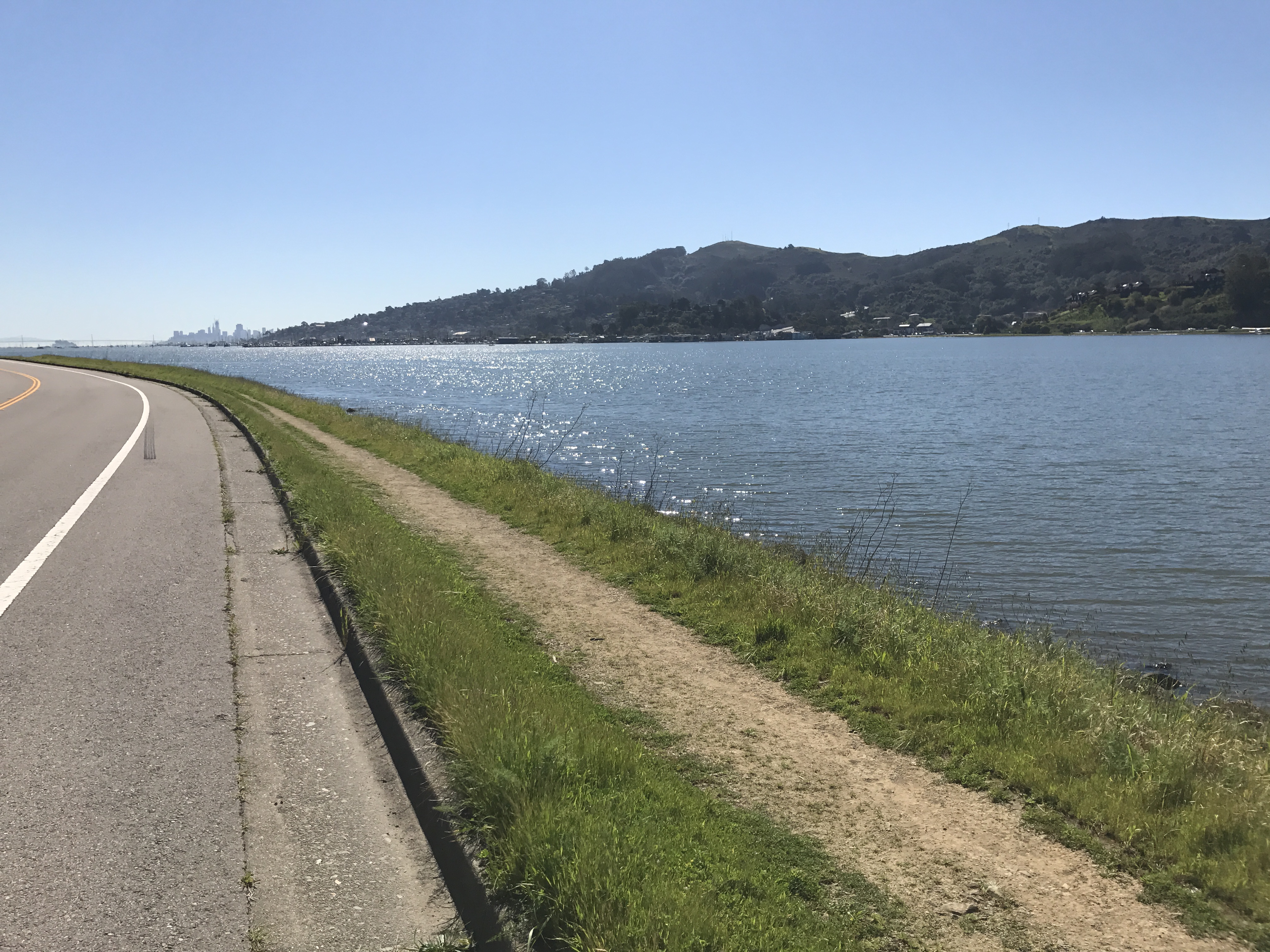
img_0154
Evening Ride

The bottom line here is that we need to understand two things: one, that we ARE intimately connected to our watersheds, our local natural resources, and the things in our nearby that make for life. Two, we need to understand also that we are part of globe-encompassing systems that either enable life or stand against it

Sigh… another book to add to my shelf…

And now onto some themes.


Economics

Here is an unexpected article from an unexpected place (an investment magazine), that, much like the previous one, asks us to move away from our meaningless categories and focus on the real question. In this case it is phrased as the distinction between a market economy and a market society. Here is a short piece:

So forget capitalism versus socialism. The more revealing debate for business, the issues executives and investors have to struggle with, is why and how, in the language of renowned Harvard philosopher Michael Sandel, we have “drifted from having a market economy to being a market society.” In other words, has the logic of profit and loss, winners and losers, insinuated itself so deeply into all aspects of society that we have eroded the sense of shared experiences and common bonds that once held together people of different means and backgrounds? Have we become a culture that knows the price of everything and the value of nothing? When the unforgiving logic of Wall Street occupies Main Street, when everything has a price, do we create divisions we can’t afford?

A market society… Something I have thought about in the way that very wealthy people have found ways to simply “opt out” of concern for others–and how all of us scramble to do the same. There is much to reflect on here: from the defacto Ayn Randian dream of retreat into an alternate society (Atlas Shrugging), to the Joan Didion “dream we won’t admit” (Howard Hughesian absolute autonomy).

And there are more links here to the the Latour explanation of climate change denial’s roots than might first appear. Are we living in a world in which each of us seeks our personal escape capsule from the destruction below. Reminds me of a recent science fiction book I read (Judas Unchained by Peter Hamilton) in which the uber wealthy built escape stations to leave destroyed star systems.


As promised, I am keeping my eye open for interesting articles on the issue of deficits and debt–especially from economists claiming that neither are big problems for an economy like the US’s. After all, now that the Republicans have officially abandoned their opposition to deficits (Democrats apparently never had that aversion), who IS left to claim that there is a problem here?

It turns out that there is a growing “school” of economic thought called (in lower case letters) “modern monetary theory” that rejects the alarmist “deficit scolds” who were so prominent until very recently. This article in the Times is a useful reminder of what has happened with deficits and debt–and economic growth–since the Bush I years. I will be curious if this really gets traction and what it will mean for debate of things like the Green New Deal or Medicare for All that we have been hearing about.

I am going to put this one under economics too… though it could easily be public health. Indeed, the actual study of the effects of Berkeley’s soda tax 3 years on is in the American Journal of Public Health (subscriber!). But there is an argument, that at least in part, people are drinking less sugary stuff because of cost. From the author

“When you implement a soda tax, there is a bunch of media around it, so people start to think, ‘Maybe soda isn’t too good.’”

The second thing that happens is that the public stops buying soda.

Go here for a summary of the research and reach out to me if you want the original study. The bottom line is that Berkeleyites have gone from drinking 1.5 services per day to 0.5. Our oh-so-progressive city could not even see fit to put this on the ballot to allow voters to decide 3+ years ago (one of many ways in which my vision for our city did not move forward), and now the state has put a moratorium on such taxes. Maybe this study will start shaking things up again.


Make America ___________ Again

Okay, this is a lame category but two offerings here remind us of who we are (and are not).

The first is who we are in relation to our cars. Not having had one for going on 16 years, I am, perhaps, uniquely positioned to see how much a religion automobile ownership actually is. I will let this article in the American Conservative speak for itself. This is who we are…

So it is that for some Americans, any discussion of the ills wrought by the car or by the automobile-dependent mode of development that defines most of the American landscape is merely a verbose substitute for “communism.” A smart, young conservative friend of mine once listened patiently while I explained New Urbanism to her: that it was a design philosophy focused on building walkable, dense, mixed-use communities in place of suburban sprawl. “That sounds communist,” she replied. She is not alone in her general estimation. Never mind that it is also the default manner of building human habitats before circa 1950.

We forget, or perhaps more accurately never learn, that almost the entire set of characteristics that constitute suburbia—from the population densities to the lawn sizes and setbacks of houses to the features of those houses to the commercial strips that replaced Main Streets and their accompanying oversized parking lots—was a project, more or less, of Keynesian economic policy and social engineering. An old professor of mine, quite correctly, called the Interstate Highway System the largest subsidy ever given to the automobile industry…

This is not to say that, in the absence of certain government policies between roughly 1930 and 1960, suburbia would not exist. But the history of suburbia, as it actually unfolded, is bound up with such policies. Suburbia was, at least in part, something resembling a crony capitalist public works project. The notion that it embodies the pinnacle of freedom and free enterprise is not much in evidence.

And if that is who we are… Bacevich is here to tell who we are not. Again, from the American Conservative we have a reminder that the US is no longer the “indispensable nation.” Will we find a way to talk about this? I kind of doubt it.

So the coming campaign will no doubt be entertaining. In some respects, it may also be enlightening. But in all likelihood, it will leave untouched the basic premises of U.S. policy—the bloated military budget, the vast empire of bases, the penchant for interventionism, all backed by the absurd claims of American exceptionalism voiced by the likes of Madeleine Albright and her kindred spirits.


The Politics of Fear… (or border dilemmas)

I don’t know what else to call this section. Both the Brexit and the “panic” over the border were born of cynical politicians using fear to get their way.

God only knows what will come of the Brexit. Most agree that it will not be good. Most over here have no idea what it is about or the key sticking point–known as the “Irish Backstop.” If you want a fairly quick read that lays out the recent history of Ireland and why the Brexit has floundered on the rocky shoals of the Irish border (between Northern Ireland, part of the UK and the Repulic of Ireland, a member of the EU who is not exiting), read this. It cleared up the whole mess for me and is timely through the end of March.

And then we have our very own border emergency here in the US. If I were to bet I would say that the Supreme Court majority, issuing a narrow decisions as they did in the case the “Travel Ban” will hand the President a “victory” in the border wall thing. I used the words cynical before. This is now a dictionary definition of that term.

This article lays out why such a ruling will take us backward (WHAT EXACTLY did happen to the Republican rage over Presidential overreach? Oh right, see what happened to their rage over deficits/debt).


Hors Categorie!

I don’t know where to place this science fiction-like article. Researchers working on AI that produces text based on basic prompts are fearful about releasing their entir project for fear of what it might do.

Read this one to remind yourself that you need to actually THINK when you read. A cautionary tale.


Lunchtime Riffs on… homelessness and housing

Went to my very first City Council meeting since my term ended last July.

What I saw is what I had seen. A privileged group of neighbors decrying a low-income housing complex as dangerous, degrading to their way of life, not a place they would even let their kids go past… And on it went for an hour.

To one person it was evidence of the “ghettoization”of his neighborhood (we have so many low-income housing complexes in this part of town–they are clustered here).

The same night, different part of the meeting, the discussion turned to homelessness and the city’s efforts to deal with its challenges.

People are (have been) demanding action on this growing problem.

One person said it was time to admit that some people were beyond help, didn’t want it, weren’t going to change, and, therefore…

What?

I mean really… what?

In the room sat two of the irredeemables, apparently now redeemed. But would the speaker have eliminated them from the “largesse” of the community back then when they were ensconced in the downtown with no hope?

One wonders.

The bottom line is that people in this educated town prefer their own beliefs about homelessness to what the evidence actually shows.

In this they demonstrate themselves to ascribe to a faith-based approach to homelessness: faith in themselves because they JUST KNOW that if you provide services more homeless people will crowd in and overwhelm our town, that homeless people are dangerous, bearers of disease, and beyond help: people who are not even from here–not ours, not our responsibility.

The facts, of course, are different. The majority of homeless people in town are “our children.”

Homeless people don’t come here for services (except perhaps a bed in the coldest months–but even that appears to be waning). They come here for the same reason everyone else does: jobs, family, education.

The facts, of course, say that if you want to make a dent in the most difficult forms of homelessness (the chronic variety, accompanied by trauma, untreated mental health conditions, and the attendant self-medication that chains people to hopelessness), you need housing first. Put people in houses and then we can deal with Maslow level two (as our homeless outreach coordinator eloquently stated).

But this is California and our “progressivism” melts in the face of the messiness of housing these folks in our “nearby.”

And that brings us back to the first part of the meeting–the low-income housing “problem”.

DO SOMETHING about homelessness but don’t provide them with housing close to me because, I will have to see things I don’t like to see.

DO SOMETHING about homelessness but don’t provide services because that will just attract more of “them.”

DO SOMETHING about homelessness but don’t spend my money, ask for my assistance, disrupt my life… (Isn’t this the “state’s” responsibility?)

DO SOMETHING about homelessness but don’t forget I am the one that pays taxes here and so don’t make the “doing” anything unpleasant for us “good folks” (they don’t have to say “makers” and “takers” but… Ayn Rand lurks at our door).

When we are expected to squeeze down the margins within which we can legitimately act in these ways, the only true solution is removal, banishment, and the final dehumanization of people who are not “people” to us in any significant way.