Building (Local) Social Infrastructure to Face Global Climate Change

IMG_0314
This post is based on a paper I co-wrote with Eric Sarriot for the “CEDARS Center” in 2010.  We wrote it as a discussion paper for the Global Health Council meeting that year entitled Hurry Up Slowly—Building Social Infrastructure as Adaptation to Climate Change in Developing Countries.
Obviously, from the title, we were thinking about adaptation to climate change in economically poorer nations and regions.  While that was our focus, I believe that our summary of climate change scenarios, adaptation strategies, and the importance of building “social infrastructure” to create resilience are important for any community that is thinking about climate change adaptation. 
Because we were focusing on economically poorer areas of the world, our “lens” for examining adaptation was food security.  The challenges of creating food security in these environments is different from what we face in Northern California, from where I write. For that reason, I will not focus on food security in this summary/adaptation of the paper, but more generally on the issue of social infrastructure—a concept that applies, I believe, to any community or region. However, given the increased economic disparities within my region (and across the entire US) that have become apparent in the past dozen years, a focus on poorer communities and vulnerable populations concerns not just places in Africa (for example) but about our own back yard.
This post is the first to two to explore this issue in the context of adaptation to global climate change.  The second delves a bit more into three keys to creating social infrastructure in my nearby and uses the concept of “social sustainability.”


Three Global Climate Change (GCC) Scenarios

A reading of the literature on climate change—see especially IPCC 4th Assessment Report and the Global Climate Change and Extreme Weather Events: Understanding the Contributions to Infectious Disease Emergence (Pachauri and Reisinger, 2007; Relman et al., 2008)[1]—suggests three broad scenarios for how climate change will proceed. These are presented in the following table, along with a summary of their possible impacts upon food security and, more generally, health and human development.[2] Note that these impacts concern, especially, the most vulnerable populations.

Three Climate Change Scenarios and Their Potential Impact

Climate Change Scenario Potential Health/Food Security and Other Impacts
1. Progressive climate change

(e.g., shifts in mean temperatures and rainfall amounts, changes in lengths of growing seasons)


Probability profile:

Irregular (high variability) over short term; incrementally significant over long term.

a.   Loss of coastal habitats reduce some food production activities.

b.   Increased rainfall variability leads to decrease in water resources in some locations and decreases irrigation potential with reduced food production.

c.   Increasing temperatures in many locations lead to more demand for water for irrigation, thus leading to lower yields.

d.   Mitigation efforts drive up input costs, reducing agricultural productivity.

e.   Change in range of infectious disease vectors.

f.    Increase in respiratory illness due to changes in air quality.

g.   Increased conflict due to resource competition

h.   Increasing temperatures lead to heat stress on animal and fish stocks, reducing fertility and increasing mortality.

2. Extreme events

(e.g., floods, destructive wind storms, droughts, climate induced fires)


Probability profile:

Already observable; increased frequency expected; limited predictability at more local levels. Likely for certain geographic profiles (lower elevation coastal areas, etc.).

a.   Heat-related deaths (heat wave).

b.   Deaths and injury (flood, fire, storms).

c.   Spread of infectious disease post-event (flood).

d.   Spread of pests reducing food production (flood following drought).

e.   Loss of cultivable land (flood/drought).

f.    Loss of water resources (drought).

g.   Heat-related stresses reduce cattle reproduction and increase deaths.

3. Threshold events or tipping points

(e.g., negative synergies with multi-system failures, seen through historic events such as massive loss of life in 16th century Mexico—reported in Global Climate Change and Extreme Weather Events)


Probability profile:

Unpredictable—High Impact

a.   Epidemics (cattle or human).

b.   Crop failure (large scale).

c.   Broad ecosystem collapse (leading to uninhabitable zones).

d.   Economic crash due to systemic and multi-system spiraling effects.

e.   Massive out-migration from affected zones.

f.    Conflict (violence) due to migration and resource scarcity.

While there is consensus that GCC will lead to an overall warming of the earth over time and that extreme events will increase along with these changes, there is great uncertainty about what the progressive changes will mean for individual nations or regions.  There is also uncertainty about the exact timing and location of the extreme events (with the exception of the effects of warming on coastal habitat and ecology, which can be anticipated with more certainty). Here in Northern California we see extremes of rainfall and drought and attendant problems that lead to the (seemingly) now-common phenomenon of catastrophic fires. Is this the “new normal?”  We do not yet know.

There is great uncertainty about the health and food security impacts of GCC. Again, while there is high certainty that extreme events will lead to decreases in food production in areas affected by them (Bloem et al., 2010; USAID, 2007; Metz et al., 2007), and there is the potential for increases and spread of infectious diseases,[3] how specific nations and regions will fare is poorly understood. Thus, while the potential for great changes in food production (for example) exist, and infectious agents and vectors could change, there is no current knowledge about the distribution and severity of these kinds of changes. The frequency of extreme events has already increased and is likely to increase further as the impact of GCC is felt. Once again, this overall trend is difficult to link to specific projections at regional and local levels, apart from specific geographic profiles such as lower elevation coastal areas.

Less is known about threshold events, although there is historical evidence (Relman et al., 2008) that these have been important throughout human history. In a hyper-connected world, a crisis in one human system can have negative synergies on other systems, with the risk of multi-system and catastrophic failure (i.e., multiple extreme climate events with crop failures and concomitant economic shocks, as well as violent conflict).[4]

Adaptation Strategies

A variety of factors can modify the effects of these changes/events in given areas and over time. These include, among others, economic growth or stagnation and population growth. While population growth rates are in rapid decline, population momentum ensures continued growth in overall population for the coming generation and beyond. The reality of the business cycle—amplified through highly integrated product and financial markets—also modifies the effects of climate change in complex ways given the link between economic growth (or stagnation) and research and development of new technologies that affect food production and the prevention and treatment of infectious diseases.

The challenges of reducing greenhouse gas emissions and the continued growth of these emissions makes it clear that humans must prepare to face the realities of global climate change.  This lends urgency to thinking clearly about what adaptation will look like. The need to focus on resilience is growing. Indeed, the IPPC 5th Assessment Report focuses a large part of its discussion on mitigation and adaptation responses to climate change in much greater detail than the 4th assessment.  It defines adaptation generally as

(t)he process of adjustment to actual or expected climate and its effects. In human systems, adaptation seeks to moderate or avoid harm or exploit beneficial opportunities. In some natural systems, human intervention may facilitate adjustment to expected climate and its effects.

Smit and Pilifosova (2001) provide a more precise definition of adaptation.

Adaptation refers to adjustments in ecological, social, or economic systems in response to actual or expected climatic stimuli and their effects or impacts. It refers to changes in processes, practices, and structures to moderate potential damages or to benefit from opportunities associated with climate change.

Their chapter provides an excellent review of the literature on adaptation, and I summarize only a few key points here:

  • Not surprisingly, “underdevelopment (and I would add, severe income disparity) fundamentally constrains adaptive capacity, especially because of a lack of resources to hedge against extreme but expected events.” Adaptive capacity is defined as building “the potential or capability of a system to adapt to (to alter to better suit) climatic stimuli or their effects or impacts.” This is also referred to as building Not surprisingly, “Activities required for the enhancement of adaptive capacity are essentially equivalent to those promoting sustainable development.
  • “Some people regard the adaptive capacity of a system as a function not only of the availability of resources but of access to those resources by decision makers and vulnerable subsectors of a population” and “the presence of power differentials can contribute to reduced adaptive capacity.”
  • “In general, countries with well-developed social institutions are considered to have greater adaptive capacity than those with less effective institutional arrangements—commonly, developing nations and those in transition.”

These points focus on a number of key elements related to the ability of communities to adapt to local manifestations of GCC—especially those that concern “underdevelopment and the need for social infrastructure.”

A World Bank report (2009) states:

Our combined experience suggests that the best way to address climate change impacts on the poor is by integrating adaptation measures into sustainable development and poverty reduction strategies… Many adaptation mechanisms will be strengthened by making progress in areas such as good governance, human resources, institutional structures, public finance, and natural resource management. Such progress builds the resilience of countries, communities, and households to all types of shocks, including climate change impacts…

In effect, this argues that building the social and institutional infrastructure of communities enhances their capacity to respond and is thus, in itself, the beginning of an adaptation that is intentional, anticipatory, long-term, strategic, and cumulative. The World Bank document is one of the few that attempts to estimate the global costs of adaptation to climate change and is useful in delineating “hard” and “soft” adaptation approaches.

  • Hard options involve acts of engineering such as river and sea dikes, beach nourishment, port upgrades, rural roads, irrigation infrastructure expansion, and improvement of health infrastructure and delivery systems.
  • Soft adaptation measures, on the other hand, might include things such as early warning systems, community preparedness programs, watershed management, urban and rural zoning, and water pricing. They rely on effective institutions supported by collective action. (emphasis added)

Adapting to risk scenarios has costs—some of which are estimated in the literature and others that are not. The World Bank authors, referring to hard options, put their cost “between 2010 and 2050 of adapting to an approximately 2oC warmer world by 2050 in the range of $75 billion to $100 billion a year.” No similar estimate is made for soft options.

While a number of authors (The World Bank, 2009; Ayers et al., 2009; USAID, 2007) acknowledge the nonnegotiable necessity of soft adaptation to improve human health and welfare, with or without climate change shocks, and to create conditions for effective hard adaptation measures, most of the climate change and health literature of recent years has focused (for partly justifiable reasons) on the need for new and hard strategies, and additional adaptation strategies and investments.

Soft options are probably addressed less frequently because they may be considered part of the underlying development requirements, as summarized by Ayers and others (2009):

Given that a community that is vulnerable in an existing climate is likely to be vulnerable to future climate change, it is not necessary to wait for climate change data to become available to start building adaptive capacity.

Soft adaptation strategies raise the baseline status of communities and will provide for easier implementation of solutions, to the extent they can draw on or expand traditional/local adaptation strategies. Hard strategies leave substantial gaps in terms of adaptation. They will be harder to implement without advances on soft strategies, which include the development of strong local decision-making structures or, to return to the language of the authors of the World Bank study, “empowered communities.” In a paper on community-based adaptation to the health impacts of climate change, Ebi and Semenza (2008) note the importance of what is needed in comparison to the current situation:

The focus has been on interventions that are the responsibility of national and state public health agencies. Although these interventions are critical, they will not be sufficient, even with optimal resources and engagement. Additional activities will need to be taken by individuals within their communities.

In reality, both hard and soft adaptation require local community action to assess needs, use information, and plan for responses. Assessment, information use, and planning can only be conducted in the context of strong and inclusive local institutions.

Developing Social Infrastructure for Adaptation (or Building Social Capital for Collective Action/Resilience)

For local actors to prepare for the effects of GCC requires strong “social infrastructure” or, what is commonly referred to as the formation of social capital

An examination of the social capital literature as it applies to community development in general (Woolcock, 1998) and climate change in particular[5] suggests that social capital development that builds adaptive capacity in the face of GCC and enables the implementation of hard and soft strategies requires the following: (1) information-based decision making; (2) multi-level decision making and coordination of action; (3) opportunities for lateral learning and sharing; (4) attention to equity not merely in ensuring that vulnerable groups are “beneficiaries” but that they are “around the table” at which decisions are made; and (5) conflict resolution mechanisms.

The Meaning of Social Capital

Ebi and Semenza (2008) provide a useful reminder of the meaning of social capital, describing it as “the potential embedded in social relationships that enables residents to coordinate community action to achieve shared goals, such as adaptation to climate change.” They go on to define briefly three well-known forms that social capital takes: bonding, bridging, and linking capital. Bonding capital enables communities to mobilize based on the deep relationships of trust that exist within largely homogeneous groups. Bridging capital refers to the resource for action derived from heterogeneous groups joining together to build relationships that bring capacities to the table that might be lacking within homogeneous groups. Linking capital concerns relationships that extend beyond community groups, connecting such groups to individuals and groups of power (for example the state in its various manifestations).

Elbie and Semenza note that all three forms of social capital are critical to enabling communities to adapt to climate change. Woolcock (1998), writing more generally about the role of social capital and development notes the same things and goes further, pointing out the challenges that exist if various forms of capital are lacking. His ideas join Ebi and Semenza’s (2008)—who make this argument explicitly in relation to climate change—when he notes that even high levels of bonding capital quickly reach a self-limiting role in development because homogeneous groups often lack essential skills and experiences to face the challenges of poverty. In addition, Woolcock talks about the problem of too little bonding capital, examples of which exist in post-conflict environments, where basic lack of trust within groups renders communal action difficult. My experience in local government also suggests that lack of “bonding” capital can also exist because local leaders’ egos or desire for personal gain can limit their willingness to reach across boundaries to foster collective action. For both groups of authors, finding ways to support the development of bonding and bridging capital is critical for local efforts—be they general development or adaptation to the local effects of GCC.

However, both also see the necessity of moving beyond these critical, local types of social capital to linking communities to those “in power,” also known as linking capital. Elbie and Semenza limit their consideration to the importance of linking capital, which is essentially about creating collaborative efforts between community groups and those in power (health, administrative, and political authorities). Woolcock concurs, calling this type of capital “synergy,” but goes a step further and notes that another type of social capital is critical to ensure useful “top-down” development efforts. He adds that credibility and capacity (technical and experiential) of state and civil society institutions are vital for top-down approaches to development in order to work and to effectively marry top-down and bottom-up approaches.[6]

I turn now to examine briefly certain specific elements critical of creating/mobilizing social capital.

Information-Based Decision Making

As the World Bank’s The Costs to Developing Countries of Adapting to Climate Change: New Methods and Estimates notes (2009), empowerment of communities requires that they have full access to climate-relevant information systems. In addition, the report states that “effective adaptation should build upon, and sustain, existing livelihoods and thus take into account existing knowledge and coping strategies…” This obviously does not deny the role of professionals, technicians, or experts, but resets the focus of expertise toward the production of actionable information.

Taken together, these two points indicate the importance of collecting and using relevant climate information and the experiences of local adaptation to enable decision making about current and future adaptation needs. The keys to information use for decision making include both its routine and consistent collection and processes that allow people of varying education and experience levels to use it.

All societies have ways of adapting to climatic (and other) shocks and while most writers agree (Tompkins and Adger, 2004) that the challenges of adapting to future climate change lie outside their experienced coping range, learning of and adapting these coping mechanisms will be critical to ongoing adaptation efforts. Bhattamishra and Barrett (2010), though not writing in the context of GCC, provide a useful summary of community-based risk management actions (CBRMA) illustrating how they exist in many places. Other studies cited in their paper illustrate the vast array of strategies used—often in the context of climatic shocks.

Given the foregoing I would propose that local information systems include these three elements at least:

  1. Community diagnosis (to identify current coping mechanisms).
  2. Community-based information systems.
  3. Ongoing multidimensional assessments, from institutional assessments—to build credibility (Orobaton et al., 2007)—to more comprehensive monitoring of the delivery and results achieved by basic social services.

The tools for collecting information at local levels meet with professional-cultural reluctance for their implementation, but they are well established and proven to be workable at the district level. What is less clear is, again, how to develop processes to enable emerging groups to analyze and then use data to make decisions; more work needs to be done to create these processes. Despite this challenge the key will be to develop routine data collection systems and to consistently, over long periods, help groups meet to analyze data and progress toward goals (see below).

Multi-Level Decision Making

The foregoing assumes that information will be used in ongoing ways to make decisions about community challenges related to GCC, and that the processes so developed will build the adaptive capacity of communities. The idea of multi-level decision making is merely another way of talking about linking capital or synergy.

What specific structures are needed? Tompkins and Adger (2004) argue for a model that operationalizes Woolcock’s (1998) concept of synergy in the form of “co-management,” which they link to the idea of “networks of engagement,” which give people access to power and representation. Quoting Ostrom (1990), they state:

Co-management is one form of collective action whereby resource stakeholders work together with a government agency to undertake some aspect of resource management. Collective action in this context is the coordination of efforts among groups of individuals to achieve a common goal when individual self-interest would be inadequate to achieve the desired outcome.

Tompkins and Adger go on to acknowledge that “inclusive institutions and the sharing of responsibility for natural resources go against the dominant hierarchical institutional forms of most governments throughout the world.” They do, however, provide examples in their article of where co-management is working.

What this implies is that the specific form of synergy must involve private actors (communities) working explicitly with government agents to develop adaptation strategies (starting with a response to current food security challenges). The same authors speak of the need to “cement localized spaces of dependence.” This echoes the longstanding research of Kurt Lewin on how the formation of new groups enables significant behavior change by members.

Opportunities for Lateral Learning and Sharing

The issue of lateral learning concerns bridging capital and, perhaps, provides an answer to the question: Where does one start the process of co-management? Bridging capital is a necessary but not sufficient condition for increasing adaptive capacity of communities. It is important for moving beyond the limitations of bonding capital—especially in the face of the local manifestations of GCC—but requires linking capital to move toward realistic solutions to poverty and GCC’s effects.

Lateral learning could begin by focusing on information sharing about the state of knowledge on the probable effects of climate change (acknowledging the great uncertainty that exists at national and local levels). In a sense this concerns bringing various communities together to discuss current development challenges and consider the need for strengthened structures now and in the future.

Beyond this, forming networks should catalogue already existing adaptation strategies that groups use to adapt to risk. Bhattamishra and Barrett (2010) provide a useful summary of community-based risk management actions illustrating how they exist in many places. One challenge they acknowledge—and that could offer a second stage of questions for local groups to deal with—is the problem that most CBRMAs don’t work well in cases of broad co-varying risks—the kinds that are going to be common in GCC-induced events. Thus, emerging social structures should be enabled to both critically examine local adaptation strategies that could be useful models, but also consider their limitations and the opportunities to build relationships beyond them.

Lateral learning sends a strong message that local experiences are valuable and that solutions can be found within the local setting while acknowledging that GCC could introduce events that go beyond the capacity of the strategies that have evolved. Because it explicitly seeks to build bridging capital through joint learning, it provides a good foundation and starting place for discussions on the role of policymakers within the state. Thus, bridging capital builds community capacity to engage in its own advocacy vis-à-vis the state.

Attention to Equity

While the social capital concept provides a useful understanding of the value of different groups coming together to do that which they could not accomplish alone, it does not deal directly with the issues of exactly who is involved in creating the bridging and linking forms of capital. This raises the issue of equity and representation. Thomas and Twyman (2005) ask explicitly about the voices that are heard and the issue of the inclusion of traditionally excluded groups in decision making bodies. They articulate the concept of equity in relation to climate change adaptation processes this way:

Therefore equity in the context of climate change outcomes ought to be much more than simply ensuring that the vulnerable are treated fairly and buffered from unduly bearing the burdens of impacts. It should relate to a wide range of issues including: decision-making processes—who decides, who responds; frameworks for taking and facilitating actions; relationships between the developed and developing world; and also to relationships between climate change impacts and other factors that affect and disturb livelihoods.

While they are not addressing directly the issue of bridging and linking capital, they are talking about creating new “social spaces” in which decisions about what to do about GCC at the local level can be debated. They point to the need for these spaces to “retain principles of equity and social justice” at their core. They conclude by pointing out the need for careful facilitation of the process: seeing a role for outsiders in asking questions and guiding debate about who should be around the table. The idea of outsiders playing this role is echoed in a manual on “people-centered” advocacy (VeneKlasen and Miller, 2007), which focuses not just on getting community issues to the table but “enlarging” the table to include more voices, especially those that are traditionally un- or under-represented.

Thus, efforts to create bridging and linking capital should not only consider the various kinds of networks that need to be developed but also ensure that “the poor” are not merely referred to in terms of being “beneficiaries” but also included around the decisionmaking table in tangible ways. This points to the need for intentional longstanding processes to ensure greater participation of all groups.

Conflict Resolution Mechanisms

A final point related to the development of the social infrastructure required to enhance community adaptation to climate change concerns the need, within actions that focus on creating bridging and linking capital, to set up mechanisms to deal fruitfully with conflict. I focus on this for two distinct reasons.

The first reason that conflict resolution skills will be necessary is because one of the effects of GCC is expected to be heightened tensions and conflicts over scarce resources. Nearly all the literature on GCC points to this seeming inevitability, with some arguing that even mean temperature changes are likely to lead to more conflict in local settings (Burke et al., 2009). This implies that the creation of new social spaces will be done, increasingly, in the context of ongoing conflict among participants. Thus, it will require skill to both create the spaces (creating safety for groups in conflict so they can come together) and to deal with conflicts that will arrive once people come into them.

A second reason why these skills will be necessary concerns the issues of power and equity, raised previously. Building trust, overcoming fear, and enabling decision making within groups in which power imbalances exist requires an attention to how power is being used to silence or exclude, to name it and to address it. These issues are often overlooked by program evaluators guided through technical expertise, but with attention are found to play an essential part in the sustainability of social development efforts (Sarriot and Jahan, 2010; Sarriot, 2002).

The fields of conflict transformation, adult education, and team building contain a variety of tools and processes that must be brought to bear to enable these groups to organize and move ahead. The existence of external facilitators that will bring new perspectives and approaches to newly forming groups will be an important element of external support to local adaptation efforts and should be a priority for donors.

Building Social Infrastructure

In considering these points it is clear that an investment in social infrastructure will be a long-term process and require a significant amount of process facilitation in many local communities around the world. As Ebi and Semenza (2008) note: “Preparing for and effectively responding to climate change will be a process, not a one-time assessment of risks and likely effective interventions.”

So where do we begin? How do we start to think about how to actually build this infrastructure?

There are few fully formed models that address all these issues comprehensively, especially for the creation of linking capital at the local/regional level, but there are a multitude of sectoral projects and programs that provide demonstration that such approaches can work in addition to a substantial learning basis.

Despite the lack of many practical implementation approaches, there are several critical points that should must be part of any efforts to develop bridging and linking capital.

Focus on Information for Decision Making

As noted previously, the local collection and use of primary data—both qualitative and quantitative—must form the basis for building decision networks. In fact, it is an oft violated rule that the only data worth collecting are to guide decision making. The specific kinds of information to be collected should be prioritized but also negotiated in each setting to ensure maximum relevance. The food/livelihood security approaches provide a useful starting place for answering information needs, including by more aggressively obtaining local information.[7]

This returns us to several points raised earlier about who should be around the table, the size of the table, and the role of participants. There is a need to explicitly focus on equity issues in forming groups and inviting participation.

Experience has shown us that power imbalances in groups must be acknowledged and managed appropriately. If decisions are to be made that represent the needs of all participants, then appropriate processes must be in place to ensure that. Building facilitative capacity that includes tools to raise voices and deal with conflict will be critical to ensuring that it is not merely the voices of the powerful that are incorporated into the decisions.

Time, Consistency, and Unity of Purpose

Time is a fundamental ingredient widely mistreated by project approaches. Some learning and key processes build and solidify over time, while projects are frequently operating on start-stop modes, which bear substantial opportunity costs in terms of human development (Shediac-Rizkallah and Bone, 1998; Witter and Adje, 2007). A review of Noraid health sector development projects argues that less successful and less sustainable projects are more likely to receive longer funding (Catterson and Lindahl Claes, 2003).

Time in itself does not suffice to ensuring progress in the building of human resiliency; two related concepts are essential and have received substantial attention in the management literature, but surprisingly little in the development and climate change literature:

  • Unity of purpose refers to multiple actors focusing on common goals, which can be made possible by the creation of social space and information systems discussed previously.
  • Consistency of purpose refers to maintaining focus and commitment to key issues over time. The world of development is notably falling short on this fundamental principle. Some exceptions are obvious, such as national immunization programs and recent efforts to bring ITN technology to the fight against malaria. At the local level, however (think district and below), both national and international actors can be involuntarily disruptive. This is most easily demonstrated by the absence of actionable information at those local levels of interaction with communities (Sarriot et al., 2008; Davis et al., 2009).

Clarity of Outcomes

The development of social infrastructure is not for the sole purpose of preparing to react to the effects of climate change. It is essential for communities to respond to changes of all kinds. Initial efforts to create social capital should focus on two distinct outcomes:

  • As noted previously, initial bridging capital efforts might focus on creating learning about adaptation strategies already in place to face uncertainty.
  • Initial data collection efforts and decisions should focus on identifying levels and then trends in community vulnerabilities with an eye to setting targets and developing plans to reduce then. With data on these issues in hand, and with an analysis of the meaning and classification of “vulnerability” in the community, emerging groups can develop plans to reduce it in the short to medium term.[8]

These outcomes are of immediate relevance: build a knowledge base, bring people together, and focus on using information to create plans based on locally available resources. Over the longer term the development of the disciplines of data analysis will lead to an ability to respond to the effects of GCC. Thus, focusing on today’s needs prepares the way enhanced adaptive capacity tomorrow:

  • A community active in examining information and making decisions to enhance its own welfare will be far better positioned to examine climate variability data, surveillance information, and evidence of climate impact on crop, health, and livelihood.
  • As basic health, livelihood, and human development indicators over time improve, the physical condition of communities will also position them to be more resilient to the shocks of climate change.

Conclusions

No one trying to tackle the complexity of Global Climate Change believes in rapid, simple, and easy fixes. One might argue that the culture of easy fixes is partly to blame for anthropogenic climate change. By reviewing the literature available to date, and mapping out scenarios for impact of GCC on local communities, as well as types of adaptation processes (or lack thereof) that can be promoted in these communities, there are three salient ideas, which should guide new efforts to build adaptive capacity/resiliency at local levels:

  1. Poor social infrastructure represents a source of insecurity and inadaptability.
  2. Even context-specific, hard adaptation strategies will be hindered in their effectiveness and impact in the absence of effective development processes focused on soft adaptation—which include the development of social infrastructure.
  3. In the face of uncertainty, progressiveness, complexity, and randomness of GCC threats, sustainable adaptation processes should emphasize the building of a responsive and capable social infrastructure. Proper respect for time as a factor of social processes, unity and consistency of purpose demonstrated through appropriate local information systems and metrics, and equity in bringing stakeholders around decision making processes will be central to these efforts.


Notes

[1] Please refer to the original document for a full bibliography

[2] The IPCC 4th Assessment address “likelihood estimates” for some of these, but virtually no statements of this kind can be made for individual regions or nations—let alone at the sub-national level, which is the focus here. However, the potential impacts listed here are broadly supported by climate change modeling activities. The problem, as noted in the Global Climate Change and Extreme Weather Events document, is that there are many pitfalls in extrapolating climate and disease; and other relationships from one spatial level or temporal scale to another.

[3] The literature (Relman et al., 2008) notes the following in relation to infectious diseases: overall increase in burden (consensus), but case-by-case it is hard to predict; shifts in the distribution is an almost certain outcome; shifts will be affected by acceleration in prevention and control measures.

[4] Risk Management “Science” has made forays into the public consciousness through recent publications, such as The Black Swan: The Impact of Unprobable Events (Taleb, 2007), which provides useful discussions on management of the risks of unpredictable system failures.

[5] I draw primarily from numerous authors for these concepts (Ebi and Semenza, 2008; Thomas and Twyman, 2005; Tompkins and Adger, 2004).

[6] These concepts in the literature echo some of our own experiences. Examples of bridging capital, for example, come from the world of microfinance in the idea of rotating savings and credit groups or federations of credit groups. Linking between community groups and decisionmakers was at the heart of remarkable and, to a high extent, sustainable achievements of an urban health project of Concern Worldwide in Bangladesh (Sarriot et al., 2004; Sarriot and Jahan, 2010). Both linking and bridging social capital were at play in projects evaluated, namely of Save the Children USA in Guinea (Sarriot, 2006) and through the Living University model.

[7] The Rapid Household Survey Handbook (Davis et al., 2009) provides a useful starting place for developing quantitative information collection methods. Other tools exist for qualitative methods, including Participatory Learning and Action—PLA (Freudenberger, 1999). Community-based monitoring systems and surveillance (nutritional and epidemiological) all have their set of challenges but have been implemented successfully in a number of settings.

[8] More detailed discussion of metrics and their production is required but can be informed by recent literature (Devereux et al., 2004).

Interesting Reads Week of December 2, 2018

Economics

If you don’t read anything else linked to below, please, at least read When in Gotham by Eric Miller at “Front Porch Republic.” Miller puts his finger on something that has bothered me in the discussion of the movement towards nationalism, and the (merited) critique of globalization: does the movement (be it Brexit or Trump’s crude

e040d1e9-2126-45e5-870b-6f6186481398
What Autumn Brings, Northern CA 2018

protectionism) really represent a departure into a new economics or merely a more local version of the corporatization of the world that lessens freedom for everyone, everywhere. Miller writes:

A corporate state of nationalist dimensions and a corporate state of internationalist dimensions may in fact be a difference in kind, but not the kind of difference likely to ease the democratic spirit… But as the passing decades have shown, we cannot stop (because we’re unwilling to stop) the growth of the corporate state. What we can do is seek to start, and re-start, forms of authentic growth within it.

Now, THAT is a call to resist! Take five minutes to read this piece.

A theme taken up by Dean Baker quite frequently in his Beat the Press blog, is the question of why the Federal Reserve of the United States is so afraid of inflation. Baker often argues that because of its fixation on inflation, and its seeming finger-on-the-trigger use of interest rate increases to tame it, the Fed essentially reigns in economic growth and job creation.

In my reading, Baker is almost alone in “beating” this particular drum. It is interesting, therefore, to read this review in The Economist of Paul Volcker’s memoir. Here is an extended quote with my highlight of the key take home:

Mr Volcker’s intuitive approach to monetary policy often seems as influential as the academic orthodoxy his tenure helped inform. He worries that economists favour reforms that would free central banks to court higher inflation during downturns. Although many do, central banks have very conspicuously declined to make such changes. They would view years of above-target inflation as a dangerous threat to their credibility, and easing policy in the face of such inflation an unforgivable sign of weakness. But years of below-target inflation in the aftermath of the global financial crisis did not generate a corresponding panic. Indeed, the Fed began raising interest rates while inflation remained below its target, unfazed by the risk that this would undermine public faith in its ability to boost the economy when the next recession strikes.

Mr Volcker writes that, time and again, governments accept “a little inflation” only to find themselves beset by spiraling prices. But the more time passes, the more the 1970s look like an inflationary aberration book-ended by decades of modest inflation. Inflation is a danger, but one among many. It is the strength of Mr Volcker’s character that deserves emulation rather than his response to a specific, bygone set of economic circumstances.

The USA (A “truth-challenged” nation)

I don’t generally like Rod Dreher. He is a conservative Catholic with a SERIOUS dislike for Pope Francis and views on immigration and cultural change with which I simply disagree. But this article, in which he quotes another well known Catholic writer (Ross Douthat of the New York Times) is astonishing in its brutal honesty about Donald Trump and other elites. A sample:

(W)henever I hear of some new vile thing that Trump is alleged to have done, I just shrug. I expect him to be a criminal, in a way that I never would have expected any other president to be a criminal. And the Republicans in Congress have barely tried to rein him in. After he goes, it’s going to be hard to restore respect to the presidency.

The rest of the article delves into the parallel moral universe other elites in this country live in. It is not easy to read.

We have a truth problem in this country. And not just for the reasons that Dreher cites in his short piece. The Economist, this week, lays out the truth about the grifters around the current President.

One theme from the hundreds of pages of indictments is that the people around the president lied frequently and easily, even under oath. It is a management cliché that culture is set at the top. That was true of the Trump campaign, too.

6091dd37-2e97-4389-a3ad-54ac3ad2cebdBut beyond the problem of “truth-telling” (or the lack thereof ) according to Shanto Iyengara and Douglas S. Massey lies the fact that we live in a post-truth society. Their particular point is about science and how scientist might respond in such a society. It does not break much new ground, but its example of how the immigration “debate” has been subjected to post-truth communication methods is engaging and informative.

(And on immigration… check out these six charts from the BBC)

This “post-truth” society is having an impact on our confidence in various institutions (though the continued trust in the military baffles me), according to research by NPR/PBS.5c09f16d-f4e7-43a7-ab8f-975b7131e5ee

Finally, Bacevich is back with a stinging critique of David Brooks’ solution to our current state of affairs. While not discussing the issue of truth telling, Bacevich lays out the case that a return to the “responsible conservatism” of the pre-Bush era is definitely NOT what this country needs. Indeed, Bacevich seems to argue that it is the kind of responsible conservatism that Brooks longs for that led to the rise of Trump and our current mess:

As for the dream of spreading global democracy, it has indeed received a fair trial. Yet to say that U.S. democracy promotion efforts in places like Afghanistan and Iraq did not work out is akin to saying that Bonaparte’s campaign to capture Moscow in 1812 didn’t quite pan out as he had hoped. Napoleon’s invasion of Russia yielded a disaster for France. So too with post-9/11 U.S. efforts to export democracy at the point of a gun: the results have been disastrous for the United States and for more than a few innocent bystanders.

Yet to this very day Brooks and other members of the conservative establishment refuse to confront the scope of that disaster. It has cost trillions and killed hundreds of thousands. It has destabilized much of the Islamic world.

Criminal Justice/Policing Reform

Heavy sigh here… It is truly sad when a bi-partisan piece of legislation the so-called “First Step Act” gets mired in the narrow political calculation of the Senate Majority Leader–a singularly grotesque individual who has waged a personal war against democracy and bi-partisanship. This New York Times editorial describes this calculus and the (probable) sad result of a bill that “aims at rationalizing federal sentencing as well as improving conditions for inmates and helping ease them back into society after prison.” 

Along with our inability to achieve meaningful criminal justice system reform, comes word (also published in the Times) of our retreat from appropriate local police oversight. In the week when my small town seated its very first citizen police oversight commission, we learn that the Sacramento County Supervisors have to play hard ball with a local sheriff to force him to stop locking the police auditor out of his office. And the Times piece shows how the federal government has retreated from its role in supporting local efforts to develop appropriate police accountability. Let’s continue to keep our eyes on this issue.

And… in case you were wondering, no, we did not always lock up immigrants and this Times (sorry for three here) article provides a history of the “bipartisan” effort over time that has led us to this point. What point? The point of treating asylum seekers as criminals. This abandonment of morality is well described in this useful historical analysis. As the author notes:

(I)n 1958 the Supreme Court, in Leng May Ma v. Barber, held that “physical detention of aliens is now the exception, not the rule,” pointing out that “certainly this policy reflects the humane qualities of an enlightened civilization.”


I close with quotes by Rene Girard and Jacques Ellul.

First Girard in The Girard Reader “Mimesis and Violence:”girard reader

Violence is discussed, nowadays, in terms of aggression. We speak of aggression as an instinct that would be especially strong in certain individuals or in man as a zoological species… Violence is also attributed by many economists to the scarcity of needed objects or to their monopolization by a social elite…

Imitation or mimicry happens to be common to animals and men. It seems to me that a theory of conflict based primarily on appropriate events mimicry does not have the drawbacks of one based on scarcity or on aggressivity; if it is correctly conceived and formulated it throws a great deal of light on much human culture, beginning with religious institutions.

And Ellul in Hope in the Time of Abandonment (written in 1972)

In the most pacified and guaranteed society which has ever existed, man is living in uncertainty and growing fear. In the most scientific of societies, man is living in the irrational. In the most liberal of societies, man is living in “repression,” and even hyper-repression. In a society in which the means of communication are the most highly developed, man is living in a sort of phantasmagoria. In a society in which everything is done to establish relationships, man is living in solitude…. It would seem that each advance nurtures its exact opposite in man’s living experience.

Interesting Reads Week of November 26, 2018

The following is a selection of interesting reads from this week. Not all were published this week but dates of publication should be apparent for each one.

1093366f-8e9d-45ed-86e9-9d8c497d4ce5
Portion of Depression Era fresco, Coit Tower

War and Peace

My friend Lisa Schirch has written a very useful analysis of Peacebuilding in The State of Peacebulding 2018: Twelve Observations. Lisa has done a great deal of work in Afghanistan and has boldly chosen to work with the Department of Defense to advance peacemaking there and elsewhere.  That lends a great deal of credibility to  her statement:

Whenever we are engaging across communities – whether we are teaching about peacebuilding in military academies or hosting military generals giving keynote talks at peacebuilding conferences – we need to identify both our common ground, and our differences, including distinct peacebuilding goals, priorities, and values, and layout our ethical principles that guide such interaction.

The rest of the article is equally rich in analysis.  I highly recommend it.

While we are on the subject, of war, US Army Officer Danny Sjursen has this to say in The American Conservative article America is Headed for Military Defeat in Afghanistan:

The United States military did all it was asked during more than 17 years of warfare in Afghanistan. It raided, it bombed, it built, it surged, it advised, it…everything. Still, none of that was sufficient. Enough Afghans either support the Taliban or hate the occupation, and managed, through assorted conventional and unconventional operations, to fight on the ground. And “on the ground” is all that really matters. This war may well have been ill-advised and unwinnable from the start.

Immigration

While it was broadcast in mid-September, current discussions of immigration should start with a listen to This American Life’s comprehensive look at the subject in Let Me Count the Ways.  Give it a listen!

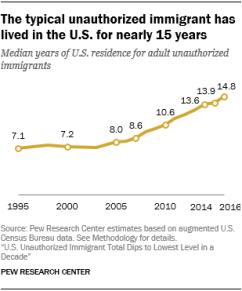
The Pew Research Center does us all a great service with its analysis and report: U.S. Unauthorized Immigrant Total Dips to Lowest Level in a Decade. The rhetoric around immigration is designed to hide the reality of what is actually happening around the issue.  This is evidenced in the way the President continues to blatantly lie about the issue. The Washington Post analyzes this. IMG_0525

The Pew Report presents actual data(!) to help describe what is happening in relation to migration from Mexico and Central America.  Of interest is the following conclusion:

Increasingly, unauthorized immigrants are long-term U.S. residents. By 2016, an unauthorized immigrant adult had typically lived in the U.S. for 14.8 years, compared with a median 8.6 years in 2007.

And the truth about what is happening right now at the border is relayed in the final paragraph of this New York Times article.

Mexico is unlikely to host the migrants who are seeking asylum without some kind of guarantees from the United States because it does not want refugee camps on its northern border.

These are refugees, fleeing violence and despair…

But, again, if we “count the ways” that the current administration is trying  limit immigration–even legal immigration–we see how comprehensive and far reaching it is.  My day-to-day work with international students is increasingly challenged by realities like the one reported by Reuters:

But now the Trump administration is weighing whether to subject Chinese students to additional vetting before they attend a U.S. school. The ideas under consideration, previously unreported, include checks of student phone records and scouring of personal accounts on Chinese and U.S. social media platforms for anything that might raise concerns about students’ intentions in the United States, including affiliations with government organizations, a U.S. official and three congressional and university sources told Reuters.

U.S. law enforcement is also expected to provide training to academic officials on how to detect spying and cyber theft that it provides to people in government, a senior U.S. official said.

Public Health

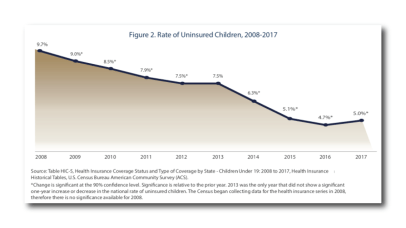
Rate of Uninsured Children 2008 2017The title of the report from The Center for Children & Families (CCF), part of the Health Policy Institute at the McCourt School of Public Policy at Georgetown University, pretty much says it all: Nation’s Progress on Children’s Health Coverage Reverses Course

The Economist had an extended analysis of the change in suicide rates world wide. The good news is that they have gone down substantially just about everywhere over the past generation.  The exception?

America is the big exception. Until the turn of the century the rate there dropped along with those in other rich countries. But since then, it has risen by 18% to 12.8—well above China’s current rate of seven. The declines in those other big countries, however, far outweigh the rise in America…

(T)he main means of suicide in America is guns. They account for half of suicides, and suicides account for more firearms deaths than homicides do. Guns are more efficient than pills, so people who impulsively shoot themselves are more likely to end up in the morgue than in the emergency ward.

One can view our transportation choices as a key public health issue–and we should.  In the short term, our commitment to use of the automobile limits are mobility and exposes us to poor air quality.  In the long term (an actually already), these choices have direct impacts on climate change.  So this LA Times article is NOT encouraging

Californians driving more and GM closes small-car plants because Americans only want pick-ups and SUVs. We are going backwards.

Other

I continue to analyze what exactly I was involved in during my years in international development.  Relying, as it did at least in part, on private philanthropy, I am always interested in reading about the current state of affairs in philanthropic giving. This New York Times editorial is part of an ongoing (and necessary) critique. 

There is a great deal of concern about the current American willingness (desire) to accept an authoritarian form of government. Most of the attention focuses on “the right” but The American Conservative summarizes the finding of recent research that shows how Hilary Clinton partisans seem to have this same bent.  This brings to mind a quote from literary critic Lionel Trilling…

We are at heart so profoundly anarchistic that the only form of state we can imagine living in is Utopian; and so cynical that the only Utopia we can believe in is authoritarian

And for those who are interested in learning more about Jacques Ellul this article that asks whether Ellul is “a prophet for our tech-saturated times?” is a great introduction to his thought.  Very accessible!

And I end with the final paragraph from a short but VERY perceptive essay by Joan Didion in her volume Slouching Towards Bethlehem. In the essay “7000 Romaine, Los Angeles 38” asks why we are so taken by men like Howard Hughes (or, in our times Steve Jobs, or Mark Zuckerberg, or… Donald Trump?).  After all, as successful as they are, they are definitely NOT the heroes we say we value… Here is Didion’s take:

There has always been that divergence between our official and our unofficial heroes. It is impossible to think of Howard Hughes without seeing the apparently bottomless gulf between what we say we want and what we do want, between what we officially admire and secretly desire, between, in the largest sense, the people we marry and the people we love. In a nation which increasingly appears to prize social virtues, Howard Hughes remains not merely antisocial but grandly, brilliantly, surpassingly, asocial. He is the last private man, the dream we no longer admit.

History At Our Door

(Or, Colonial Chickens Coming Home to Roost)

According to The Guardian (reported Thanksgiving Day), Hillary Clinton is “calling on the continent to send out a stronger signal showing they are ‘not going to be able to continue to provide refuge and support’”.

Reading more deeply into her reasoning, she is advising this in order to stem the tide of right wing “populism” for which immigration has become the cause célèbre.

Let that rest in your mind for a moment: refugees–people desperately fleeing desperate places; people crossing oceans, vast deserts, and war-torn zones; people vulnerable to some of the world’s worst predators (human)–are the cause of right wing populism and, therefore, must be stopped from coming in.

1520563242744(I know, I know–most of these people are “economic” migrants. Not exactly “fleeing” just trying to benefit from the global north’s prosperity… Well of course they are. People everywhere and at all times have moved to improve their lives. But for people to go through what these people go through when they decide to move… Well, that tells you something about how distressed their current lives must be. And, no, they are not, as Mr. Trump has called them “criminals”. Criminals slip into countries, they do not charge fortified border fences. Only a certain kind of despair can lead to such reckless boldness.)



Interestingly, her recommendation, if not her reasoning, has been picked up by the nativists in our own land (not a pejorative term, simply a statement of what they are) who argue the same: we must close the doors.

Mr. Trump will claim “economic necessity” (America first, American jobs for Americans, etc.), while others who fancy themselves as much more “reasoned” on the issue will claim cultural or “identity” necessity: these people are not like us and they are changing us–changing our identity as a nation (these arguments are fairly mainstream and “respectable”).

And so we must turn them away.

One wonders when history begins for these folks. For Mr. Trump it’s clear, history began when he last opened his mouth. He has no sense of history, values it not at all, and, therefore, can choose its true beginning based on his mood.

For the others, the more reasoned ones, history apparently begin in the late 80s or 90s when the flows of migrants from the global south really took off across Europe and North America. That is when the problems started that have led us to today. What happened before that, what set the stage for all that human movement? Doesn’t matter. That is all pre-history.  As inscrutable as it is unimportant.

But for those for whom we should no longer provide “refuge,” history begins and runs through the 500 plus years since the northern states, who must now block them (according to Ms. Clinton, according to Mr. Trump), first entered their lands.

One must ask how much those “migrants” changed those lands, those peoples, those identities?

Substantially.

And it wasn’t just then–when the current nation states were still in flux with their own identity issues. It was all the time since then, up and through today. We (yes, I am part of this), have seen it as our right to create vassal states from where the “unsupportables” now come. We used their lands for our proxy wars when the fear and hatred of communism ran hot in our blood. From coastal Mogadishu, through then-Zaire, and on to coastal Namibia; from Nicaragua’s highlands to those of Guatemala and El Salvador; we armed the worst, “coup d’etated” the best, and generally played our global war in their dooryards. Or as Peter Gabriel sang: It’s games without frontiers–war without tears. 

It is not hyperbole to say that we caused these human flows. We have given plenty of aid there, but invested nothing. We have dispensed cures, but never healed. And the rich have gotten richer, and the poor have gotten cell phones.

And now history is at our doorstep.

Bowmansville, Baseball and Bob: Awakenings in a Small Town

I “awoke” to baseball in 1967. I say “awoke” because I can’t find another way to explain the sense that nothing existed in my life before 1967 (when I was 7) and that, at least for a time thereafter, baseball would so define the “necessary” of every waking hour. Growing up in a small town in south-central Pennsylvania (population c1000), baseball was, literally, the only game in town and if you lived in that town you were a Phillies fan. Except I wasn’t.

Sometime in 1967 my dad bought me my first glove—a lefty—after seeing me toss a small rubber ball against the steps going upstairs from near the front door of our house (he almost got me a righty but noticed I only used my left hand). And from the start I was a St Louis Cardinals fan. Why? Ronnie Sanger.  Ronnie was hands down the best baseball player in town. Two years older than me, Ronnie came from a “baseball family”. His brothers had had or would soon have tryouts with professional baseball clubs and they each made it to the lower levels of the minor leagues. In Bowmansville, my home town, that was a level of success that was unheard of. I idolized Ronnie Sanger. And sometime before Ronnie came into my conscious mind he had met former St Louis great Stan “the Man” Musial (Stan died on 19 January, 2013) at spring training in Florida. He got Stan’s autograph, fell in love with the Cardinals and, well, so did I.

But even though I awoke in 1967—and the Cardinals won the series over the Red Sox that year—it was not until 1968 that I really took notice of the team, its players and, especially a pitcher named Bob Gibson. I was a pitcher too and Bob Gibson was the most amazing pitcher of that era. In 1968 he won 22 games—not bad but, incredibly, he gave up a paltry 1.12 runs for every nine innings pitched (and in those days he pitched the whole game—he started 34 that year and finished 28—a feat unheard of today). He struck out 17 Detroit Tigers in game one of the World Series that year—a record that still stands.

Bob-GibsonI was crazy about Bob Gibson. He had a way of holding the ball behind his back before going into a full hands-over-head windup and flinging the ball towards home plate. I mimicked that motion every summer day as I threw a rubber ball relentlessly against the barn door in my backyard (though Bob was a righty and I was a lefty, as I said). It was always the World Series that summer (and several after that), and I (Bob) pitched a no-hitter every time out. I am sure there were a few times when I (Bob) struck out every single batter in the 7th game of the World Series.

Martin died that spring and I know I had a glove on my hand the day I heard about it. I was in the kitchen and that is all I remember. King (as he was known in our house) was a communist and his death left no imprint except that there was a sense of relief that his rabble rousing was finally over.

Also that spring, though I can’t remember exactly if it was before or after Martin Luther King’s assassination, I got a book about my hero Bob Gibson. Did I mention that Bob Gibson is black? Did I mention that I did not know any black people? Did I mention that I loved Bob Gibson?

Anyway, I got the book through one of those “Scholastic” book fliers that came home from school about once per month. My parents never said no to letting me get at least one book, and to my amazement sometime that spring included in the list was a biography of Bob Gibson! I think I read that book about five times the first week I had it and the black and white pictures of Bob Gibson in a little league team photo, then in the minors and then pitching for the Cardinals absorbed my gaze for hours on end.

But Bob Gibson’s biography was not just about his pitching exploits (which I had expected). It was about his life growing up in Omaha, his sickly childhood (asthma), and the shocking story of how the great Bob Gibson could not sleep in the same hotel room as his fellow teammates when he was coming up through the minors in the Cardinals’ organization. In fact, Bob Gibson told a lot of stories of how he was treated as a black man and how it was unfair (even an 8-year old could understand that). I remember being stunned and saddened but mostly confused. How could Bob Gibson be denied the same treatment as anyone else simply because he was black? It just made no sense.

And so, sometime in that spring and summer of 1968 I also “awoke” to something else: something about injustice (though that word was not yet available to my tongue), something about privilege (though I could not have imagined that such a thing really existed), something about race…

And in that small town—thanks in part to the confluence of baseball, Ronnie Sanger, the Cardinals and a great pitcher named Bob Gibson a different way of viewing the world took root.

Martin, I was born too late to know you for what you were when I was 8 years old. I was born in the wrong place to be able to hear and see what you were about. I was born in the wrong family to understand the power of your message. But I was born in Bowmansville and thanks to baseball and Bob Gibson I was given a window—a glimpse—into the challenges of racism and the hope that change might come. And I learned that the agents of change in our land might even appear wearing a baseball uniform.

To Bike… Perhaps to Dream

Yesterday I responded to a survey put out by “Strava,” a fitness app that I use to track my running and biking activities. The questionnaire drilled down into my “active” lifestyle and two questions, in particular, stuck out to me (paraphrased):

1. Do you like to run/bike in most of your free time?

2. Do you take vacations that are built around biking?

These were surprising questions, and ones I never really thought about, but my answer to both were “strongly agree” (they used a Likert scale for all questions). So… yes, I like to stay active, and if given the chance I will spend a weekend biking here or there and I run 4-6 days per week. I guess that makes me active.

So I thought I would write about three things that have made my biking/running possible no matter where I am. I am not into product endorsement so I apologize if it comes across that way but I am going to mention a few. I find that I want a few things when I am out for a ride:

First, I want to plan my ride before I go with some sense of how much climbing I will do, how far I might go, where I can start and where I can end. I need help planning my outings.

Second, I want to arrive in a place, arrange for a bike, and then benefit from the great rides that local cyclists, who know the area, consider to be the best ones.

Third, I want to find quiet places to run or ride when I get to a new location. And, per number one above, I want to plan some runs/rides that are low stress and use off road facilities.

Fourth, I am NOT a speed guy, but rather a “touring” guy. As a result, I don’t mind taking a few pounds of stuff with me (change of shirt, lock, snacks, pump, tube, multi-tool, etc.). I can’t put all that stuff on my person so I have always been interested about how to outfit a fast road bike with a simple kit that I don’t have to wear on my back (back packs are sweaty and uncomfortable

That’s about it…

Over the past few years I have found two apps and one piece of gear that help me do all those things.

“Ride with GPS” is the best bike trip planning app I have come across. It is mostly free but to use all its tools you can pay a small annual fee. I like it because it is quick and easy to use. It allows me to quickly plan rides and then provides decent (though not perfect) turn by turn directions for the ride. It does not do a good job correcting you if you get off course, but it is fine. But the best thing about it is that it lets you search rides within any distance of where you are. This is a great tool that opens up a world of local rides based on local riders actual rides. Even if you don’t choose the exact route they recommend, you can use their routes as a starting point to create your own.

Trail Link is the second app that has been a boon for my active lifestyle. It provides a comprehensive list of “rails to trails” and other trails in communities all across the US. It is an amazing app. You can download it for free and pay a small fee to download specific maps. When I say “comprehensive” I mean it. It includes trails as short as nine tenths of a mile and all the big long ones. If you log in to its online site it gives you updates on trail closures and other important things to know. If you blow into town and need a place to run, check out “Trail Link” first. It might have some great suggestions nearby.

These are my two, “go-to” apps, but what about gear? Having played with a lot of bags, backpacks, panniers, etc, over the past decade, I am ready to say that a decent seat bag it THE BEST option for day rides, and should be part of your kit for longer distance touring too. I am a big fan of Arkel (une entreprise Quebecois!) and their seat bags (in two sizes) are THE best I have found. The minimalist “hardware,” lightweight design, and waterproof feature (tested in a monsoon from Union Station in DC to Silver Spring, MD), make them the best bag I have ever had. I have a large one for touring and a smaller one for day rides.

So… that’s it. I would love to work with anyone interested in using these tools to enhance their vacations, trips, day rides, runs… Whatever. Let me know.

Final Speech

Here is the final speech I gave as Mayor of Davis.  I gave it in French to the Board of Directors of Limagrain, a French seed cooperative with a local subsidiary named HM Clause.  I include the English and French versions here.

Think globally act locally. Perhaps in our days this aphorism, largely adopted by the environmental movement, has been so overused that it has lost all meaning. Penser globalement agir localement. Peut-être que de nos jours cet aphorisme, largement adopté par le mouvement environnemental, a été tellement surutilisé qu’il a perdu tout son sens.
Despite this, I would like to consider it today and, perhaps, rediscover the meaning the person who originally developed it had in mind about it. It is generally agreed that the person who coined this phrase was Jacques Ellul a French jurist, environmental activist, and theologian who wrote volumes on what he referred to as the problem of technique in our world. Malgré cela, je voudrais le considérer aujourd’hui et, peut-être, redécouvrir le sens que la personne qui l’a développé à l’origine avait en tête à ce sujet. La plupart des commentateurs seraient d’accord que la personne qui a inventé cette phrase était Jacques Ellul, un juriste français, activiste environnemental, et théologien qui a écrit des volumes sur ce qu’il a appelé le problème de la technique dans notre monde.
Ellul argued that society’s challenges can seem insurmountable because they occur within complex systems and that the only way to really face them was to seek locally adapted solutions to them.  He critiqued attempts to find global solutions for two broad reasons. Ellul a fait valoir que les défis de la société peuvent sembler insurmontables parce qu’ils se produisent dans des systèmes complexes et que la seule façon de vraiment y faire face était de chercher des solutions adaptées localement. Il a critiqué les tentatives de trouver des solutions globales pour deux grandes raisons.
First, he doubted that it is possible to solve problems of a global nature at a global level given the complexity of the systems that give rise to them.  And he believed that any attempt to do so could only lead to an over reliance on technique, which he defined as the attempt to find the one best way to solve each problem in a very narrow way. Premièrement, il doutait qu’il soit possible de résoudre des problèmes d’ordre mondial à l’échelle mondiale, compte tenu de la complexité des systèmes qui les engendrent. Et il pensait que toute tentative en ce sens ne pouvait conduire qu’à un recours excessif à la technique, qu’il définissait comme la tentative de trouver la meilleure façon de résoudre chaque problème d’une manière très étroite. Ce qu’il appelait « the one best way »
Second, he believed that reliance on technique leads to a focus not on the ultimate ends of the human endeavor but rather to an increasing focus on the means to accomplishing the ends. He stated the following in one of his earliest writing on the subject: Deuxièmement, il croyait que le déploiement de la technique conduit à ne pas se concentrer sur les fins ultimes de l’activité humaine, mais plutôt à mettre davantage l’accent sur les moyens d’atteindre les objectifs (mal-définis). Il a déclaré ce qui suit dans l’une de ses premières publications sur le sujet:
The first enormous fact of our civilization is that today everything has become means, there are no longer any ends.  We don’t know towards what we are walking.  We have forgotten our collective goals, we possess enormous means, and we put into action prodigous machines to go nowhere. Le premier fait énorme de notre civilisation, c’est qu’aujourd’hui tout est devenu moyen. Il n’y a plus de fin. Nous ne savons plus vers quoi nous marchons. Nous avons oublié nos buts collectifs, nous disposons d’énormes moyens, et nous mettons en marche de prodigieuses machines pour n’arriver nulle part.
Keep in mind that Ellul was writing in the immediate post-World War II world. The time when he and other writers such as Albert Schweizer and Ivan Illich lived had seen the incredible technical accomplishments such as the splitting of the atom turned to the end of destroying tens of thousands of innocent lives.  They were horrified by the deployment of these prodigious means without reference to the ultimate ends to which they should be deployed. Gardez à l’esprit que Ellul écrivait dans le monde immédiat après la Seconde Guerre mondiale. L’époque où lui et d’autres écrivains comme Albert Schweizer et Ivan Illich vivaient avaient vu les incroyables accomplissements techniques tels que la division de l’atome se transformer en la destruction de dizaines de milliers de vies innocentes. Ils ont été horrifiés par le déploiement de ces moyens prodigieux sans référence aux fins ultimes auxquelles ils devraient être déployés.
Ellul understood that our challenges are global and systemic, and so thinking globally was absolutely critical to understanding them.  But he very much doubted the efficacy of global solutions, ergo, act locally. Ellul a compris que nos défis sont globaux et systémiques, et donc penser globalement était absolument essentiel pour les comprendre. Mais il doutait beaucoup de l’efficacité des solutions globales, ergo, agir localement.
Today, I would like us to consider together “think globally, act locally” in relation to food. Aujourd’hui, j’aimerais que nous considérions ensemble «penser globalement, agir localement» par rapport à la nourriture.
What is the end we seek in relation to food; the goal, if you will, of our food systems? Quelle est la fin que nous recherchons par rapport à la nourriture ; l’objectif, si vous voulez, de nos systèmes alimentaires?
Is the end merely greater global food output?  Increased yields per hectare?  Greater efficiency of land and water use?  The widespread deployment of sustainable farming practices? The availability of robust and resilient seed varieties? La fin est-elle simplement une plus grande production alimentaire mondiale? Augmentation des rendements par hectare? Une plus grande efficacité de l’utilisation des terres et de l’eau? Le déploiement généralisé de pratiques agricoles durables? La disponibilité de variétés de semences robustes et résilientes?
Or is the end something more? Are these important things that I just named ends, or the means to something else? Ou est la fin quelque chose de plus? Est-ce que ce sont des choses importantes que je viens de nommer les fins, ou les moyens d’autre chose?
It is in considering the true ends of our food systems, I believe, that we begin to realize how critical it is to act locally. C’est en considérant les véritables fins de nos systèmes alimentaires, je crois, que nous commençons à réaliser à quel point il est essentiel d’agir localement.
For me the end we seek in relation to food are not merely greater output or increased yields but rather food security for human beings; our neighbors who live in our neighborhoods, in our cities and in our bioregions. Pour moi, la fin que nous recherchons par rapport à la nourriture n’est pas simplement une production plus importante ou des rendements accrus, mais plutôt la sécurité alimentaire pour les êtres humains; nos voisins qui vivent dans nos quartiers, dans nos villes et dans nos bio régions.
But we need to think globally about food security. We need to understand that food security is a complex matter that has as much to do with our nearly complete integration into global food markets as it does with our ability to grow food locally.  This is how we think globally about food and food security. Bien sûr, nous devons penser globalement à la sécurité alimentaire. Nous devons comprendre que la sécurité alimentaire est une question complexe qui a autant à voir avec notre intégration presque complète dans les marchés alimentaires mondiaux qu’avec notre capacité à produire de la nourriture localement. C’est ainsi que nous pensons globalement et à la nourriture et à la sécurité alimentaire.
Despite our integration into the global food system, I believe if we are to overcome the problems of food insecurity we must act locally.  Act locally, vis-à-vis any problem. Ellul never suggested it is a panacea, that it is straightforward to accomplish, that it is without risks. Malgré notre intégration dans le système alimentaire mondial, je crois que si nous voulons surmonter les problèmes d’insécurité alimentaire, nous devons agir localement. Agir localement, vis-à-vis n’importe quel problème. Ellul n’a jamais suggéré que c’est une panacée, que c’est simple à réaliser, que c’est sans risque.
Parenthetically, now that I arrive at the end of my mandate, I have come to understand just how much local government is, in fact, an exercise in decision making within severe constraints. Those constraints come from the reality that our local economy is inserted into a global economy. They come from the fact that many of the things that were required to do within our local jurisdictions are dictated to us by state and federal government. The constraints are fiscal and political, as well as environmental and social. Entre parenthèses, maintenant que j’arrive à la fin de mon mandat, j’en suis venu à comprendre à quel point le gouvernement local est, en fait, un exercice de prise de décision soumis à de sévères contraintes. Ces contraintes viennent de la réalité non seulement que notre économie locale est insérée dans une économie mondiale. Ils viennent aussi du fait que beaucoup de choses que nous devions faire dans nos juridictions locales nous sont dictées par l’État et le gouvernement fédéral. Les contraintes sont fiscales et politiques, environnementales et sociales.
Indeed, I often think of local action as working within the interstices of the possible. En effet, je pense souvent à l’action locale comme travaillant dans les interstices du possible.
Homelessness here in our city is a good example of this.  We have several hundred homeless people at any time living in and around our city. The causes of homelessness are extremely complex as we know. They have much to do with untreated mental health problems, substance abuse, and our inability to provide for physical spaces for people to live. All of these things are the result of many very rational and well-considered decisions that have been made over many years.Homelessness cannot be solved at the national level but here in Davis we have had and continue to have some important success because we confront it locally with a very relational approach to those living in the streets.  Our successes depend on us understanding the complexity (the global) but acting in the context of individual encampments around our city (the local). Le problème des sans abri ici dans notre ville en est un bon exemple. Nous avons plusieurs centaines de sans-abri qui vivent à l’intérieur et autour de notre ville. Les causes de cette réalité sont extrêmement complexes comme nous le savons. Ils ont beaucoup à voir avec les problèmes de santé mentale non traités, la toxicomanie, et notre incapacité à fournir des espaces physiques pour les gens à vivre. Toutes ces choses sont le résultat de nombreuses décisions très rationnelles et réfléchies qui ont été prises au cours de nombreuses années. Le sans-abrisme ne peut être résolu au niveau national mais ici, à Davis, nous avons eu et continuons à avoir un succès important parce que nous le confrontons localement avec une approche très relationnelle à ceux qui vivent dans la rue. Nos succès dépendent de notre compréhension de la complexité (le global) mais en agissant dans le contexte des campements individuels autour de notre ville (le local).
And so, in like manner I would argue that achieving food security requires local action.

The food system that is evolved in the United States over the past 50 years is a perfect example of the confusion of means versus ends. We have, arguably, created one of the most prodigious food producing machines that the world has ever known here in United States but in doing so we’ve created a brittle food system that over produces basic commodities and under produces a varied macro- and micronutrient rich diet for people. The results of these prodigious means are over processed food-like products (which are not really food at all), the consumption of empty calories, the overconsumption of refined sugars that lead to obesity, the precursors of diabetes, and general poor health.

Et ainsi, de la même manière, je dirais que la réalisation de la sécurité alimentaire nécessite une action locale.

Le système alimentaire qui a évolué aux États-Unis au cours des 50 dernières années est un parfait exemple de la confusion entre les moyens et les fins. Nous avons, sans doute, créé l’une des machines produisant des aliments les plus prodigieuses que le monde ait jamais connues ici aux États-Unis, mais nous avons créé un système alimentaire fragile qui surproduit des produits de base et qui sousproduit des macro et micronutriments variés qui donnes une régime riche pour les gens. Les résultats de ces moyens prodigieux sont des produits transformés semblables à des aliments (qui sont pas du tout de la nourriture), la consommation de calories « vides », la surconsommation de sucres raffinés qui mènent à l’obésité, aux précurseurs du diabète et à une mauvaise santé en général.

And despite the “success” of our system to produce more and more, we have not solved the problem of food insecurity in our nation, or even in our local region—one of the most productive agricultural regions on the planet. This is because our food system is focused on means and not ends

This is because our food system is focused on means and not ends

Et malgré le «succès» de notre système à produire de plus en plus, nous n’avons pas résolu le problème de l’insécurité alimentaire dans notre pays, ou même dans notre région locale, l’une des régions agricoles les plus productives de la planète.


C’est parce que notre système alimentaire est axé sur les moyens et non sur les fins

Fully 22% of children in this county live in households that are food insecure. From this reality, we have come to understand that food security is not merely a function of food availability. We see also that food security is a function of accessibility. Can people access sufficient quantities of quality food? And of course, food security is also a function of the body’s ability to utilize the nutrients people take in. The general poor health of members of our community impedes the uptake of nutrition within their gut. Au total, 22% des enfants de ce comté vivent dans des ménages en insécurité alimentaire. De cette réalité, nous avons fini par comprendre que la sécurité alimentaire n’est pas simplement fonction de la disponibilité de la nourriture. Nous voyons aussi que la sécurité alimentaire est une fonction de l‘accessibilité. Les gens peuvent-ils avoir accès à des quantités suffisantes de nourriture de qualité? Et bien sûr, la sécurité alimentaire dépend également de la capacité du corps à utiliser les nutriments que les gens absorbent. La mauvaise santé générale des membres de notre communauté empêche l’absorption de la nutrition dans leur intestin.
My point in all of this is to acknowledge that our food system does achieve certain means—notably the production of large quantities of food. But it does NOT produce the end of food security. Tout ce que je veux dire, c’est reconnaître que notre système alimentaire atteint certains objectifs, notamment la production de grandes quantités de nourriture. Mais cela ne produit PAS la fin de la sécurité alimentaire.
Well, at this point you might reasonably ask: What does all of this have to do with us today? To answer that I will return to a concept I developed when I had the privilege of inaugurating this site back in 2015.  At that time I used the image of a chain that links all actors in the food system to solve the problem of food insecurity. Eh bien, à ce stade, vous pourriez raisonnablement demander: Qu’est-ce que tout cela a à voir avec nous aujourd’hui? Pour y répondre, je reviendrai sur un concept que j’ai développé lorsque j’ai eu le privilège d’inaugurer ce site en 2015. A cette époque, j’ai utilisé l’image d’une chaîne qui relie tous les acteurs du système alimentaire pour résoudre le problème de l’insécurité alimentaire.
I like the concept of the chain because it shows a sense of temporal, geographical, and social connectedness. This chain has, as its end, the creation of food security.


So perhaps it begins at one end with fundamental scientific research into things like how enzymes can be used to increase yield, or to protect seeds, or to enhance certain characteristics of seeds to make them robust (research that is now carried out by several firms here in Davis). The chain continues to those who work within field testing to ensure the quality of the seed product. Other parts of the chain include production of food, harvesting techniques, food processing that preserves, nutrition education, cooking classes and others perhaps at the other end of the chain are those like my friend Michael Bisch who works for the local food bank distributing excess food to those in greatest need with the fewest economic resources.

J’aime le concept de la chaîne parce qu’il montre un sens de la connexité temporelle, géographique et sociale. Cette chaîne a, comme fin, la création de la sécurité alimentaire.


Alors peut-être commence-t-il par une recherche scientifique fondamentale sur des choses comme la façon dont les enzymes peuvent être utilisées pour augmenter le rendement ou protéger les graines, ou pour améliorer certaines caractéristiques des graines pour les rendre robustes (la recherche qui est maintenant effectuée par plusieurs entreprises ici à Davis). La chaîne continue à ceux qui travaillent dans le cadre d’essais sur le terrain pour assurer la qualité du produit de semences. Les autres parties de la chaîne comprennent la production de nourriture, les techniques de récolte, la préparation des aliments, l’éducation nutritionnelle, les cours de cuisine et d’autres à l’autre bout de la chaîne sont ceux comme mon ami Michael Bisch qui travaille pour la banque alimentaire locale qui distribue excès de nourriture à ceux qui en ont le plus besoins, vivants avec le moins de ressources économiques.

All of these together work as a chain linked from one end to the other from basic research to education to those that distribute food to the neediest in a way that enable us together to address the issue of food insecurity in our local situation. Tous ces éléments fonctionnent comme une chaîne reliée d’un bout à l’autre de la recherche fondamentale à l’éducation à ceux qui distribuent la nourriture aux plus nécessiteux de manière à nous permettre ensemble de résoudre le problème de l’insécurité alimentaire dans notre situation locale.
Limagrain, from what I can see models a commitment to this concept of the chain and in being a critical link in this chain in at least two clear ways. First of all in your very governance structure and the way you go about doing your business you bring different members of this chain—different links in the chain—together.  You combine researchers, with farmers, and those with business minds to try to create comprehensive solutions for your company that will enable you to produce high-quality products that can meet human needs for food. Limagrain, d’après ce que je peux voir, modèle un engagement envers ce concept de la chaîne et constitue un maillon critique dans cette chaîne d’au moins deux manières claires. Tout d’abord, dans votre structure de gouvernance et dans la manière dont vous menez vos activités, vous amenez différents membres de cette chaîne – différents liens dans la chaîne – ensemble. Vous combinez des chercheurs, des agriculteurs et des gens d’affaires pour essayer de créer des solutions complètes pour votre entreprise qui vous permettront de produire des produits de haute qualité pouvant répondre aux besoins alimentaires des humains.
But second you also demonstrate your commitment to our local food system and solving the problem of food insecurity locally by contributing excess food produced from your field trials to our local food bank that serves the poorest members of our community.  And in doing these things you demonstrate a deep commitment to dealing with the most vulnerable members of our local community. Mais ensuite, vous démontrez également votre engagement envers notre système alimentaire local et la résolution du problème de l’insécurité alimentaire au niveau local en fournissant de la nourriture produite à partir de vos essais sur le terrain à notre banque alimentaire locale qui dessert les membres les plus pauvres de notre communauté.
Yours is a company that is privileged to see and operate at the global while remaining linked to local action in many ways.  You understand not only how to increase yield sand productivity but you also enable our local community to solve our local food insecurity problems. Votre entreprise est privilégiée de voir et de fonctionner à l’échelle mondiale tout en restant liée à l’action locale de plusieurs façons. Vous comprenez non seulement comment augmenter le rendement et la productivité mais aussi vous participez avec notre communauté locale pour résoudre nos problèmes d’insécurité alimentaire locale.
We are honored to have you thinking globally but acting locally, with us, in our local food system. Nous sommes honorés que vous pensiez globalement mais agissiez localement, avec nous, dans notre système alimentaire local
We are honored that you have come here to be part of a local conversation on what it means to create food security. Nous sommes honorés que vous soyez venus ici pour participer à une conversation locale sur ce que signifie créer la sécurité alimentaire.
And we are honored that you’ve chosen our town to bring your workers, your expertise, and your generosity to help solve the problem of food insecurity. Et nous sommes honorés que vous ayez choisi notre ville pour apporter vos travailleurs, votre expertise et votre générosité pour aider à résoudre le problème de l’insécurité alimentaire
I am thankful that we are working to think globally but to act locally together. Je suis reconnaissant que nous travaillions à penser globalement mais à agir localement ensemble.
Thank you very much, and welcome to Davis. Merci beaucoup, et bienvenue à Davis.

Flo (a mother)

She stands by the sink creating or cleaning up after a creation

(usually sweet, always lovingly made)

A useless arm

(crippled by something we never understood–most people never knew)

Later, she speaks of unspeakable abuse

At the end, her mind struggles to understand

How the man before her is the baby she just bore (as she now remembers it)


She stands by the sink

Describing how privilege works without that word

How the rich screw the rest (without THAT word)

How nothing is given, everything must be fought for

When you are poor

When you are trash


She stands by the sink

Listening to the stories of the hobo

(Yes, that is what we called them)

The single mom, the divorcee, the one shredded by mental illness, the abandoned child…

The “other” (the otherized). And she just listens


She stands by the sink

Washing dishes.  And my daughter watches

The grandma who washes dishes

And who cries over a soul lost


She stands by the sink

Head spinning in prayer to an angry God

Who saved her man (and whom she can never abandon (despite the anger) because of that)


She stands by the sink

Steam creating that halo for a woman too good for a broken world.


She stands by the sink.


(I miss you mom)


My Ellulian Moment: Dialectical Challenges of Homelessness, and the Ends and Means of Addressing It.

If you have read or listened to me speak over the past 3-plus years, you know that a significant influence in my life is the French sociologist and jurist Jacques Ellul.  Ellul, who died in the 1980s was a prolific writer best known for his writing on technique, propaganda, money, and ethics. He was a Marxist Christian who embraced the contradictions between the two, believing that dialectic tension should not lead to “synthesis” but should remain as what it is: a tension. But that tension could and should form our approach to the world because it recognizes the complexity of the world and our approaches to dealing with it.*89-79-PB

In Ellul’s writing on technique, he frequently dealt with the tension that technique was both a normal part of human advancement as well as a power that had enslaved humanity in a pernicious search for “the one best way,” or the most efficient means to achieve something.  The problem, for Ellul, is that humanity’s quest for the one best way left us enamored with means but bereft of a clear sense of where we are headed (the ends).

He spoke of our deployment of prodigious means which enable us to hurtle full speed towards… nowhere.

An Uncomfortable Dialectic

I have returned to Ellul over and over in these times and pondered his thought and what it means for the problem of homelessness in our community.  First, I know any discussion of homelessness is replete with contradictory statements–I make them myself.  I will say that homelessness is not just about finding housing for people, even while I work to provide housing. I will say we must provide a “housing first” solution for people, even as I know many will not avail themselves of that housing. I will state we must solve the challenge of homelessness even as I acknowledge that we cannot end it.

These real tensions send a message to those with whom I speak that I really don’t have a clue about what is going on, that I lack a way forward, or that the problem is simply too big for a City the size of ours to deal with. At the limit, some view my statements on the challenges of and plans for dealing with homelessness as contradictory, inconsistent and even dishonest.

But, like Ellul, I have moved towards the conviction that these tensions cannot be resolved.  There is no synthesis to be found.  We must live with the contradictions and seek a way through them to change our current reality.

I understand these contradictions/tensions to be a function not only of the complexity of the problem itself but because the word “homeless” \does not lend itself to a consistent definition or description.  The tensions around homelessness exist because we have chosen to define a syndrome as a simple and simplistic identifiable outcome–people living without permanent shelter, a fixed address, or a known place to raise their heads.

The tension abounds because this “thing” is actually many things at once and so one can say almost anything about homelessness and it is probably true in at least one case.

But drawing on Ellul, I am choosing to remain within the tensions to better, more honestly, deal with the complexity, the multiple causes, the difficult results, the uncertain outcomes of our efforts to deal with it.

The “Ends” of our Efforts Related to Homelessness

Over the past few months–as discussions of programs to deal with the challenges of homelessness have spiked in our community, due to a proposal to use taxation as a means to fund services–I have heard many “proposals” about what the ends of our efforts should be.

These have run the gamut from providing “tiny homes” for all homeless people to doing what is necessary to make Davis inhospitable for anyone who is homeless.  The latter set of “recommendations” has been extremely troubling for me, both because dozens have written to me (often in anger) to suggest it, but also because it so profoundly dehumanizes the people who find themselves in this situation.

Letters in this vein often begin or end with some variation on “I am a tax paying citizen, why do you care more about someone who does not pay taxes (not demonstrably true), than you care about me.”  These letters go on to demand that I “take action” against these people but almost always include the caveat “don’t expect me to pay for it.”

To be honest, I am writing this piece today to deal with the grief I am feeling right now about all these emails and discussions.  I have gone through several stages of grief–including a persistent anger–but can’t understand what direction I am being given.  I have referred to this call as a call to “social cleansing” and I will stick with that for now because what I hear and perceive is a call to “move them along,” “get rid of them,” or “make them leave.”

But these statements have forced me to re-examine the “ends” I am trying to achieve in all the efforts I am supporting to deal with the problem. And while it may be far too vague for programmatic purposes, I have settled on the following as the “ends” statement of what I am trying to accomplish. I believe that the end

I believe that the ends of our efforts should be to “provide a homecoming” for those who are on the streets.  Providing a homecoming implies a “welcome back,” a “reintegration,” a “return.”  More than anything (and I want to be careful not to dehumanize the many people who find themselves in this condition) I see homelessness as a form of alienation: alienation from society, from healthy relationships, and ultimately (I fear) from oneself.

I am not going to say, as many suggest, that this alienation is a choice; or perhaps more accurately the inevitable outcome of a series of choices.  To me, the evidence is clear that “choice” has very little to do with it and maybe never did.  But even if there was a choice in there at some point, today, in the moment, we see folks who are adrift, dis-integrated, on the margins.  Though they are in our midst they are the “other” in a way that causes fear.  Though we see them, we do not–indeed, cannot–look at them.  Though we know they are without a home we do not want to imagine the places in which they lay their heads.

And what I am saying is that our goal should be to bring them home.

Now I realize that this can sound paternalistic or condescending and please forgive me if it does, but what I am trying to convey is that we need to reel them in, to send out a message, to find a way to communicate that we want them not just among us, but with us; not just present, but included; not just housed, but home.

What this homecoming will look like varies by the case, but it will certainly mean a return to mental and physical health, a roof, a job if that is possible, meaningful and healthy relationships (even if not with kin), and a sense of peace about where one will go the next day to take care of life’s basic needs.

The Means by Which we Will Achieve these Ends

Though I never knew him, I hope that Ellul would be happy to see an elected official (he himself held local office for a time), focusing on ends. I realize these ends are not fully articulated but if we can grasp the concept of the need for homecoming then we will have taken an important step on the long path towards constructively dealing with homelessness.

But what of our means.  Well, the foregoing should point the way to the kinds of programs, approaches, processes that will probably be necessary: mental health and addiction treatment, housing, job training, and supportive services.

But I would like to focus on what I believe to be the means that will make all these other means actually work.

I believe that the means by which we must approach this challenge is best defined as “pursuit.”  We must doggedly pursue the people whom we wish to welcome home.

Again, I write the foregoing with a bit of trepidation.  I am never certain how my words will be taken and so I need to hear how you hear this–I do not wish to offend.

What I mean by “pursuit” is that we must not give up in our attempt to welcome people home.  We must not grow weary because of the failures, the flameouts, the inevitable disappointments.  We must be determined to continue.

But pursuit has another sense: we must commit to the relational.  We must never see homelessness as a “technical” problem to be solved, a condition that lends itself to “dose/response” type input, or left to a cadre of professionals who deliver programs.  No, we must pursue loving and longstanding relationships as simple folks with the simple commitment to “press on.”

I realize that not everyone is gifted to be a “pursuer.”  I know that others must stand alongside or stand aside as the pursuit continues.  That’s okay.

But for those who are gifted (and I suspect you know who you are); for those who were made, or who have grown to do this work, we must be relentless in our pursuit of the relationships that result in the homecoming of these, our brothers and sisters without homes.

Happy MLK remembrance day.

*See Garrison, Kevin “Jacques Ellul’s Dialectical Theology: Embracing Contradictions about the Kingdom in the New Testament.” in The Ellul Forum.  Issue 60, Fall 2017.

Thinking about… homelessness (and the ties that no longer seem to bind)

Some thoughts on the topic that cannot leave my mind at the end of 2017.

Less than a week ago the Sacramento Bee ran an article about my push for a $50 per year parcel tax in Davis, to raise money for services for homeless individuals in Davis.  We already have a program in place that has moved 7 homeless individuals into permanent housing over the past year.  It has also provided jobs for 6 previously unemployed homeless individuals.  Will there be some who drop out?  Yes, there will.

But the results are clear, and in a city of our size, they are considerable.

The only problem is that the resources we are using to support local non-profits to run these programs is a short-term (3-year) grant and if we are to continue it we will need a longer-term revenue stream.

But… based on the emails I am receiving, the posts on a local newsblog, and some postings on my own Facebook site, it is clear that $50 dollars is simply too much for local property owners to pay for these vital services.

Some thoughts, quotes, observations.

The median closing price on a Davis, CA home is $615,000.

One (apparently respected) business leader in the community has written that “Davis needs to determine how many homeless people it can serve and get rid of the rest…”

I am, according to what people have written, taking other people’s money to deal with a problem that is not theirs.  This shows that I am merely a “tax and spend” politician who penalizes “makers” at the expense of “takers.”  (Ayn Rand lives in the hearts of far too many Davisites is my take home message on this one).  Apparently, people should be able to decide whether or not they want to contribute to this problem but no one should have the temerity to require them to do so (did I mention that the proposed tax is $50 per year and that the median home closing cost is $615,000?). One CA columnist held out Houston’s mayor as an example of creative problem solving without taxation and then blithely added that Beyonce gave a cool $7 million to efforts to end homelessness there.  Hey, I will take that, and if Beyonce gives that amount I will bank it and run a full program on the interest…

One resident wrote that we must make Davis so inhospitable to homeless people that they leave.  Another suggested that if we spend money on the problem that another 100 or 1000 homeless people will flood our community.  Another said we cannot “solve” homelessness and so he will actively campaign against a tax.

(Note: In the annals of human history only one significant public health problem has ever been “solved.”  That would be smallpox.  All the others, from measles to malaria, are still with us (polio may be on its last legs but don’t bet on it).  So… the fact that we can’t “solve” them implies we should not spend money dealing with them?  I am just trying to understand the logic here.  Tell that to the hundreds of thousands of African children who are no longer dying of malaria since we decided to spend money on it.  And make no mistake, homelessness is first and foremost a public health problem.  It is not about moral turpitude or “bad decisions.”  Two hundred years ago cholera could not be solved but then safer water systems were put into place…)

Another local “leader” suggested that we need to (essentially) intern the “occupying army” (his words) of homeless people in camps on the City’s edge and make them work cleaning up the City.  (I am NOT going to comment on the implications of this)

Someone wrote to tell me that this is not “our” problem but that the state needs to step up.

Another said that this is a problem that requires a federal response (good luck with that).

Someone called homeless people “the animals that get into our trash cans.”

Davis went 75% for Dems in the last election.

Look, I get it.  Your lives are hard.  You are overtaxed and underappreciated.  You worked for yours and others should not suck off your teat.  Right?

Except… no…

  • Let’s talk about childhood trauma
  • Let’s talk about drug companies that facilitate the slide into opiate addiction
  • Let’s talk about the cheapness of meth (oh my god it is so cheap… cheaper than a movie for two and dinner and that will get you a week’s supply).
  • Let’s talk about felony convictions–the scarlet letter of our age.
  • Let’s talk about our collective decision to underfund mental health services for a generation and then we can discuss chickens coming home to roost.

So, here we are.  Lost souls living on the edges, in ditches, under bridges…  Do we really believe that this is “lifestyle choice” or the result of “bad decisions”?

Maybe…

But standing at the end of 2017 I must say that I would have thought that we would be far more enlightened at this point in time.  Instead, we have retreated into the gospel of personal peace and security where our savior is our sacred right to consume without guilt, live without social responsibility, and blame our social ills on the bad choices of a coddled population.

All the while, on the edge of your town a human being is reaching the end of a long road that was not at all like the road you had the privilege to walk.